

 登录
登录
三、选词语填空。
long ago, start with, jumped into, good luck, looks like
1. Let's ______ the Spring Festival. It is the Chinese New Year.
2. What can bring ______ to you?
3. The Mid-autumn Festival started ______, too.
4. Zongzi ______ a triangle.
5. Qu Yuan ______ the river and died.
long ago, start with, jumped into, good luck, looks like
1. Let's ______ the Spring Festival. It is the Chinese New Year.
2. What can bring ______ to you?
3. The Mid-autumn Festival started ______, too.
4. Zongzi ______ a triangle.
5. Qu Yuan ______ the river and died.
答案
1. start with
2. good luck
3. long ago
4. looks like
5. jumped into
2. good luck
3. long ago
4. looks like
5. jumped into
解析
【分析】做选词填空类题目,首先要准确理解所给五个短语的含义,再逐句分析句子的语义和语法要求,将合适的短语填入句子,使句子通顺、逻辑合理。
【解析】1. 句意为“让我们以春节开始吧,它是中国新年”,start with表示“以……开始”,符合语境,故填start with;2. 句意为“什么能给你带来好运?”,good luck意为“好运”,符合“bring sth to sb”的搭配,故填good luck;3. 句意为“中秋节也是很久以前开始的”,long ago表示“很久以前”,用于描述过去的时间,符合句子时态和语义,故填long ago;4. 句意为“粽子看起来像三角形”,looks like意为“看起来像”,主语Zongzi是第三人称单数,动词用第三人称单数形式,符合语境,故填looks like;5. 句意为“屈原跳进河里死了”,jumped into意为“跳进”,是过去式,与后面的died时态一致,符合语境,故填jumped into。
【答案】1. start with 2. good luck 3. long ago 4. looks like 5. jumped into
【知识点】短语辨析,固定搭配,动词短语用法
【点评】本题为基础选词填空题,主要考查常用短语的词义及语境运用,需学生掌握短语含义并结合句子逻辑选择,难度较低。
【难度系数】0.3
【解析】1. 句意为“让我们以春节开始吧,它是中国新年”,start with表示“以……开始”,符合语境,故填start with;2. 句意为“什么能给你带来好运?”,good luck意为“好运”,符合“bring sth to sb”的搭配,故填good luck;3. 句意为“中秋节也是很久以前开始的”,long ago表示“很久以前”,用于描述过去的时间,符合句子时态和语义,故填long ago;4. 句意为“粽子看起来像三角形”,looks like意为“看起来像”,主语Zongzi是第三人称单数,动词用第三人称单数形式,符合语境,故填looks like;5. 句意为“屈原跳进河里死了”,jumped into意为“跳进”,是过去式,与后面的died时态一致,符合语境,故填jumped into。
【答案】1. start with 2. good luck 3. long ago 4. looks like 5. jumped into
【知识点】短语辨析,固定搭配,动词短语用法
【点评】本题为基础选词填空题,主要考查常用短语的词义及语境运用,需学生掌握短语含义并结合句子逻辑选择,难度较低。
【难度系数】0.3
四、阅读短文,判断下列句子的正(T)误(F)。
January is winter in China. It's snowy and cold. People can stay at home to have hot pot. Cars can't move in the heavy snow. But January is summer in Australia. It's hot and dry. People can go to the beach to swim in the sea.
(
(
(
(
(
January is winter in China. It's snowy and cold. People can stay at home to have hot pot. Cars can't move in the heavy snow. But January is summer in Australia. It's hot and dry. People can go to the beach to swim in the sea.
(
F
)1. January is spring in China.(
T
)2. It's cold and snowy in January in China.(
T
)3. January is summer in Australia.(
F
)4. People stay at home to have dumplings during the winter in China.(
F
)5. People don't go to the beach to swim during the summer in Australia.答案
1 ~ 5 FTTFF
解析
【分析】
解答此类判断正误题,需先通读短文明确内容,再将每个小题的表述与短文对应信息逐一比对,表述与原文一致则为正(T),不一致则为误(F)。
【解析】
1. 短文明确提到“January is winter in China”,小题表述为“January is spring in China”,与原文不符,故为F;
2. 短文提到中国一月的天气是“It's snowy and cold”,与小题表述一致,故为T;
3. 短文提到“But January is summer in Australia”,与小题表述一致,故为T;
4. 短文提到中国一月人们在家“have hot pot”,小题表述为“have dumplings”,与原文不符,故为F;
5. 短文提到澳大利亚夏天人们“go to the beach to swim”,小题表述为“don't go to the beach to swim”,与原文不符,故为F。
【答案】
FTTFF
【知识点】
阅读理解细节判断,季节英文表达,短文信息匹配
【点评】
本题为基础英语阅读理解判断题,考查学生对短文细节信息的提取能力,难度较低,认真阅读短文即可正确作答。
【难度系数】
0.8
解答此类判断正误题,需先通读短文明确内容,再将每个小题的表述与短文对应信息逐一比对,表述与原文一致则为正(T),不一致则为误(F)。
【解析】
1. 短文明确提到“January is winter in China”,小题表述为“January is spring in China”,与原文不符,故为F;
2. 短文提到中国一月的天气是“It's snowy and cold”,与小题表述一致,故为T;
3. 短文提到“But January is summer in Australia”,与小题表述一致,故为T;
4. 短文提到中国一月人们在家“have hot pot”,小题表述为“have dumplings”,与原文不符,故为F;
5. 短文提到澳大利亚夏天人们“go to the beach to swim”,小题表述为“don't go to the beach to swim”,与原文不符,故为F。
【答案】
FTTFF
【知识点】
阅读理解细节判断,季节英文表达,短文信息匹配
【点评】
本题为基础英语阅读理解判断题,考查学生对短文细节信息的提取能力,难度较低,认真阅读短文即可正确作答。
【难度系数】
0.8
五、搜集一些有趣的节日,并根据问题提示选择其中一个节日简单介绍一下,完成表格。
Festival
Country
When is it?
What do people do?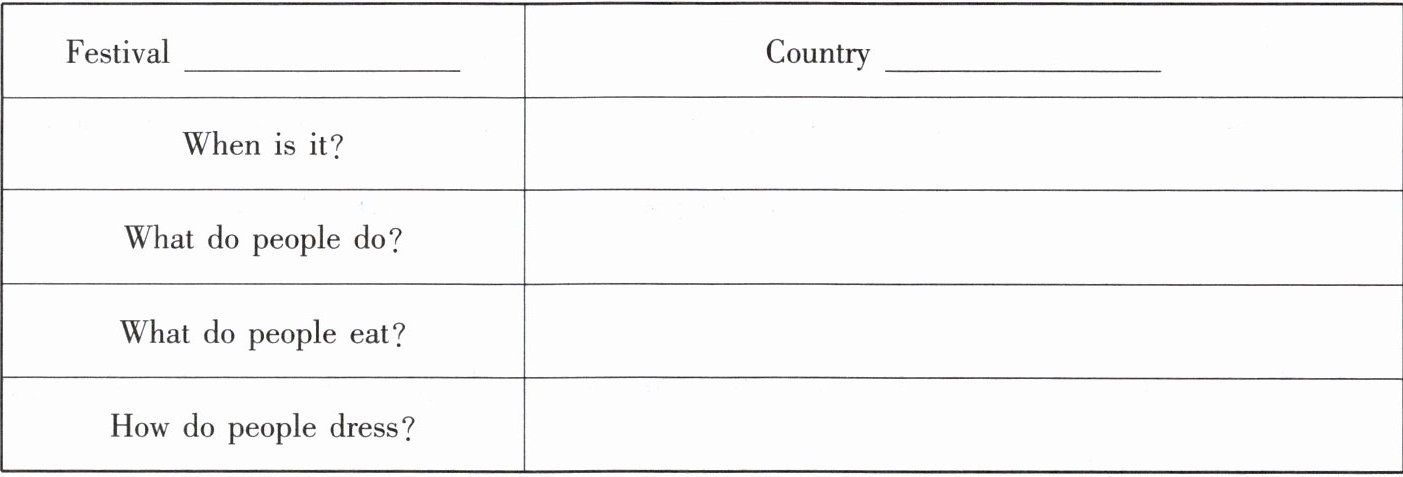
What do people eat?
How do people dress?
Festival
Country
When is it?
What do people do?
What do people eat?
How do people dress?
答案
1. Festival:The Spring Festival
2. Country:China
3. When is it?:It comes in January or February according to the Chinese lunar calendar.
4. What do people do?:People clean their houses, paste Spring Festival couplets, watch the Spring Festival Gala, visit relatives and friends, and set off fireworks.
5. What do people eat?:People eat traditional food like dumplings, niangao and other delicious dishes.
6. How do people dress?:People usually wear new clothes, many of which are in red to stand for good luck.
2. Country:China
3. When is it?:It comes in January or February according to the Chinese lunar calendar.
4. What do people do?:People clean their houses, paste Spring Festival couplets, watch the Spring Festival Gala, visit relatives and friends, and set off fireworks.
5. What do people eat?:People eat traditional food like dumplings, niangao and other delicious dishes.
6. How do people dress?:People usually wear new clothes, many of which are in red to stand for good luck.
