

 登录
五、阅读理解
What will our life be like in 50 years?
Although we don't know the answer, we believe that it will be very different from the life today. In the future, I think we will live on Mars. Here is what life will be like there.
First of all, transport should be much better. Now, our spaceships are too slow to carry lots of people to Mars—it takes months. However, in the future, it will take us two or three days to get to Mars by spaceship!
Life on Mars may allow people to have more free time. Many people believe that robots will do most of our work, so we will have more time for our hobbies.
How about the food, water, and air people need to live? Scientists will be able
to develop plants that can be grown on Mars. These plants will produce(产出)the food and air we need. However, can these plants give water to us? There is no answer now.
There are also some problems for us. Mars pulls us much less than the earth does. This will be dangerous because we can easily jump too high and fly slowly away into space. To stop this, humans on Mars have to wear special shoes to put on weight. What's more, food will look like pills and will not be as delicious as it is today. Also, space travel may make many people feel ill.
1. What will the future spaceship be like?
A. It will be much slower.
B. It will become much faster.
C. It will be more expensive.
D. It can carry people to any place.
2. What does the underlined word “this” refer to?
A. Flying away into space.
B. Becoming much heavier.
C. Looking more beautiful.
D. Eating too many pills.
3. Which of the following shows the structure of this passage?
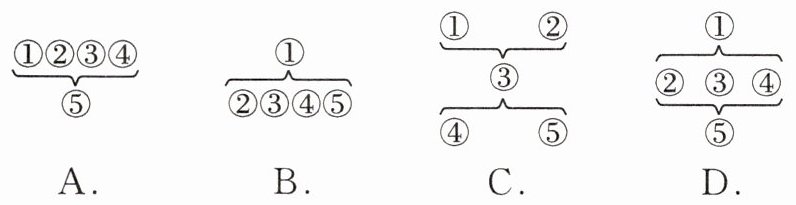
4. Who may be interested in this passage?
A. Miss Xie, a traveller, who tries to fly around the world.
B. Ms Liang, a reporter, who loves reading history books.
C. Mr Smith, a food service worker, who studies food plants.
D. Ann, a student, who wants to learn about life in outer space.
5. What is NOT mentioned as a solution in living on Mars according to the passage?
A. Transportation improvements to travel time.
B. The use of robots to free up human time for hobbies.
C. The development of special shoes to adapt to Mars' lower gravity.
D. The creation of artificial gravity to simulate the earth's conditions.
What will our life be like in 50 years?
Although we don't know the answer, we believe that it will be very different from the life today. In the future, I think we will live on Mars. Here is what life will be like there.
First of all, transport should be much better. Now, our spaceships are too slow to carry lots of people to Mars—it takes months. However, in the future, it will take us two or three days to get to Mars by spaceship!
Life on Mars may allow people to have more free time. Many people believe that robots will do most of our work, so we will have more time for our hobbies.
How about the food, water, and air people need to live? Scientists will be able
to develop plants that can be grown on Mars. These plants will produce(产出)the food and air we need. However, can these plants give water to us? There is no answer now.
There are also some problems for us. Mars pulls us much less than the earth does. This will be dangerous because we can easily jump too high and fly slowly away into space. To stop this, humans on Mars have to wear special shoes to put on weight. What's more, food will look like pills and will not be as delicious as it is today. Also, space travel may make many people feel ill.
1. What will the future spaceship be like?
A. It will be much slower.
B. It will become much faster.
C. It will be more expensive.
D. It can carry people to any place.
2. What does the underlined word “this” refer to?
A. Flying away into space.
B. Becoming much heavier.
C. Looking more beautiful.
D. Eating too many pills.
3. Which of the following shows the structure of this passage?
4. Who may be interested in this passage?
A. Miss Xie, a traveller, who tries to fly around the world.
B. Ms Liang, a reporter, who loves reading history books.
C. Mr Smith, a food service worker, who studies food plants.
D. Ann, a student, who wants to learn about life in outer space.
5. What is NOT mentioned as a solution in living on Mars according to the passage?
A. Transportation improvements to travel time.
B. The use of robots to free up human time for hobbies.
C. The development of special shoes to adapt to Mars' lower gravity.
D. The creation of artificial gravity to simulate the earth's conditions.
答案
1. B 2. A 3. B 4. D 5. D
解析
【分析】
本题是关于未来火星生活的阅读理解题,共5道选择题,需结合原文细节逐一分析每个问题,通过定位原文对应内容、理解指代关系、梳理文章结构等方式确定答案。
【解析】
1. 第1题:定位原文第三段,提到现在的宇宙飞船太慢,未来乘飞船到火星只需两三天,说明未来飞船会更快,对应选项B。
2. 第2题:定位第五段,“this”指代前面的“fly slowly away into space”,对应选项A。
3. 第3题:文章结构为:第一段总起说明未来生活在火星,后续段落分别讲述交通、空闲时间、生存所需、存在的问题,属于“总-分”结构,对应选项B。
4. 第4题:文章主题是未来火星生活,对外太空生活感兴趣的学生Ann会关注,对应选项D。
5. 第5题:原文提到交通改进、机器人解放时间、特殊鞋子适应低重力,未提及人工重力,对应选项D。
【答案】1.B 2.A 3.B 4.D 5.D
【知识点】阅读理解细节理解、词义猜测、文章结构、推理判断
【点评】本题围绕未来火星生活展开,考查学生对文章多维度信息的理解能力,需仔细定位原文内容,理清逻辑关系。
【难度系数】0.6
