

 登录
登录
七、Sarah 正在向同学们介绍自己攒钱的原因。请根据中文提示,写单词或短语补全短文。
I love science very much. I always want to learn more about the small world around us. I often read books about plants and insects. They are so interesting and make me want to know more. My parents give me 1. (零花钱) every week. I can use this money to buy things I need. I think it is important to learn how to 2. (管理) money well. So I don’t spend my money quickly on snacks or toys. I keep my money in a 3. (罐子) in my bedroom. This is my own money box. I hope to buy a useful tool for my science lessons. I want to use a 4. (显微镜) to see tiny things clearly. To make my dream come true, I decide to 5. (攒钱) little by little every week. I know it will take some time, but I will not give up. Saving money teaches me to be patient and careful. It also helps me understand the value of hard work. I will keep this good habit and make my dream come true.
I love science very much. I always want to learn more about the small world around us. I often read books about plants and insects. They are so interesting and make me want to know more. My parents give me 1. (零花钱) every week. I can use this money to buy things I need. I think it is important to learn how to 2. (管理) money well. So I don’t spend my money quickly on snacks or toys. I keep my money in a 3. (罐子) in my bedroom. This is my own money box. I hope to buy a useful tool for my science lessons. I want to use a 4. (显微镜) to see tiny things clearly. To make my dream come true, I decide to 5. (攒钱) little by little every week. I know it will take some time, but I will not give up. Saving money teaches me to be patient and careful. It also helps me understand the value of hard work. I will keep this good habit and make my dream come true.
答案
1. pocket money
2. manage
3. jar
4. microscope
5. save money
2. manage
3. jar
4. microscope
5. save money
解析
【分析】
本题是根据中文提示补全英语短文的题目,解题思路为:首先通读短文,理解上下文语境;接着针对每个空格后的中文提示,回忆对应的英语单词或短语,同时注意语法结构(如decide to后接动词原形等);最后验证所填内容是否符合语境和语法要求。
【解析】
1. 中文提示为“零花钱”,对应的英语固定短语是pocket money;
2. 中文提示为“管理”,对应动词manage,符合“how to do sth.”的结构;
3. 中文提示为“罐子”,对应名词jar;
4. 中文提示为“显微镜”,对应名词microscope;
5. 中文提示为“攒钱”,对应固定短语save money,符合“decide to do sth.”的结构。
【答案】
1. pocket money
2. manage
3. jar
4. microscope
5. save money
【知识点】
英语词汇运用、固定短语搭配
【点评】
本题考查基础英语词汇及常用短语的运用,结合语境填写即可,难度较低,是常见的基础题型,有助于学生积累日常英语表达。
【难度系数】
0.8
本题是根据中文提示补全英语短文的题目,解题思路为:首先通读短文,理解上下文语境;接着针对每个空格后的中文提示,回忆对应的英语单词或短语,同时注意语法结构(如decide to后接动词原形等);最后验证所填内容是否符合语境和语法要求。
【解析】
1. 中文提示为“零花钱”,对应的英语固定短语是pocket money;
2. 中文提示为“管理”,对应动词manage,符合“how to do sth.”的结构;
3. 中文提示为“罐子”,对应名词jar;
4. 中文提示为“显微镜”,对应名词microscope;
5. 中文提示为“攒钱”,对应固定短语save money,符合“decide to do sth.”的结构。
【答案】
1. pocket money
2. manage
3. jar
4. microscope
5. save money
【知识点】
英语词汇运用、固定短语搭配
【点评】
本题考查基础英语词汇及常用短语的运用,结合语境填写即可,难度较低,是常见的基础题型,有助于学生积累日常英语表达。
【难度系数】
0.8
八、Tom 是如何从乱花钱变成妥善管理零花钱的?读一读,完成任务。
Tom is a Grade 6 student. He gets 20-yuan of pocket money every week from his parents.
At first, he always spent all his money on snacks and comic books in three days. Then he had no money left for the rest of the week.
One day, his teacher talked about money management in class. Tom decided to change. First, he learned to tell needs from wants. He stopped buying too many snacks, because they are not good for his health and are not necessary(必要的;必需的). He only bought school things he really needed.
Next, Tom made a spending plan. He wrote down his weekly budget of 20 yuan. He planned to save 5 yuan, spend 10 yuan on school supplies and 5 yuan on small treats. He put his saved money in a small jar.
Tom also listed what people often do with money. He found that many people save money for future goals, like buying a book or a gift for their families. Later, he wrote some tips for his classmates: “Save a little every week, buy needs first, and don’t spend money on things you don’t need.”
Now, Tom can manage his pocket money well. He even saved enough money to buy a science book he wanted.
任务一: 根据短文内容, 把下列图片的字母序号写在相应的位置。
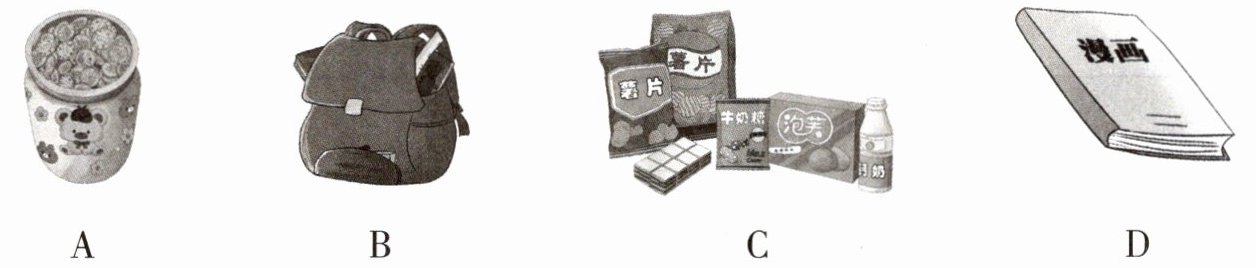
A B C D
Things Tom used to spend most of his pocket money on: 1.
Where Tom keeps his saved money: 2.
Things Tom now buys as his ‘needs’ : 3.
任务二: 根据短文内容, 选择正确的答案。
()1. Why did Tom decide to change his way of using pocket money?
A. Because his parents stopped giving him pocket money.
B. Because his teacher taught about money management in class.
C. Because he wanted to buy more snacks and comic books.
()2. What is the main reason Tom stopped buying too many snacks?
A. Snacks are too expensive for him.
B. His parents don’t allow him to eat snacks.
C. Snacks are bad for his health and not a necessary need.
()3. What did Tom do with the money he saved?
A. He bought a new toy car for himself.
B. He gave all the saved money to his family.
C. He used it to buy a science book he wanted.
任务三: 根据短文内容, 判断下列句子的正(T)误(F)。
()1. Tom’s weekly spending plan includes saving 5 yuan.
()2. Tom wrote tips for his classmates about how to get more pocket money.
()3. Tom found that people only use money to buy things for themselves.
Tom is a Grade 6 student. He gets 20-yuan of pocket money every week from his parents.
At first, he always spent all his money on snacks and comic books in three days. Then he had no money left for the rest of the week.
One day, his teacher talked about money management in class. Tom decided to change. First, he learned to tell needs from wants. He stopped buying too many snacks, because they are not good for his health and are not necessary(必要的;必需的). He only bought school things he really needed.
Next, Tom made a spending plan. He wrote down his weekly budget of 20 yuan. He planned to save 5 yuan, spend 10 yuan on school supplies and 5 yuan on small treats. He put his saved money in a small jar.
Tom also listed what people often do with money. He found that many people save money for future goals, like buying a book or a gift for their families. Later, he wrote some tips for his classmates: “Save a little every week, buy needs first, and don’t spend money on things you don’t need.”
Now, Tom can manage his pocket money well. He even saved enough money to buy a science book he wanted.
任务一: 根据短文内容, 把下列图片的字母序号写在相应的位置。
A B C D
Things Tom used to spend most of his pocket money on: 1.
Where Tom keeps his saved money: 2.
Things Tom now buys as his ‘needs’ : 3.
任务二: 根据短文内容, 选择正确的答案。
()1. Why did Tom decide to change his way of using pocket money?
A. Because his parents stopped giving him pocket money.
B. Because his teacher taught about money management in class.
C. Because he wanted to buy more snacks and comic books.
()2. What is the main reason Tom stopped buying too many snacks?
A. Snacks are too expensive for him.
B. His parents don’t allow him to eat snacks.
C. Snacks are bad for his health and not a necessary need.
()3. What did Tom do with the money he saved?
A. He bought a new toy car for himself.
B. He gave all the saved money to his family.
C. He used it to buy a science book he wanted.
任务三: 根据短文内容, 判断下列句子的正(T)误(F)。
()1. Tom’s weekly spending plan includes saving 5 yuan.
()2. Tom wrote tips for his classmates about how to get more pocket money.
()3. Tom found that people only use money to buy things for themselves.
答案
任务一:1. C、D 2. A 3. B
任务二:1. B 2. C 3. C
任务三:1. T 2. F 3. F
任务二:1. B 2. C 3. C
任务三:1. T 2. F 3. F
解析
【分析】
本题是英语阅读理解题,需先通读短文掌握Tom从乱花钱到管理零花钱的过程,再按三个任务要求逐一分析:任务一需匹配图片与Tom的消费、存钱、购买物品;任务二是细节选择题,对应短文找原因;任务三是判断正误,核对短文内容。
【解析】
任务一:
1. 短文第二段提到Tom过去三天花光零花钱在零食和漫画书,图C是各类零食,图D是漫画书,故填C、D;
2. 短文第四段提到Tom把存的钱放在小罐子里,图A是小熊罐子,故填A;
3. 短文第三段提到Tom现在只买真正需要的学习用品,图B是书包(学习用品),故填B。
任务二:
1. 短文第三段第一句提到老师在课上讲了理财,Tom决定改变,故选B;
2. 短文第三段提到停止买零食因为不健康且不必要,故选C;
3. 短文最后一段提到Tom用存的钱买了想要的科学书,故选C。
任务三:
1. 短文第四段提到计划存5元,故正确(T);
2. 短文第五段提到Tom给同学写的是理财建议,不是赚零花钱,故错误(F);
3. 短文第五段提到人们存钱为家人等,不是只为自己,故错误(F)。
【答案】
任务一:1. C、D 2. A 3. B
任务二:1. B 2. C 3. C
任务三:1. T 2. F 3. F
【知识点】
英语阅读理解;细节理解;理财英语表达
【点评】
本题以Tom管理零花钱的故事为载体,考查学生对短文细节的理解与信息匹配能力,题型贴合小学六年级英语学习要求,帮助学生了解理财相关的英语知识。
【难度系数】
0.6
本题是英语阅读理解题,需先通读短文掌握Tom从乱花钱到管理零花钱的过程,再按三个任务要求逐一分析:任务一需匹配图片与Tom的消费、存钱、购买物品;任务二是细节选择题,对应短文找原因;任务三是判断正误,核对短文内容。
【解析】
任务一:
1. 短文第二段提到Tom过去三天花光零花钱在零食和漫画书,图C是各类零食,图D是漫画书,故填C、D;
2. 短文第四段提到Tom把存的钱放在小罐子里,图A是小熊罐子,故填A;
3. 短文第三段提到Tom现在只买真正需要的学习用品,图B是书包(学习用品),故填B。
任务二:
1. 短文第三段第一句提到老师在课上讲了理财,Tom决定改变,故选B;
2. 短文第三段提到停止买零食因为不健康且不必要,故选C;
3. 短文最后一段提到Tom用存的钱买了想要的科学书,故选C。
任务三:
1. 短文第四段提到计划存5元,故正确(T);
2. 短文第五段提到Tom给同学写的是理财建议,不是赚零花钱,故错误(F);
3. 短文第五段提到人们存钱为家人等,不是只为自己,故错误(F)。
【答案】
任务一:1. C、D 2. A 3. B
任务二:1. B 2. C 3. C
任务三:1. T 2. F 3. F
【知识点】
英语阅读理解;细节理解;理财英语表达
【点评】
本题以Tom管理零花钱的故事为载体,考查学生对短文细节的理解与信息匹配能力,题型贴合小学六年级英语学习要求,帮助学生了解理财相关的英语知识。
【难度系数】
0.6
