

 登录
登录
Ⅰ. 选择合适的单词补全句子。
exercises always rang
(1) Sam ______ goes swimming at half past four.
(2) In the UK students don't do morning ______.
(3) The bell ______ at five o'clock and then we went home.
exercises always rang
(1) Sam ______ goes swimming at half past four.
(2) In the UK students don't do morning ______.
(3) The bell ______ at five o'clock and then we went home.
答案
(1)always
(2)exercises
(3)rang
解析
(1)句子“Sam ______ goes swimming at half past four.”中,需要选择一个副词来描述Sam去游泳的频率。“always”是一个频率副词,表示“总是”,符合句子意思,表示Sam总是在四点半去游泳。
(2)句子“In the UK students don't do morning ______.”中,根据常识和语境,这里需要选择一个与“morning”相搭配的名词,构成常见的短语。“morning exercises”是一个固定短语,表示“早操”,符合句子意思,表示在英国学生不做早操。
(3)句子“The bell ______ at five o'clock and then we went home.”中,需要选择一个动词来描述铃声的动作。“rang”是动词“ring”的过去式,表示“(铃)响”,符合句子意思,表示铃声在五点钟响起,然后我们回家。
(2)句子“In the UK students don't do morning ______.”中,根据常识和语境,这里需要选择一个与“morning”相搭配的名词,构成常见的短语。“morning exercises”是一个固定短语,表示“早操”,符合句子意思,表示在英国学生不做早操。
(3)句子“The bell ______ at five o'clock and then we went home.”中,需要选择一个动词来描述铃声的动作。“rang”是动词“ring”的过去式,表示“(铃)响”,符合句子意思,表示铃声在五点钟响起,然后我们回家。
Ⅱ. 选择句意相符的图片,将序号填入括号内。
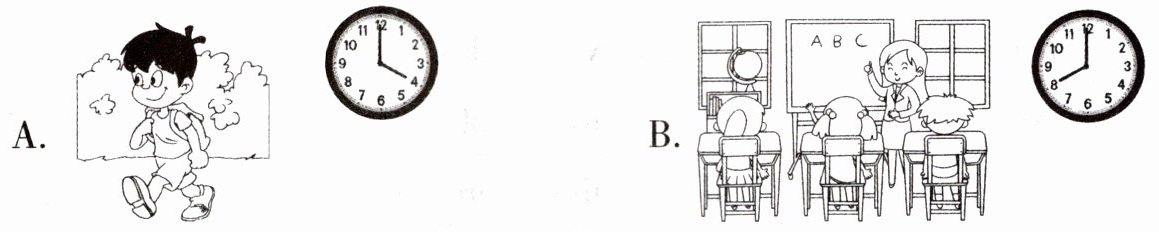
( ) (1) They start school at eight o'clock.
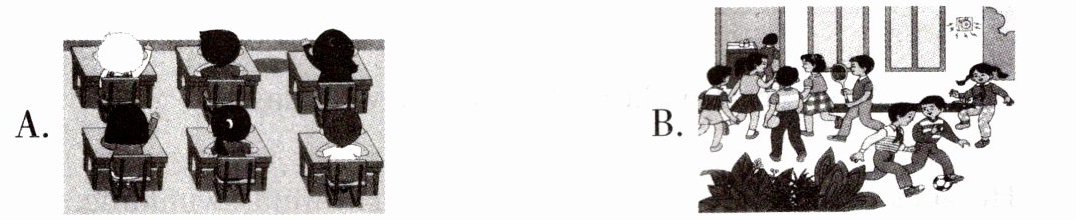
( ) (2) The students all play in the playground.
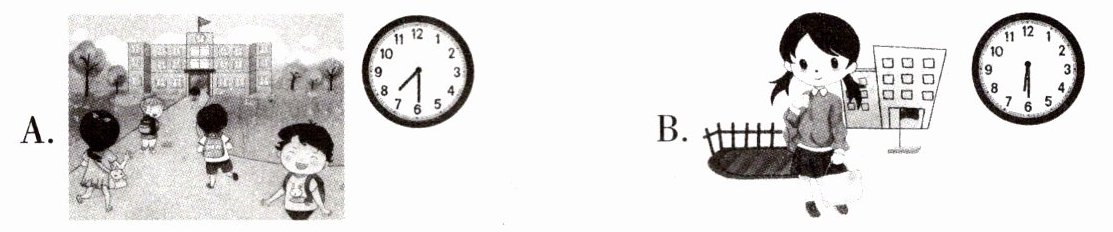
( ) (3) I go to school at half past seven.
( ) (1) They start school at eight o'clock.
( ) (2) The students all play in the playground.
( ) (3) I go to school at half past seven.
答案
B
@@B
@@A
@@B
@@A
Ⅲ. 选择合适的单词补全句子。
doesn't near with
(1) Amy's house is ______ the shop.
(2) She ______ want to walk.
(3) He can play ______ friends.
doesn't near with
(1) Amy's house is ______ the shop.
(2) She ______ want to walk.
(3) He can play ______ friends.
答案
(1) near
(2) doesn't
(3) with
解析
(1) 句意表示Amy的家和商店的位置关系,根据选项,“near”表示“在...附近”,符合语境,描述位置关系。
(2) 句中主语是“She”,为第三人称单数,且句子为否定句,“doesn't”是“does not”的缩写,用于第三人称单数的否定,所以这里选“doesn't”。
(3) “play with...”是固定短语,意为“和...一起玩”,所以这里选“with”。
