

 登录
(
—It . After all, good neighbours are better than distant relatives.
A.makes sense
B.takes place
C.takes action
D.catches attention
A
) 3. —We all need to keep good relationships with people around us in the community.—It . After all, good neighbours are better than distant relatives.
A.makes sense
B.takes place
C.takes action
D.catches attention
答案
3. A
解析
【分析】先通读对话把握语境:第一句提出“我们都需要和社区周围的人保持良好关系”,第二句是对该观点的回应,后半句“远亲不如近邻”是补充说明,因此需要选一个表示“认同该观点有道理”的短语,再结合各选项含义排除不合适的选项。
【解析】逐一分析选项:A. makes sense 意为“有道理,合乎情理”,代入后表示“这是有道理的”,契合对话中对观点的认同逻辑;B. takes place 意为“发生”,与语境无关;C. takes action 意为“采取行动”,对话未涉及行动相关内容;D. catches attention 意为“引起注意”,不符合此处对观点的回应逻辑。综上,正确答案为A。
【答案】A
【知识点】动词短语辨析;语境理解
【点评】本题考查常用动词短语的含义辨析及语境运用,需结合对话上下文逻辑选择合适的短语,属于基础词汇考查题。
【难度系数】0.6
(
—You're right. We cannot achieve our goals we have a strong body.
A.if
B.though
C.unless
D.after
C
)4. —A balanced diet and everyday exercise are the keys to good health.—You're right. We cannot achieve our goals we have a strong body.
A.if
B.though
C.unless
D.after
答案
4. C
解析
【分析】首先理解对话的逻辑语境:第一句指出均衡饮食和日常锻炼是健康的关键,第二句表达“我们无法实现目标______我们拥有强壮的身体”,空格处需填入体现否定条件关系的连词。接下来逐一分析选项的含义,结合语境排除不符合的选项。
【解析】先翻译句子:“均衡饮食和日常锻炼是健康的关键。——你说得对。我们不能实现目标,除非我们有强壮的身体。”分析各选项:A.if(如果,表肯定条件,不符合否定语境);B.though(虽然,表让步,逻辑不符);C.unless(除非,相当于if not,引导否定条件状语从句,契合语境);D.after(在……之后,表时间,逻辑不通)。因此选C。
【答案】C
【知识点】连词的用法;条件状语从句
【点评】本题考查连词在语境中的辨析,需结合句子逻辑关系判断,属于基础题型,侧重语境理解能力。
【难度系数】0.7
(
—. You will soon be familiar with everything.
A.It's hard to say
B.Take your time
C.I am afraid so
D.I suppose so
B
) 5. —I find it difficult to find my ways around in a new place.—. You will soon be familiar with everything.
A.It's hard to say
B.Take your time
C.I am afraid so
D.I suppose so
答案
5. B
解析
【分析】
本题为英语情景交际题,解题思路是先理解对话语境,再逐一分析选项含义,选出符合上下文逻辑的答语。对话中一方表示在新地方找路困难,另一方需给出安慰或鼓励的回应,结合后半句“你很快会熟悉一切”判断合适选项。
【解析】
逐一分析选项:
A. It's hard to say(很难说),不符合对话中安慰鼓励的语境;
B. Take your time(别着急,慢慢来),契合“很快会熟悉一切”的语境,是对对方的安慰;
C. I am afraid so(恐怕是这样),仅表示赞同对方的话,无安慰作用;
D. I suppose so(我想是这样),同样是赞同,不符合语境要求。
综上,选B。
【答案】
B
【知识点】
情景交际;日常用语
【点评】
本题考查日常情景交际用语,需结合对话语境理解各选项含义,难度较低,属于基础题型,学生易掌握。
【难度系数】
0.7
三、阅读理解
Suddenly, the little prince asked:
“A sheep—if it eats grass, does it eat flowers too?”
“A sheep eats anything it finds.”
“Even flowers that have thorns(刺)?”
“Yes, even flowers that have thorns.”
“Then the thorns—what use are they?”
I did not know. At that moment I was so busy trying to repair my plane that I had no time to share. I answered with the first thing that came into my head:
“The thorns are of no use at all.”
“Oh...”
Just as I thought the little prince would keep quiet for some time, he continued:
“And you actually believe that the flowers...”
“Oh, no! No, no, no! I don’t believe anything. I answered you with the first thing that came into my head. Don’t you see—I am very busy with things of importance!”
“Things of importance? You talk just like the adults! I know a red-faced gentleman. He has never smelled a flower. He has never looked at a star. He has never loved anyone. He has never done anything in his life but count his money. And all day he says over and over again, just like you: ‘I am busy with things of importance!’ And that makes him so proud. He immerses himself in his own business so much that he is no longer a man—he is a mushroom(蘑菇)!”
“A what?”
“A selfish mushroom! And so are you! If someone knows there is a flower growing on one star among the millions, it is enough to make him happy just to look at the stars. But if the sheep eats the flower, in one moment all the stars will become dark... And you think that is not important!”
His tears of anger as well as love made me suddenly stop, with tools falling off my hands. I never thought his feeling for a flower could be so strong. I was frozen by his love for flowers, stars and life.
Slowly, I took him in my arms and said softly to him that the flower he loved would not be in danger. I would do anything to protect it. But seeing the tears on the little prince’s face, I could continue no more. What I said earlier, which I wished to take back, had hurt him badly.
—Adapted from The Little Prince
(
A. Looking at a flower. B. Repairing his plane.
C. Shouting at a sheep. D. Watching the stars.
(
A. Pays attention to. B. Has trouble in.
C. Gives answers to. D. Shows dislike for.
(
A. Who could give me a flower?
B. Why do some flowers have thorns?
C. Do sheep eat grass and flowers?
D. How can I protect my flower from a sheep?
(
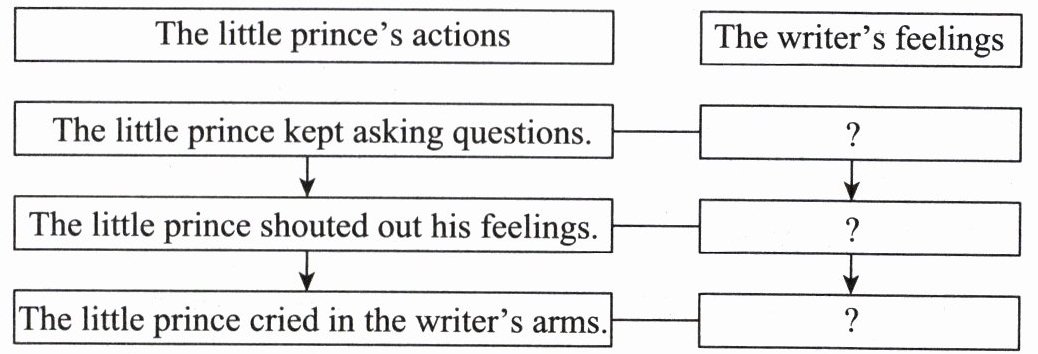
A. happy—angry—sad
B. happy—sad—angry
C. impatient—surprised—regretful
D. impatient—regretful—surprised
Suddenly, the little prince asked:
“A sheep—if it eats grass, does it eat flowers too?”
“A sheep eats anything it finds.”
“Even flowers that have thorns(刺)?”
“Yes, even flowers that have thorns.”
“Then the thorns—what use are they?”
I did not know. At that moment I was so busy trying to repair my plane that I had no time to share. I answered with the first thing that came into my head:
“The thorns are of no use at all.”
“Oh...”
Just as I thought the little prince would keep quiet for some time, he continued:
“And you actually believe that the flowers...”
“Oh, no! No, no, no! I don’t believe anything. I answered you with the first thing that came into my head. Don’t you see—I am very busy with things of importance!”
“Things of importance? You talk just like the adults! I know a red-faced gentleman. He has never smelled a flower. He has never looked at a star. He has never loved anyone. He has never done anything in his life but count his money. And all day he says over and over again, just like you: ‘I am busy with things of importance!’ And that makes him so proud. He immerses himself in his own business so much that he is no longer a man—he is a mushroom(蘑菇)!”
“A what?”
“A selfish mushroom! And so are you! If someone knows there is a flower growing on one star among the millions, it is enough to make him happy just to look at the stars. But if the sheep eats the flower, in one moment all the stars will become dark... And you think that is not important!”
His tears of anger as well as love made me suddenly stop, with tools falling off my hands. I never thought his feeling for a flower could be so strong. I was frozen by his love for flowers, stars and life.
Slowly, I took him in my arms and said softly to him that the flower he loved would not be in danger. I would do anything to protect it. But seeing the tears on the little prince’s face, I could continue no more. What I said earlier, which I wished to take back, had hurt him badly.
—Adapted from The Little Prince
(
B
) 1. What was the writer doing when the little prince started to ask questions?A. Looking at a flower. B. Repairing his plane.
C. Shouting at a sheep. D. Watching the stars.
(
A
) 2. What does the underlined expression “immerses himself in” mean?A. Pays attention to. B. Has trouble in.
C. Gives answers to. D. Shows dislike for.
(
D
) 3. According to the little prince’s words, which question did he care most about?A. Who could give me a flower?
B. Why do some flowers have thorns?
C. Do sheep eat grass and flowers?
D. How can I protect my flower from a sheep?
(
C
) 4. Which of the following shows the change of the writer’s feelings?A. happy—angry—sad
B. happy—sad—angry
C. impatient—surprised—regretful
D. impatient—regretful—surprised
答案
1. B 2. A 3. D 4. C
解析
【分析】
本题为《小王子》相关的英语阅读理解题,需结合原文内容逐一分析各题目:
1. 第1题是细节理解题,需定位作者在小王子提问时的具体行为;
2. 第2题是词义猜测题,需结合上下文语境推断划线短语的含义;
3. 第3题是细节推理题,需找出小王子最关心的核心问题;
4. 第4题是情感推理题,需梳理作者情绪的变化过程。
【解析】
1. 第1题:根据原文“I did not know. At that moment I was so busy trying to repair my plane that I had no time to share.”可知,作者当时正在修理飞机,对应选项B。
2. 第2题:划线短语描述的是只专注于数钱的绅士,结合语境可知“immerses himself in”意为“专注于”,与选项A(Pays attention to)含义一致。
3. 第3题:根据小王子的话“If someone knows there is a flower growing on one star... But if the sheep eats the flower, in one moment all the stars will become dark...”可知,他最关心的是如何保护自己的花不被羊吃掉,对应选项D。
4. 第4题:作者一开始忙着修飞机,对小王子的问题表现出不耐烦(impatient);当小王子说出对花、星星和生活的爱时,作者被震惊,感到惊讶(surprised);最后作者意识到自己的话伤害了小王子,感到后悔(regretful),对应选项C。
【答案】
1. B 2. A 3. D 4. C
【知识点】
阅读理解细节理解、词义猜测、情感推理
【点评】
本题改编自经典作品《小王子》,考查学生的英语阅读理解能力,涵盖细节查找、词义推测和情感分析,需结合原文内容准确判断,难度适中。
【难度系数】
0.6
