

 登录
阅读下列短文,从每题所给的A、B、C、D四个选项中选出最佳选项。
A
Come and join in the Science Festival!
Our school will hold the 2025 Science Festival! During the festival, you’re encouraged to bring and introduce your inventions to teachers and students. Of course you can also learn about interesting and useful inventions created by other students. What are you waiting for?
The theme of 2025 Science Festival: Inventions make our life easy
Schedule (安排表)
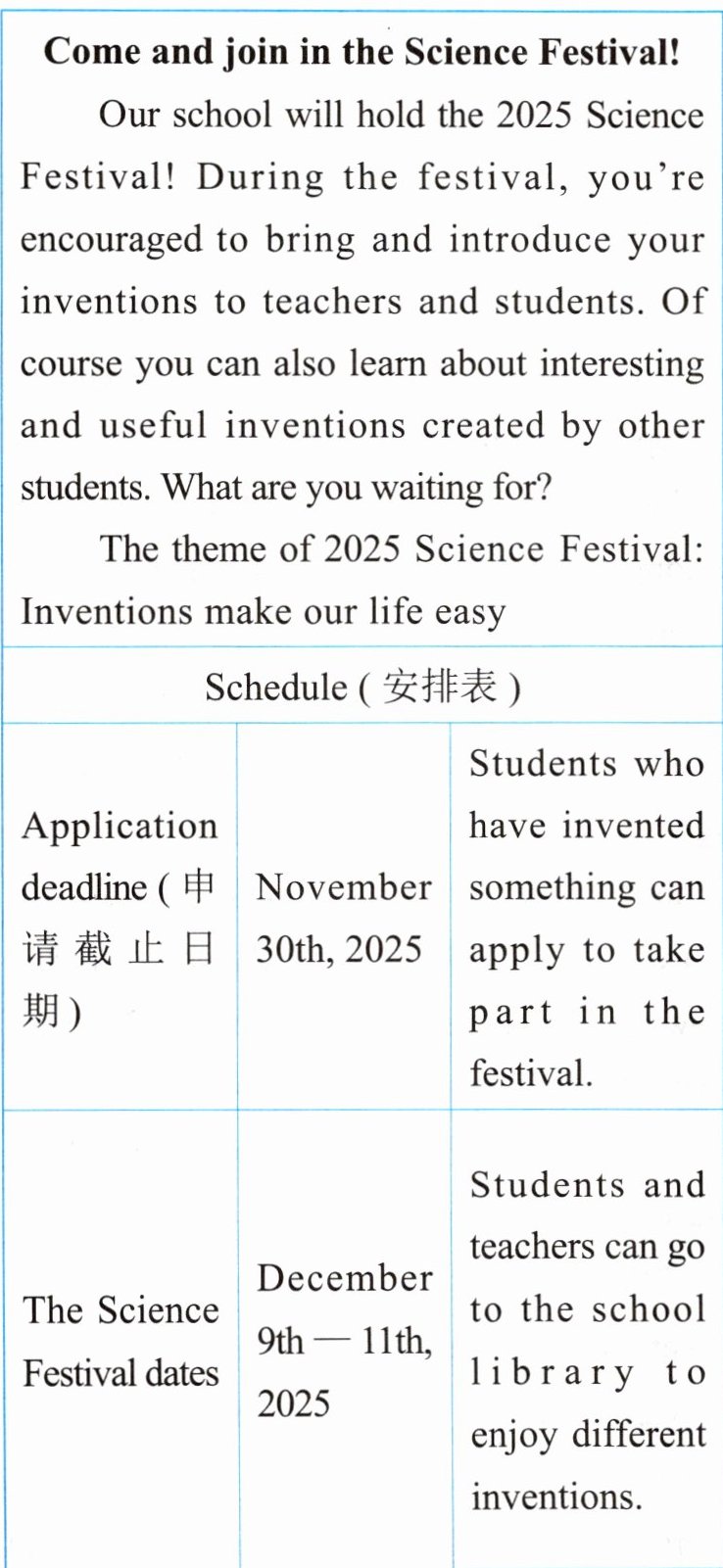
Application deadline (申请截止日期) | November 30th, 2025 | Students who have invented something can apply to take part in the festival.
The Science Festival dates | December 9th — 11th, 2025 | Students and teachers can go to the school library to enjoy different inventions.
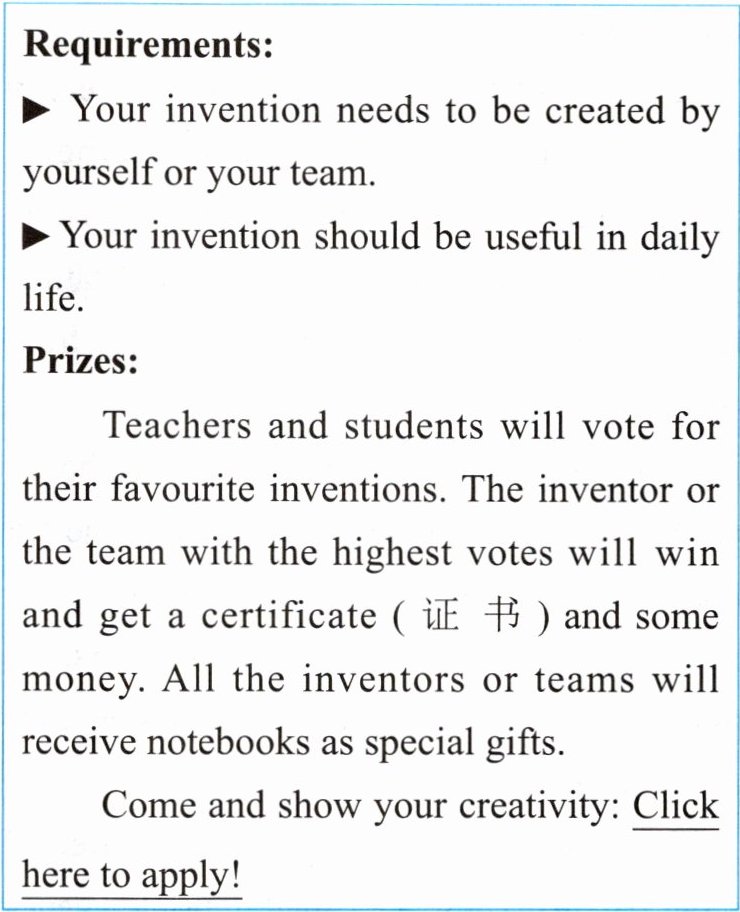
Requirements:
▶ Your invention needs to be created by yourself or your team.
▶ Your invention should be useful in daily life.
Prizes:
Teachers and students will vote for their favourite inventions. The inventor or the team with the highest votes will win and get a certificate (证书) and some money. All the inventors or teams will receive notebooks as special gifts.
Come and show your creativity: Click here to apply!
56. How long will the Science Festival last?
A. For one day.
B. For three days.
C. For nine days.
D. For eleven days.
57. What does Alice need to do in order to take part in the festival?
A. Apply on December 30th.
B. Create something by herself.
C. Buy something useful.
D. Learn science in a team.
58. What can the inventor or the team with the lowest votes get?
① a certificate ② some money
③ a notebook
A. ①②
B. ②③
C. ②
D. ③
A
Come and join in the Science Festival!
Our school will hold the 2025 Science Festival! During the festival, you’re encouraged to bring and introduce your inventions to teachers and students. Of course you can also learn about interesting and useful inventions created by other students. What are you waiting for?
The theme of 2025 Science Festival: Inventions make our life easy
Schedule (安排表)
Application deadline (申请截止日期) | November 30th, 2025 | Students who have invented something can apply to take part in the festival.
The Science Festival dates | December 9th — 11th, 2025 | Students and teachers can go to the school library to enjoy different inventions.
Requirements:
▶ Your invention needs to be created by yourself or your team.
▶ Your invention should be useful in daily life.
Prizes:
Teachers and students will vote for their favourite inventions. The inventor or the team with the highest votes will win and get a certificate (证书) and some money. All the inventors or teams will receive notebooks as special gifts.
Come and show your creativity: Click here to apply!
56. How long will the Science Festival last?
A. For one day.
B. For three days.
C. For nine days.
D. For eleven days.
57. What does Alice need to do in order to take part in the festival?
A. Apply on December 30th.
B. Create something by herself.
C. Buy something useful.
D. Learn science in a team.
58. What can the inventor or the team with the lowest votes get?
① a certificate ② some money
③ a notebook
A. ①②
B. ②③
C. ②
D. ③
答案
56. B 57. B 58. D
解析
【分析】
本题为校园活动广告类阅读理解,解题时需根据题干关键词定位原文对应信息,逐一匹配选项。56题需定位科技节的日期计算时长;57题需定位参加活动的要求;58题需区分最高票与所有发明者的奖励,从而确定最低票获得者的所得。
【解析】
56. 题干询问科技节持续时长,根据Schedule中的“The Science Festival dates | December 9th — 11th, 2025”,可知活动时间为12月9日至11日,共3天,对应选项B。
57. 题干询问参加活动的要求,根据Requirements中的“Your invention needs to be created by yourself or your team.”,可知需自己或团队创造发明,对应选项B;A选项申请截止日期为11月30日,错误;C选项应为创造而非购买发明,错误;D选项应为创造而非组队学习科学,错误。
58. 题干询问得最低票的发明者的奖励,根据Prizes部分,得最高票的获证书和钱,所有发明者均可获得笔记本,因此最低票的发明者仅能得到笔记本,即③,对应选项D。
【答案】56.B 57.B 58.D
【知识点】广告类阅读理解,细节理解题
【点评】本题为校园活动广告类阅读理解,考查学生快速提取细节信息的能力,题目均为基础细节题,难度较低,学生可通过定位原文轻松作答。
【难度系数】0.8
B
“You are just like your mother.” This phrase is often said by many people. As we grow older, we may notice that we’re getting more like our mother. Yet surprisingly, new research has found that most people are more
similar to their father.
A team of scientists from the University of North Carolina School of Medicine in the US found that we inherit (继承) equal amounts of genes from our mother and father. But we use more of the DNA we inherit from our father.
The study helps us to partly explain who we are. And more importantly, it helps us to find out whether we are likely to develop diseases. For example, if we inherit the gene for a disease from our mother, it may not be as strong as if we had inherited it from our father.
We know that there are 95 genes affected by our parents. These are called imprinted genes (印记基因). But now, the study has found that there are thousands of other genes that have come from our parents.
For the study, the scientists chose three different species of mice with different genes. The mice then gave birth to nine babies each. When they all reached adulthood, the team then measured (测量) every single gene of their DNA.
They found an imbalance that swung toward their father. A scientist said that the recent study was the first to show that mammals (哺乳动物) are more similar to their father than mother.
59. What is the new finding?
A. We are born to look more like our father.
B. We are more like our mother when we grow up.
C. We use more of the DNA we inherit from our father.
D. We have equal chances to be more like our mother or father.
60. What’s the main idea of Paragraph 3?
A. We are supposed to be stronger than our parents.
B. We don’t inherit the gene of a disease from our mother.
C. We inherit exactly the same diseases from our parents.
D. The finding helps us predict possible diseases.
61. What does the underlined word “they” in Paragraph 5 refer to?
A. The three mother mice.
B. The nine baby mice.
C. The scientists.
D. The genes.
答案
59. C 60. D 61. B
解析
【分析】
本题为科普类英语阅读理解题,包含3道选择题,分别考查细节理解、段落主旨大意和代词指代。解题时需根据题干关键词定位原文对应内容,逐一比对选项与原文信息,排除错误选项得出正确答案。
【解析】
59题:根据题干“new finding”定位原文第一段末及第二段,原文指出新研究发现多数人更像父亲,且继承父母基因数量相等,但使用更多来自父亲的DNA。A选项“出生就更像父亲”原文未提及;B选项“长大后更像母亲”与原文相悖;D选项“有同等机会更像父母”不符合研究结论,故正确答案为C。
60题:第三段主旨围绕研究的作用展开,原文提到该研究有助于解释自我特征,更重要的是帮助判断是否易患疾病,对应选项D。A选项“比父母强壮”未提及;B选项“不会从母亲继承疾病基因”与原文“母亲的疾病基因可能不如父亲的强”矛盾;C选项“从父母继承完全相同的疾病”无依据,故正确答案为D。
61题:代词指代题定位第五段,前文说明“老鼠每只生下9只幼崽,当它们成年时”,结合语境,“they”指代前面出生的幼鼠,对应选项B。A为母鼠、C为科学家、D为基因,均不符合指代逻辑,故正确答案为B。
【答案】59.C 60.D 61.B
【知识点】阅读理解(细节理解、主旨大意、词义猜测)
【点评】本题考查学生对科普类文章的信息提取与理解能力,需精准定位原文细节、概括段落核心、推断代词指代,整体难度适中。
【难度系数】0.6
