

 登录
五、写作实践。
Task: Share your favourite invention with the help of the checklist.
Step 1: Choose the invention you like.
Tell us about your favourite invention. Answer these questions:
◇ What is it?
My favourite invention is
◇ Who invented it?
The
◇ Do you know any other information about the invention?
It was invented
Step 2: Share the details(细节) of the invention you chose.
Now, tell us about the details of the invention you chose. Think about:
◇ What problems did we have before it was invented?
Before this invention,
◇ How did the inventor come up with the solution(解决办法)?
So in order to solve this problem,
◇ How did the invention work?
It
◇ What other challenges did the inventor face?
Step 3: Explain the reason why you like this invention.
Finally, tell us the reason why you like this invention. Explain:
◇ What is the influence of this invention?
It helped
◇ Why do you like it so much?
It’s my favourite because
.
.
.
.
.
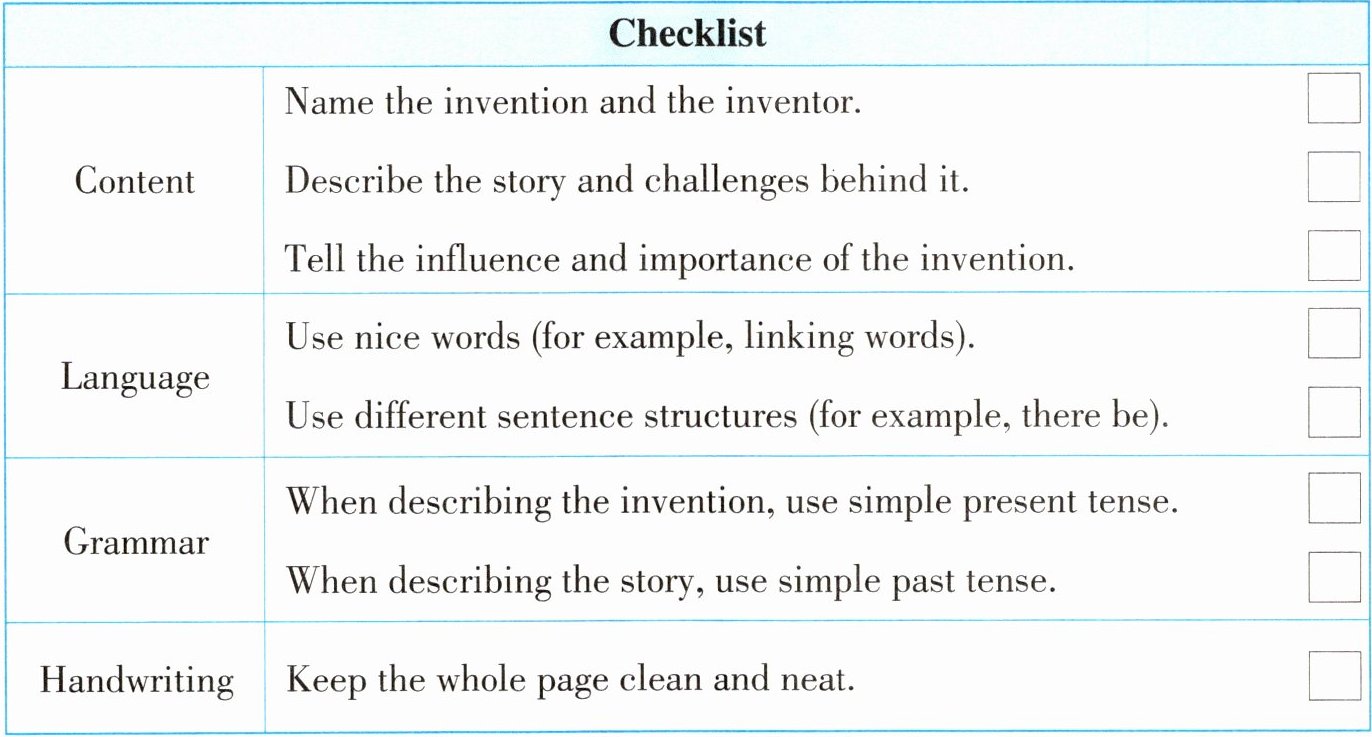
Task: Share your favourite invention with the help of the checklist.
Step 1: Choose the invention you like.
Tell us about your favourite invention. Answer these questions:
◇ What is it?
My favourite invention is
mobile X-ray cars called "Little Curies"
.◇ Who invented it?
The
inventor
of it is Marie Curie
(who).◇ Do you know any other information about the invention?
It was invented
during World War I
(time) to bring life-saving technology to wounded soldiers in the war
(purpose).Step 2: Share the details(细节) of the invention you chose.
Now, tell us about the details of the invention you chose. Think about:
◇ What problems did we have before it was invented?
Before this invention,
the soldiers suffered a lot from their wounds
because doctors couldn't see the wounds clearly inside the soldiers' bodies. So it was like working "in the dark" for them, risking mistakes
.◇ How did the inventor come up with the solution(解决办法)?
So in order to solve this problem,
Marie Curie
decided to put X-ray machines in cars and drive them to the front-line so doctors could see the wounds
.◇ How did the invention work?
It
helped show the wounds clearly and saved a lot of time for doctors to treat the wounded
.◇ What other challenges did the inventor face?
At that time, very few people knew how to use this new invention, and X-rays were dangerous to use. So Madame Curie trained 150 women—including her teenage daughter—to use them. She even drove one of the cars to the front-line herself! What's more, she raised money to build more of these mobile cars to help the wounded soldiers
.Step 3: Explain the reason why you like this invention.
Finally, tell us the reason why you like this invention. Explain:
◇ What is the influence of this invention?
It helped
save over 1 million soldiers by helping doctors, and it is the ancestor(原型) of modern ambulances
.◇ Why do you like it so much?
It’s my favourite because
as a pioneering woman scientist, Madame Curie used her invention to prove that women could also do well in high-tech fields. To me, she didn't just win Nobel Prizes for science—she used her knowledge to heal(疗愈) the world.
..
.
.
.
.
答案
Possible version:
Step 1:
My favourite invention is mobile X-ray cars called "Little Curies".
The inventor of it is Marie Curie.
It was invented during World War I to bring life-saving technology to wounded soldiers in the war.
Step 2:
Before this invention, the soldiers suffered a lot from their wounds because doctors couldn't see the wounds clearly inside the soldiers' bodies. So it was like working "in the dark" for them, risking mistakes.
So in order to solve this problem, Marie Curie decided to put X-ray machines in cars and drive them to the front-line so doctors could see the wounds.
It helped show the wounds clearly and saved a lot of time for doctors to treat the wounded.
At that time, very few people knew how to use this new invention, and X-rays were dangerous to use. So Madame Curie trained 150 women—including her teenage daughter—to use them. She even drove one of the cars to the front-line herself! What's more, she raised money to build more of these mobile cars to help the wounded soldiers.
Step 3:
It helped save over 1 million soldiers by helping doctors, and it is the ancestor(原型) of modern ambulances.
It's my favourite because as a pioneering woman scientist, Madame Curie used her invention to prove that women could also do well in high-tech fields. To me, she didn't just win Nobel Prizes for science—she used her knowledge to heal(疗愈) the world.
My Favourite Invention
My favourite invention is the mobile X-ray car called the "Little Curie", invented by Marie Curie. During World War I, wounded soldiers suffered because doctors couldn't see inside their bodies. To solve this problem, Marie Curie put X-ray machines in cars and drove them to the frontline.
These mobile machines helped doctors see the wounds clearly, saving time and lives. Few people knew how to use X-rays then, so Madame Curie trained 150 women, including her teenage daughter, and even drove one of the cars to the front herself! She also raised money to build more cars.
The "Little Curies" saved over 1 million soldiers and inspired modern ambulances. I love this invention because Marie Curie proved women could also do well in science. She didn't just win Nobel Prizes—she used her knowledge to heal the world.
