

 登录
登录
Ⅰ. Read and number.(读句子,根据发生的频率,为下列图片排序。)
Zhou Jie often plays football after school.
Ben sometimes plays Chinese chess with his grandfather.
Li Min always cooks lunch for her family at the weekend.
Chen Hui usually plays the pipa on Sundays.
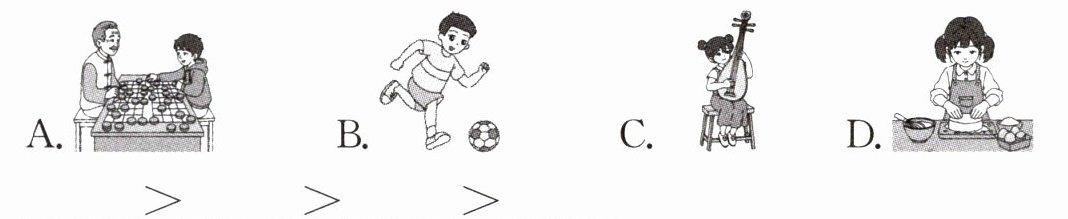
Zhou Jie often plays football after school.
Ben sometimes plays Chinese chess with his grandfather.
Li Min always cooks lunch for her family at the weekend.
Chen Hui usually plays the pipa on Sundays.
D
> C
> B
> A
答案
I. D; C; B; A
解析
【分析】首先明确不同频度副词代表的动作发生频率高低:always(总是,频率最高)> usually(通常,频率次之)> often(经常,频率第三)> sometimes(有时,频率最低);接着将每个句子与对应图片匹配:句子“Li Min always cooks lunch...”对应图片D(做饭),“Chen Hui usually plays the pipa...”对应图片C(弹琵琶),“Zhou Jie often plays football...”对应图片B(踢足球),“Ben sometimes plays Chinese chess...”对应图片A(下棋);最后按频率从高到低排列图片即可。
【解析】1. 确定频度副词的频率等级:always(最高)> usually > often > sometimes(最低);2. 匹配句子与图片:D对应always描述的做饭,C对应usually描述的弹琵琶,B对应often描述的踢足球,A对应sometimes描述的下棋;3. 按频率从高到低排序为D>C>B>A。
【答案】D; C; B; A
【知识点】频度副词的含义、图片与句子匹配
【点评】本题考查频度副词的理解与应用,需要学生掌握不同频度副词的频率差异,结合图片完成排序,是小学英语基础题型,难度适中。
【难度系数】0.5
【解析】1. 确定频度副词的频率等级:always(最高)> usually > often > sometimes(最低);2. 匹配句子与图片:D对应always描述的做饭,C对应usually描述的弹琵琶,B对应often描述的踢足球,A对应sometimes描述的下棋;3. 按频率从高到低排序为D>C>B>A。
【答案】D; C; B; A
【知识点】频度副词的含义、图片与句子匹配
【点评】本题考查频度副词的理解与应用,需要学生掌握不同频度副词的频率差异,结合图片完成排序,是小学英语基础题型,难度适中。
【难度系数】0.5
Ⅱ. Read and write. (根据中文提示完成句子。)
1. 我有时会在周六为家人做晚饭。
I
2. 她通常在周末上琵琶课。
She usually
3. Mary 总是在周日和她的妈妈下象棋。
Mary always
1. 我有时会在周六为家人做晚饭。
I
sometimes
cook
dinner
for my family on
Saturdays
.2. 她通常在周末上琵琶课。
She usually
has
pipa
lessons
at
the
weekend
.3. Mary 总是在周日和她的妈妈下象棋。
Mary always
plays
Chinese
chess
with
her mum on
Sundays
.答案
1. sometimes cook dinner; on Saturdays
2. has pipa lessons at the weekend
3. plays Chinese chess with; on Sundays
2. has pipa lessons at the weekend
3. plays Chinese chess with; on Sundays
解析
【分析】
本题为根据中文提示补全英语句子的题型,解题思路如下:首先根据句中频度副词(sometimes、usually、always)确定使用一般现在时;其次对应中文含义,匹配对应的动词短语,同时注意主语的人称和数,判断动词是否需要变为第三人称单数形式;最后补充正确的时间状语,注意时间介词的固定搭配(星期前用on,周末用at the weekend)。
【解析】
1. 第一句:“有时”对应频度副词sometimes,放于主语后;“做晚饭”是固定短语cook dinner,主语I为第一人称,动词用原形;“在周六”是时间状语on Saturdays,故填sometimes cook dinner; on Saturdays。
2. 第二句:“上琵琶课”是固定短语have pipa lessons,主语she为第三人称单数,一般现在时中动词用has;“在周末”是at the weekend,故填has pipa lessons at the weekend。
3. 第三句:“下象棋”是固定短语play Chinese chess,“和某人”用介词with连接,主语Mary为第三人称单数,play变plays;“在周日”是on Sundays,故填plays Chinese chess with; on Sundays。
【答案】
1. sometimes cook dinner; on Saturdays
2. has pipa lessons at the weekend
3. plays Chinese chess with; on Sundays
【知识点】
一般现在时、动词短语、时间介词
【点评】
本题考查小学英语基础知识点,涵盖一般现在时的动词形式变化、常用动词短语及时间状语的搭配,需掌握频度副词的用法和固定表达,适合基础巩固练习。
【难度系数】
0.6
本题为根据中文提示补全英语句子的题型,解题思路如下:首先根据句中频度副词(sometimes、usually、always)确定使用一般现在时;其次对应中文含义,匹配对应的动词短语,同时注意主语的人称和数,判断动词是否需要变为第三人称单数形式;最后补充正确的时间状语,注意时间介词的固定搭配(星期前用on,周末用at the weekend)。
【解析】
1. 第一句:“有时”对应频度副词sometimes,放于主语后;“做晚饭”是固定短语cook dinner,主语I为第一人称,动词用原形;“在周六”是时间状语on Saturdays,故填sometimes cook dinner; on Saturdays。
2. 第二句:“上琵琶课”是固定短语have pipa lessons,主语she为第三人称单数,一般现在时中动词用has;“在周末”是at the weekend,故填has pipa lessons at the weekend。
3. 第三句:“下象棋”是固定短语play Chinese chess,“和某人”用介词with连接,主语Mary为第三人称单数,play变plays;“在周日”是on Sundays,故填plays Chinese chess with; on Sundays。
【答案】
1. sometimes cook dinner; on Saturdays
2. has pipa lessons at the weekend
3. plays Chinese chess with; on Sundays
【知识点】
一般现在时、动词短语、时间介词
【点评】
本题考查小学英语基础知识点,涵盖一般现在时的动词形式变化、常用动词短语及时间状语的搭配,需掌握频度副词的用法和固定表达,适合基础巩固练习。
【难度系数】
0.6
Ⅲ. Read and choose.(读一读,选择正确的选项补全对话。)
Mr Li: Hi, Binbin. 1.
Binbin: I often play ping-pong.
Mr Li: That's nice. 2.
Liu Jia: My mother works at the weekend, so I often cook lunch for my family.
Mr Li: 3.
Liu Jia: No, he doesn't. He often cleans the house and washes clothes.
Mr Li: Good! How about you, Chen Jie?
Chen Jie: 4.
Mr Li: 5.
A. Great! Have a nice weekend, everyone!
B. What about you, Liu Jia?
C. I often do my homework on Saturdays.
D. Does your father work at the weekend?
E. What do you usually do at the weekend?
Mr Li: Hi, Binbin. 1.
E
Binbin: I often play ping-pong.
Mr Li: That's nice. 2.
B
Liu Jia: My mother works at the weekend, so I often cook lunch for my family.
Mr Li: 3.
D
Liu Jia: No, he doesn't. He often cleans the house and washes clothes.
Mr Li: Good! How about you, Chen Jie?
Chen Jie: 4.
C
And I usually play in the park on Sundays.Mr Li: 5.
A
A. Great! Have a nice weekend, everyone!
B. What about you, Liu Jia?
C. I often do my homework on Saturdays.
D. Does your father work at the weekend?
E. What do you usually do at the weekend?
答案
1. E 2. B 3. D 4. C 5. A
解析
【分析】本题为补全对话题型,需结合上下文的问答逻辑匹配选项:第1题Binbin答周末做的事,对应询问周末活动的问句;第2题答语来自Liu Jia,对应询问Liu Jia的问句;第3题答语为一般疑问句否定回答,对应一般疑问句;第4题Chen Jie需答自身周末活动;第5题对话结尾为祝福类语句。
【解析】1. 根据Binbin的答语“I often play ping-pong”,问句询问周末活动,选E;2. 下一个答语是Liu Jia的内容,此处询问Liu Jia的情况,选B;3. 答语以“No, he doesn't.”开头,是一般疑问句的否定回答,选D;4. Chen Jie需回答自身周末活动,选C;5. 对话结尾应为祝福语句,选A。
【答案】1.E 2.B 3.D 4.C 5.A
【知识点】补全对话;日常交际用语
【点评】本题考查日常交际中关于周末活动的补全对话,需结合上下文语境分析问答逻辑,属于基础题型,难度适中。
【难度系数】0.5
【解析】1. 根据Binbin的答语“I often play ping-pong”,问句询问周末活动,选E;2. 下一个答语是Liu Jia的内容,此处询问Liu Jia的情况,选B;3. 答语以“No, he doesn't.”开头,是一般疑问句的否定回答,选D;4. Chen Jie需回答自身周末活动,选C;5. 对话结尾应为祝福语句,选A。
【答案】1.E 2.B 3.D 4.C 5.A
【知识点】补全对话;日常交际用语
【点评】本题考查日常交际中关于周末活动的补全对话,需结合上下文语境分析问答逻辑,属于基础题型,难度适中。
【难度系数】0.5
