

 登录
登录
七、信息还原。(2024·江苏常州溧阳期末改编)
阅读下面短文,从短文后所给的选项中选出能填入短文空白处的最佳选项,使短文通顺连贯,其中有两项是多余选项。
Money may not buy happiness, but it helps. Many teenagers want to learn how to manage money before going out into the grown-up world. 1 This idea is raised by Dr Mara Harvey, a money expert. The following are some of her tips.
Learn to make money. Ask your parents if you can do chores(家庭杂务) to make pocket money. These could include washing a car or taking the dog for a walk. 2 In this way, you can also improve your communication skills(沟通技巧), which will help when you have a grown-up job.
Help your money grow. Money can’t grow if it’s sitting inside a piggy bank. Put your money in the bank and you can get interest(利息). 3 One day you may feel surprised at how much money you have.
Make a plan. If you have a big event like a holiday coming up, it might mean you will need to spend more of your pocket money. Try making a plan for spending and saving. 4 Then it will help you take control of your money.
5 Figure out how much you can reasonably spend each month. Spend your money on what you truly need. Then try to cut down on spending. For example, rather than eating out, you can choose to cook at home.
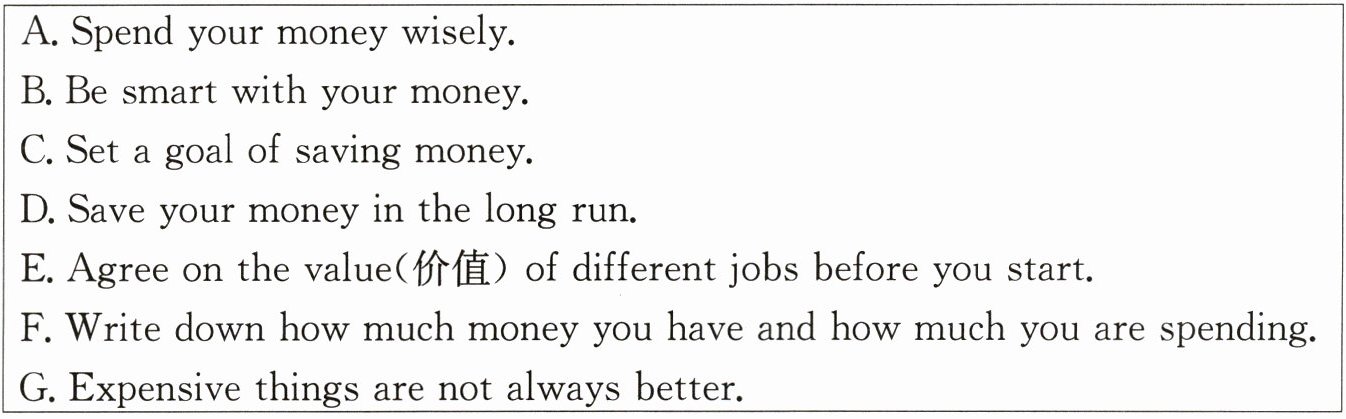
1.
阅读下面短文,从短文后所给的选项中选出能填入短文空白处的最佳选项,使短文通顺连贯,其中有两项是多余选项。
Money may not buy happiness, but it helps. Many teenagers want to learn how to manage money before going out into the grown-up world. 1 This idea is raised by Dr Mara Harvey, a money expert. The following are some of her tips.
Learn to make money. Ask your parents if you can do chores(家庭杂务) to make pocket money. These could include washing a car or taking the dog for a walk. 2 In this way, you can also improve your communication skills(沟通技巧), which will help when you have a grown-up job.
Help your money grow. Money can’t grow if it’s sitting inside a piggy bank. Put your money in the bank and you can get interest(利息). 3 One day you may feel surprised at how much money you have.
Make a plan. If you have a big event like a holiday coming up, it might mean you will need to spend more of your pocket money. Try making a plan for spending and saving. 4 Then it will help you take control of your money.
5 Figure out how much you can reasonably spend each month. Spend your money on what you truly need. Then try to cut down on spending. For example, rather than eating out, you can choose to cook at home.
1.
B
2. E
3. D
4. F
5. A
答案
1. B 2. E 3. D 4. F 5. A
解析
【分析】
首先通读全文,明确文章主旨是给青少年的理财建议。第1空需承接前文“青少年想学习理财”,引出理财核心观点;第2空需衔接“做家务赚零花钱”与“提升沟通技巧”的逻辑;第3空需对应“存钱生息后存款增多”的语境;第4空需匹配“制定花钱存钱计划”的具体做法;第5空需契合“合理消费、减少开支”的段落主题,结合各选项含义逐一匹配。
【解析】
1. 第1空:前文提到青少年想学习理财,后文指出该想法由理财专家提出,选项B“Be smart with your money.”(明智处理钱财)是理财的核心观点,符合语境,故选B。
2. 第2空:前文说通过做家务赚零花钱,后文提到能提升沟通技巧,选项E“Agree on the value of different jobs before you start.”(明确不同工作的价值),做家务是工作,明确价值后能更好理解工作意义,衔接后文沟通技巧的提升,故选E。
3. 第3空:前文讲把钱存银行得利息,后文说存款会增多,选项D“Save your money in the long run.”(长期存钱),符合存钱生息、长期积累的逻辑,故选D。
4. 第4空:前文提到要制定花钱和存钱的计划,选项F“Write down how much money you have and how much you are spending.”(写下收支情况)是制定计划的具体做法,衔接后文“控制钱财”,故选F。
5. 第5空:后文讲合理消费、减少不必要开支,选项A“Spend your money wisely.”(明智花钱)是该段主旨,符合语境,故选A。
【答案】
1. B 2. E 3. D 4. F 5. A
【知识点】
英语信息还原、语篇逻辑衔接
【点评】
本题为期末改编的信息还原题,围绕青少年理财话题展开,考查学生对上下文语境的理解和语篇逻辑的把握能力,需结合前后文内容匹配合适的句子,难度适中。
【难度系数】
0.6
首先通读全文,明确文章主旨是给青少年的理财建议。第1空需承接前文“青少年想学习理财”,引出理财核心观点;第2空需衔接“做家务赚零花钱”与“提升沟通技巧”的逻辑;第3空需对应“存钱生息后存款增多”的语境;第4空需匹配“制定花钱存钱计划”的具体做法;第5空需契合“合理消费、减少开支”的段落主题,结合各选项含义逐一匹配。
【解析】
1. 第1空:前文提到青少年想学习理财,后文指出该想法由理财专家提出,选项B“Be smart with your money.”(明智处理钱财)是理财的核心观点,符合语境,故选B。
2. 第2空:前文说通过做家务赚零花钱,后文提到能提升沟通技巧,选项E“Agree on the value of different jobs before you start.”(明确不同工作的价值),做家务是工作,明确价值后能更好理解工作意义,衔接后文沟通技巧的提升,故选E。
3. 第3空:前文讲把钱存银行得利息,后文说存款会增多,选项D“Save your money in the long run.”(长期存钱),符合存钱生息、长期积累的逻辑,故选D。
4. 第4空:前文提到要制定花钱和存钱的计划,选项F“Write down how much money you have and how much you are spending.”(写下收支情况)是制定计划的具体做法,衔接后文“控制钱财”,故选F。
5. 第5空:后文讲合理消费、减少不必要开支,选项A“Spend your money wisely.”(明智花钱)是该段主旨,符合语境,故选A。
【答案】
1. B 2. E 3. D 4. F 5. A
【知识点】
英语信息还原、语篇逻辑衔接
【点评】
本题为期末改编的信息还原题,围绕青少年理财话题展开,考查学生对上下文语境的理解和语篇逻辑的把握能力,需结合前后文内容匹配合适的句子,难度适中。
【难度系数】
0.6
