

 登录
登录
任务四:根据短文内容填空。
1. Once upon a time, there was a fisherman who was .
2. The genie didn't look , so he shouted "Prepare to die!"
3. The fisherman pretended that the bottle was small for the genie fit in.
4. The genie turned into smoke and to the bottle.
5. The fisherman closed the bottle .
1. Once upon a time, there was a fisherman who was .
2. The genie didn't look , so he shouted "Prepare to die!"
3. The fisherman pretended that the bottle was small for the genie fit in.
4. The genie turned into smoke and to the bottle.
5. The fisherman closed the bottle .
答案
1. old and poor
2. thankful
3. too; to
4. returned
5. at once
2. thankful
3. too; to
4. returned
5. at once
解析
本题结合经典故事《渔夫与魔鬼》的内容,同时考察七年级核心语法和词汇点:
1. 故事开篇介绍这位渔夫的设定是年老且贫穷,两个空填入对应描述即可;
2. 魔鬼完全不感激渔夫将他从瓶中放出,所以放出狠话要杀死渔夫,填入符合语境的形容词;
3. 本题考察七年级核心固定结构too...to...,含义为"太……而不能",符合句意"渔夫假装瓶子太小了,魔鬼根本装不进去";
4. 魔鬼化作烟雾回到瓶子里,and连接并列谓语,和前面的turned时态保持一致,用动词过去式;
5. 渔夫在魔鬼变回烟雾钻回瓶子后,立刻把瓶子封上,填入对应含义的短语即可。
1. 故事开篇介绍这位渔夫的设定是年老且贫穷,两个空填入对应描述即可;
2. 魔鬼完全不感激渔夫将他从瓶中放出,所以放出狠话要杀死渔夫,填入符合语境的形容词;
3. 本题考察七年级核心固定结构too...to...,含义为"太……而不能",符合句意"渔夫假装瓶子太小了,魔鬼根本装不进去";
4. 魔鬼化作烟雾回到瓶子里,and连接并列谓语,和前面的turned时态保持一致,用动词过去式;
5. 渔夫在魔鬼变回烟雾钻回瓶子后,立刻把瓶子封上,填入对应含义的短语即可。
B. 语音规则。
The Story in Class
“What story should we read today?” asked Miss Lin. “This one!” said Tom, holding up a thick book about a lion. “Would you like to read it to us, Tom?” she asked. Tom began, “One day, a little mouse ran over a sleeping lion. ‘What are you doing?’ the lion shouted. The thin mouse said, ‘Please don’t eat me! I may help you someday.’ The lion laughed but let him go in the end.” Miss Lin stopped him. “Don’t you think the lion was kind that day?” “Yes,” said the class. “Later,” Tom continued, “the lion was caught in a net. The mouse remembered his promise. He came and bit through the ropes! ‘Thank you!’ said the lion. ” “That is a great story about friendship,” said Miss Lin. “Who do you think interests you more? Would you like to tell me the meanings behind it?”
任务一:请朗读短文,注意黑体单词的发音。
任务二:梳理读音规则。请将上文中重点标注的单词或短语进行分类,根据读音规则,将其填入不同的表格中。
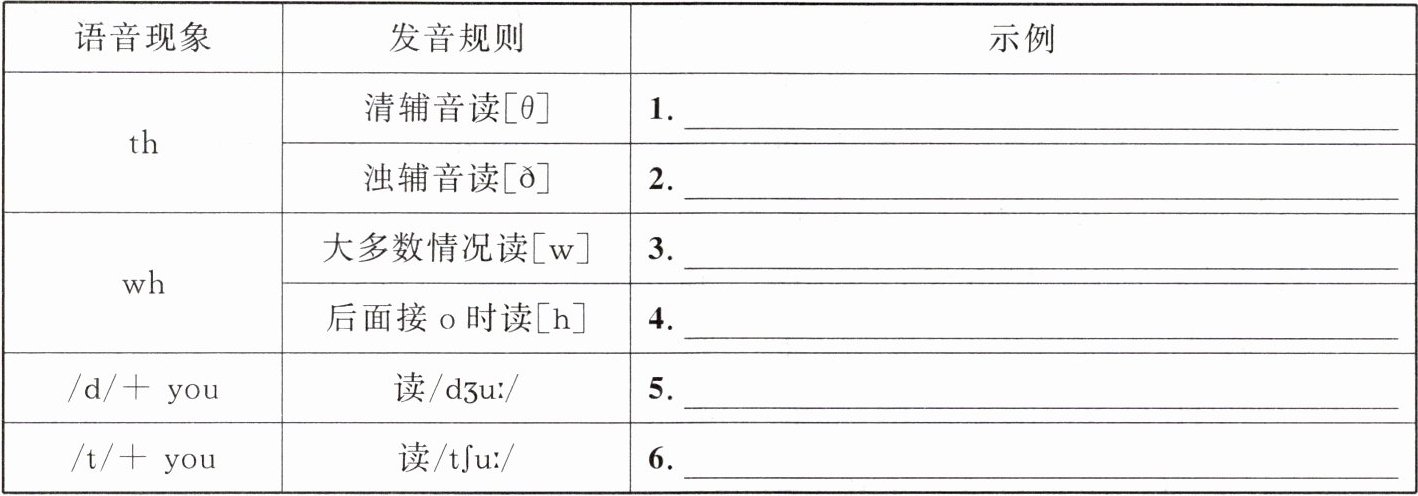
| 语音现象 | 发音规则 | 示例 |
| ---- | ---- | ---- |
| th | 清辅音读[θ] | 1. |
| th | 浊辅音读[ð] | 2. |
| wh | 大多数情况读[w] | 3. |
| wh | 后面接o时读[h] | 4. |
| /d/+ you | 读/dʒu:/ | 5. |
| /t/+ you | 读/tʃu:/ | 6. |
The Story in Class
“What story should we read today?” asked Miss Lin. “This one!” said Tom, holding up a thick book about a lion. “Would you like to read it to us, Tom?” she asked. Tom began, “One day, a little mouse ran over a sleeping lion. ‘What are you doing?’ the lion shouted. The thin mouse said, ‘Please don’t eat me! I may help you someday.’ The lion laughed but let him go in the end.” Miss Lin stopped him. “Don’t you think the lion was kind that day?” “Yes,” said the class. “Later,” Tom continued, “the lion was caught in a net. The mouse remembered his promise. He came and bit through the ropes! ‘Thank you!’ said the lion. ” “That is a great story about friendship,” said Miss Lin. “Who do you think interests you more? Would you like to tell me the meanings behind it?”
任务一:请朗读短文,注意黑体单词的发音。
任务二:梳理读音规则。请将上文中重点标注的单词或短语进行分类,根据读音规则,将其填入不同的表格中。
| 语音现象 | 发音规则 | 示例 |
| ---- | ---- | ---- |
| th | 清辅音读[θ] | 1. |
| th | 浊辅音读[ð] | 2. |
| wh | 大多数情况读[w] | 3. |
| wh | 后面接o时读[h] | 4. |
| /d/+ you | 读/dʒu:/ | 5. |
| /t/+ you | 读/tʃu:/ | 6. |
答案
1. thick, thin, through, Thank
2. This, the, that, That
3. What
4. Who
5. Would you
6. Don't you
2. This, the, that, That
3. What
4. Who
5. Would you
6. Don't you
解析
本题考查七年级英语常见语音发音规则,我们先梳理文中所有加粗标注的词汇,按照对应的语音现象分类:
1. th发清辅音/θ/:对应th字母组合发音为清辅音、发音时声带不振动的单词;
2. th发浊辅音/ð/:对应th字母组合发音为浊辅音、发音时声带振动的单词;
3. wh多数情况发/w/:对应wh后不接o、发音为/w/的单词;
4. wh后接o发/h/:对应wh后接字母o、发音为/h/的单词;
5. /d/ + you连读为/dʒuː/:对应前词尾音为/d/、后接you的连读组合;
6. /t/ + you连读为/tʃuː/:对应前词尾音为/t/、后接you的连读组合。
1. th发清辅音/θ/:对应th字母组合发音为清辅音、发音时声带不振动的单词;
2. th发浊辅音/ð/:对应th字母组合发音为浊辅音、发音时声带振动的单词;
3. wh多数情况发/w/:对应wh后不接o、发音为/w/的单词;
4. wh后接o发/h/:对应wh后接字母o、发音为/h/的单词;
5. /d/ + you连读为/dʒuː/:对应前词尾音为/d/、后接you的连读组合;
6. /t/ + you连读为/tʃuː/:对应前词尾音为/t/、后接you的连读组合。
