

 登录
登录
三、根据材料内容选择最佳答案。
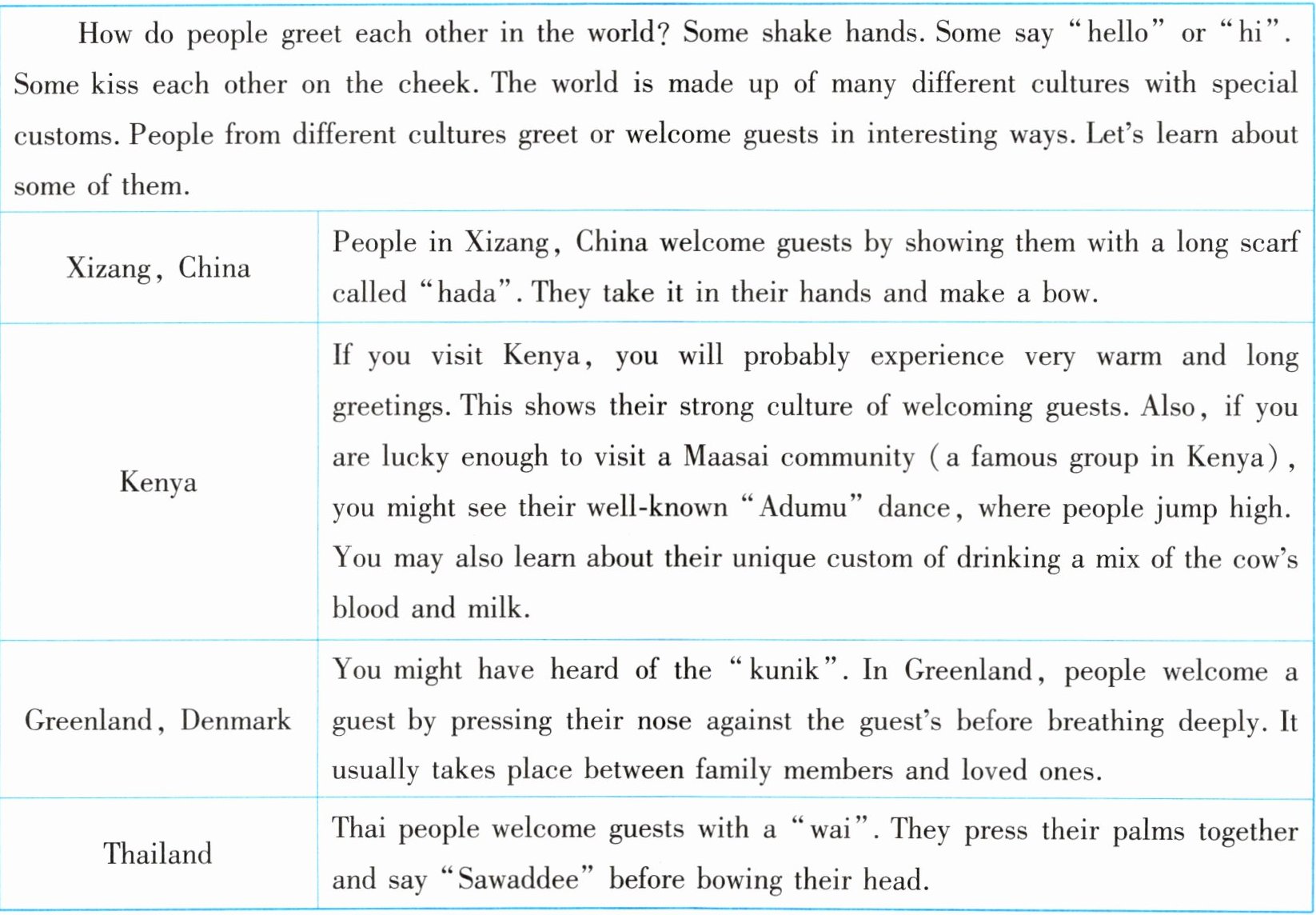
How do people greet each other in the world? Some shake hands. Some say “hello” or “hi”. Some kiss each other on the cheek. The world is made up of many different cultures with special customs. People from different cultures greet or welcome guests in interesting ways. Let's learn about some of them.
(
A. By shaking hands.
B. By dancing together.
C. By saying “Sawaddee”.
D. By giving a scarf called “hada”.
(
A. In China.
B. In Denmark.
C. In Kenya.
D. In Thailand.
(
A. To describe how popular the “kunik” is.
B. To tell readers where the “kunik” comes from.
C. To show who usually uses the “kunik” greeting.
D. To explain how to perform the “kunik” correctly.
(
A. How people in different places greet each other.
B. Why people around the world like welcoming guests.
C. When to use traditional greetings in foreign countries.
D. What food and drinks are served to guests in different cultures.
(
A. History.
B. Culture.
C. Science.
D. Sports.
How do people greet each other in the world? Some shake hands. Some say “hello” or “hi”. Some kiss each other on the cheek. The world is made up of many different cultures with special customs. People from different cultures greet or welcome guests in interesting ways. Let's learn about some of them.
(
D
)1. How do people greet guests in Xizang, China?A. By shaking hands.
B. By dancing together.
C. By saying “Sawaddee”.
D. By giving a scarf called “hada”.
(
C
)2. Where will you probably receive the greeting of “Adumu” dance?A. In China.
B. In Denmark.
C. In Kenya.
D. In Thailand.
(
C
)3. Why does the writer mention “family members and loved ones” in the text?A. To describe how popular the “kunik” is.
B. To tell readers where the “kunik” comes from.
C. To show who usually uses the “kunik” greeting.
D. To explain how to perform the “kunik” correctly.
(
A
)4. What is the main idea of the text?A. How people in different places greet each other.
B. Why people around the world like welcoming guests.
C. When to use traditional greetings in foreign countries.
D. What food and drinks are served to guests in different cultures.
(
B
)5. In which part of a magazine can we probably read the text?A. History.
B. Culture.
C. Science.
D. Sports.
答案
三、1—5 DCCAB
解析
【分析】
这是一篇介绍不同地域特色问候习俗的说明文,解题时可以按照先读题干、带着问题回原文定位的思路来做:1. 细节类题目直接找到对应国家/地区的介绍板块,比对选项和原文内容就能选出正确答案;2. 主旨类题目重点关注文章首尾段的总起总结内容,提炼核心主题;3. 文章出处类题目结合全文介绍的内容属性,匹配对应杂志板块即可。
【解析】
1. 定位到中国西藏的介绍板块,原文提到“People in Xizang, China welcome guests by showing them with a long scarf called "hada"”,可知西藏人民通过敬献名为哈达的长围巾迎客,对应选项D。
2. 定位到肯尼亚的介绍板块,原文提到“if you are lucky enough to visit a Maasai community (a famous group in Kenya), you might see their well-known "Adumu" dance”,可知Adumu舞蹈出现在肯尼亚,对应选项C。
3. 定位到丹麦格陵兰岛的介绍板块,原文最后一句“It usually takes place between family members and loved ones”是补充说明kunik这种问候方式的适用人群,对应选项C。
4. 文章首段就点明主题:不同文化背景的人用有趣的方式问候、欢迎客人,全文分别介绍了四个地区的特色迎客问候方式,核心主旨是不同地方的人如何互相问候,对应选项A。
5. 全文内容围绕不同国家和地区的特色文化习俗、问候礼仪展开,最可能出现在杂志的文化板块,对应选项B。
【答案】
1—5 DCCAB
【知识点】
阅读理解细节定位,阅读理解主旨判断,地域文化常识
【点评】
本题属于文化类说明文阅读,绝大多数题目都可以通过原文直接定位得到答案,难度适中,既考察了学生的信息检索阅读能力,也能帮助学生了解世界各地不同的特色问候习俗,拓展文化视野。
【难度系数】
0.7
这是一篇介绍不同地域特色问候习俗的说明文,解题时可以按照先读题干、带着问题回原文定位的思路来做:1. 细节类题目直接找到对应国家/地区的介绍板块,比对选项和原文内容就能选出正确答案;2. 主旨类题目重点关注文章首尾段的总起总结内容,提炼核心主题;3. 文章出处类题目结合全文介绍的内容属性,匹配对应杂志板块即可。
【解析】
1. 定位到中国西藏的介绍板块,原文提到“People in Xizang, China welcome guests by showing them with a long scarf called "hada"”,可知西藏人民通过敬献名为哈达的长围巾迎客,对应选项D。
2. 定位到肯尼亚的介绍板块,原文提到“if you are lucky enough to visit a Maasai community (a famous group in Kenya), you might see their well-known "Adumu" dance”,可知Adumu舞蹈出现在肯尼亚,对应选项C。
3. 定位到丹麦格陵兰岛的介绍板块,原文最后一句“It usually takes place between family members and loved ones”是补充说明kunik这种问候方式的适用人群,对应选项C。
4. 文章首段就点明主题:不同文化背景的人用有趣的方式问候、欢迎客人,全文分别介绍了四个地区的特色迎客问候方式,核心主旨是不同地方的人如何互相问候,对应选项A。
5. 全文内容围绕不同国家和地区的特色文化习俗、问候礼仪展开,最可能出现在杂志的文化板块,对应选项B。
【答案】
1—5 DCCAB
【知识点】
阅读理解细节定位,阅读理解主旨判断,地域文化常识
【点评】
本题属于文化类说明文阅读,绝大多数题目都可以通过原文直接定位得到答案,难度适中,既考察了学生的信息检索阅读能力,也能帮助学生了解世界各地不同的特色问候习俗,拓展文化视野。
【难度系数】
0.7
