

 登录
Ⅱ. 任务型阅读
A
阅读并根据下面的短文,在表格中的空格里填入一个最恰当的单词,第9小题至少20词。
(2026·南京二模)When you think of animal communication, you probably imagine sounds—dogs barking, birds singing, or lions roaring. But animals have developed many surprising ways to send messages without making a noise.
Take the cuttlefish, for example. This sea creature is sometimes called the “chameleon of the sea” because it can change its skin colour and texture in less than a second. A cuttlefish uses these changes to communicate with other cuttlefish. A dark colour might mean “I’m angry” or “stay away”, while a light colour with waving patterns might mean “I’m interested in you”. Male cuttlefish have even been observed showing female patterns on one side of their body to attract a female, while showing male patterns on the other side to fool a competing male.
Bees, as many people know, communicate through dance. When a scout bee finds a good food source, it returns to the hive and performs a “waggle dance”. The direction of the dance tells other bees which way to fly, and the duration of the dance tells them how far to go. This form of communication is so precise that other bees can find flowers up to 10 kilometres away.
Elephants have a secret language that humans cannot hear. They produce low-frequency sounds called infrasound that travel for many kilometres through the ground. Other elephants “hear” these messages through their feet, which are extremely sensitive to vibrations. Scientists have recorded elephants using specific infrasound calls to warn others of danger, to gather the herd, and even to greet old friends after long separations.
Perhaps the most unusual form of animal communication comes from the honeybee’s “shaking signal”. When a bee returns from a disappointing trip with little or no food, it performs a shaking dance. This signal discourages other bees from going to that location, saving the colony’s energy for more promising sources.
Ants communicate mainly through chemicals called pheromones. When an ant finds food, it leaves a chemical trail on the ground as it returns to the nest. Other ants follow this trail to the food. But ants also use different pheromones for different purposes—one for “danger”, one for “follow me”, and even one for “I’m dead” (which causes other ants to carry the body away).
Understanding animal communication is not just interesting—it can help us protect endangered species. For example, by recording and understanding elephant infrasound calls, conservationists can predict when herds are moving toward human farms and take action to prevent conflicts.
| Aspect | Details |
| --- | --- |
| What is the article about? | Animals communicate in many 1.
| Examples of silent communication | |
| Cuttlefish | Change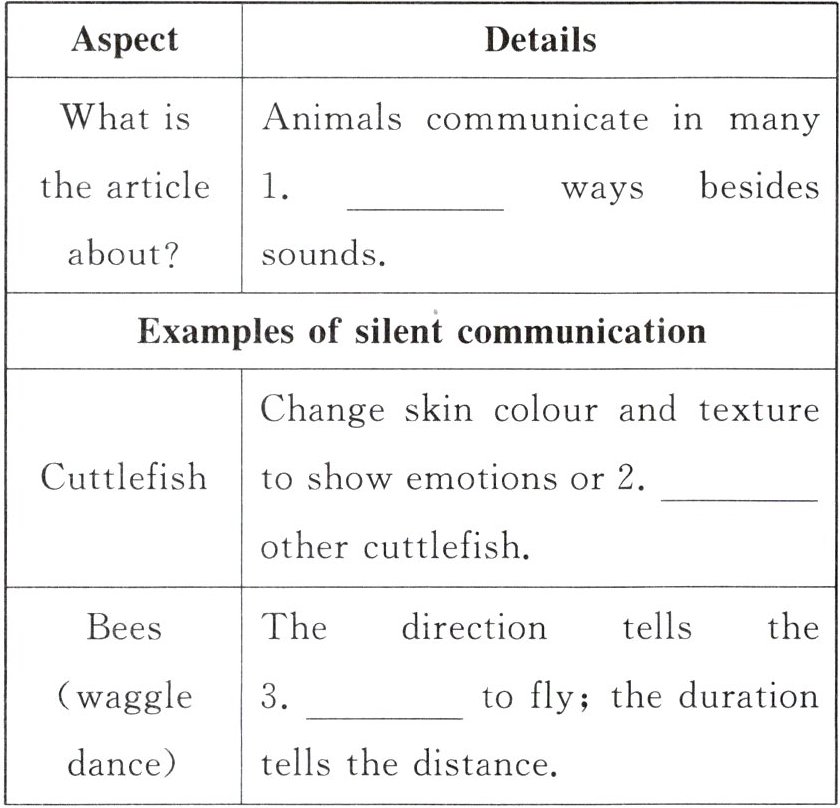 skin colour and texture to show emotions or 2.
| Bees (waggle dance) | The direction tells the 3.
| Elephants | Use infrasound that travels through the ground; other elephants 4.
| Honeybees (shaking signal) | Performed after a 5.
| Ants | Leave 6.
| Why it matters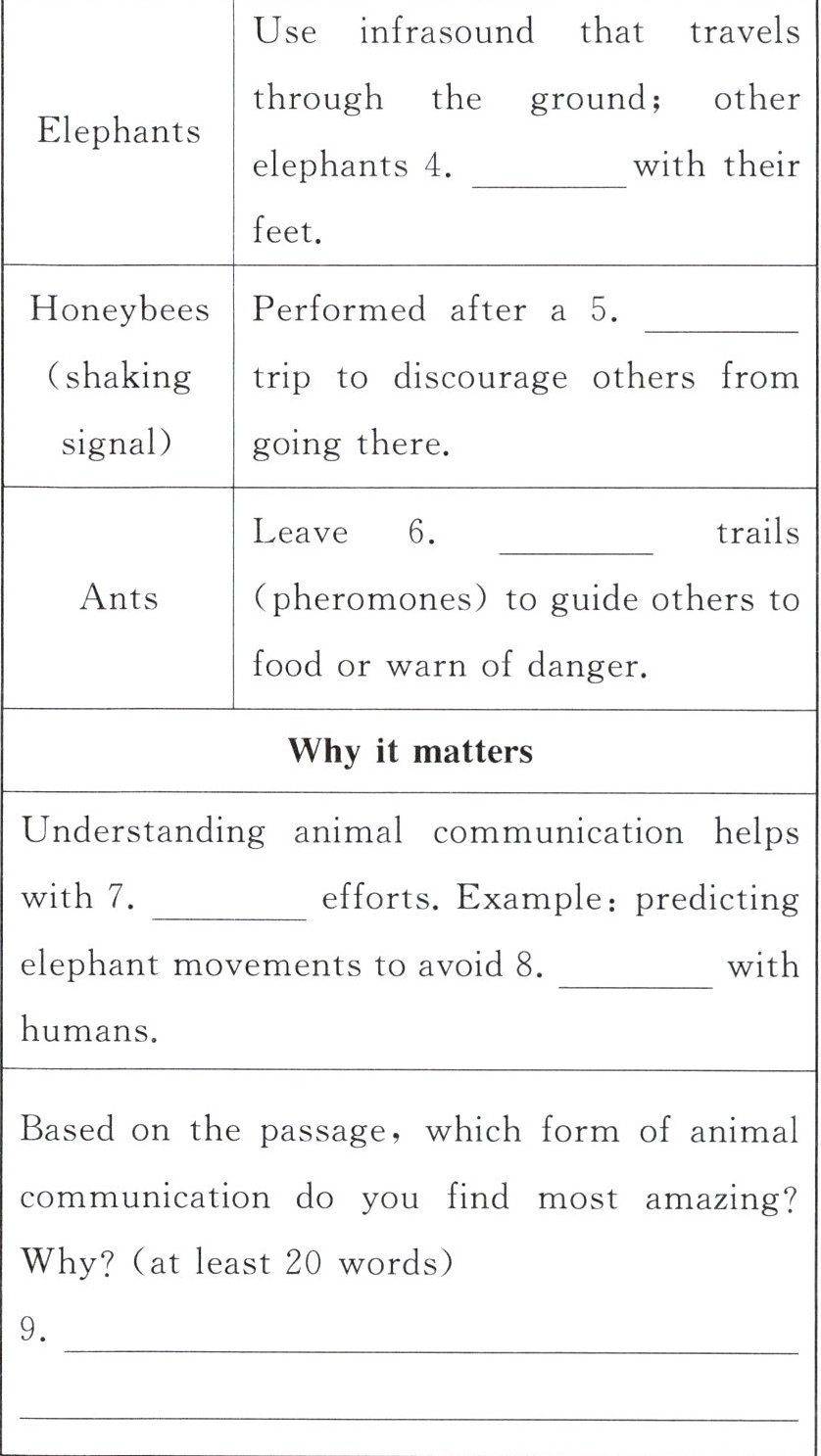 | |
| Understanding animal communication helps with 7.
| Based on the passage, which form of animal communication do you find most amazing? Why? (at least 20 words) | 9.
A
阅读并根据下面的短文,在表格中的空格里填入一个最恰当的单词,第9小题至少20词。
(2026·南京二模)When you think of animal communication, you probably imagine sounds—dogs barking, birds singing, or lions roaring. But animals have developed many surprising ways to send messages without making a noise.
Take the cuttlefish, for example. This sea creature is sometimes called the “chameleon of the sea” because it can change its skin colour and texture in less than a second. A cuttlefish uses these changes to communicate with other cuttlefish. A dark colour might mean “I’m angry” or “stay away”, while a light colour with waving patterns might mean “I’m interested in you”. Male cuttlefish have even been observed showing female patterns on one side of their body to attract a female, while showing male patterns on the other side to fool a competing male.
Bees, as many people know, communicate through dance. When a scout bee finds a good food source, it returns to the hive and performs a “waggle dance”. The direction of the dance tells other bees which way to fly, and the duration of the dance tells them how far to go. This form of communication is so precise that other bees can find flowers up to 10 kilometres away.
Elephants have a secret language that humans cannot hear. They produce low-frequency sounds called infrasound that travel for many kilometres through the ground. Other elephants “hear” these messages through their feet, which are extremely sensitive to vibrations. Scientists have recorded elephants using specific infrasound calls to warn others of danger, to gather the herd, and even to greet old friends after long separations.
Perhaps the most unusual form of animal communication comes from the honeybee’s “shaking signal”. When a bee returns from a disappointing trip with little or no food, it performs a shaking dance. This signal discourages other bees from going to that location, saving the colony’s energy for more promising sources.
Ants communicate mainly through chemicals called pheromones. When an ant finds food, it leaves a chemical trail on the ground as it returns to the nest. Other ants follow this trail to the food. But ants also use different pheromones for different purposes—one for “danger”, one for “follow me”, and even one for “I’m dead” (which causes other ants to carry the body away).
Understanding animal communication is not just interesting—it can help us protect endangered species. For example, by recording and understanding elephant infrasound calls, conservationists can predict when herds are moving toward human farms and take action to prevent conflicts.
| Aspect | Details |
| --- | --- |
| What is the article about? | Animals communicate in many 1.
surprising/amazing
ways besides sounds. || Examples of silent communication | |
| Cuttlefish | Change
skin colour and texture to show emotions or 2. fool/trick
other cuttlefish. || Bees (waggle dance) | The direction tells the 3.
way
to fly; the duration tells the distance. || Elephants | Use infrasound that travels through the ground; other elephants 4.
hear/sense/feel
with their feet. || Honeybees (shaking signal) | Performed after a 5.
disappointing/bad/unsuccessful
trip to discourage others from going there. || Ants | Leave 6.
chemical
trails (pheromones) to guide others to food or warn of danger. || Why it matters
| || Understanding animal communication helps with 7.
protection/conservation
efforts. Example: predicting elephant movements to avoid 8. conflicts/trouble
with humans. | || Based on the passage, which form of animal communication do you find most amazing? Why? (at least 20 words) | 9.
I find the cuttlefish most amazing. Because it can change colours in less than a second to show different emotions and even trick other cuttlefish. That's truly incredible!
|答案
1. surprising/amazing 第一段指出:"But animals have developed many surprising ways to send messages without making a noise.",说明动物除了依靠声音交流外,还有许多奇特的方式传递信息,所以此处填 surprising(也可填 amazing)作定语。
2. fool/trick 第二段指出:"Male cuttlefish have even been observed showing female patterns on one side of their body to attract a female, while showing male patterns on the other side to fool a competing male.",说明乌贼改变肤色和纹路除了表达情绪,还能迷惑其他同类,所以此处填 fool(也可填 trick)。
3. way 第三段指出:"The direction of the dance tells other bees which way to fly, and the duration of the dance tells them how far to go.",说明蜜蜂摇摆舞的方向会告知同伴飞行的方向,所以此处填 way。
4. hear/sense/feel 第四段指出:"Other elephants 'hear' these messages through their feet, which are extremely sensitive to vibrations.",说明其他大象会依靠双脚接收、感知次声波传递的信息,所以此处填 hear(也可填 sense/feel),主语是复数,动词用原形。
5. disappointing/bad/unsuccessful 第五段指出:"When a bee returns from a disappointing trip with little or no food, it performs a shaking dance.",直接表明蜜蜂在失望的觅食之旅后跳摇动舞,所以此处填 disappointing(也可填 bad/unsuccessful)作定语。
6. chemical 第六段指出:"When an ant finds food, it leaves a chemical trail on the ground as it returns to the nest.",说明蚂蚁会留下化学踪迹(信息素)来引导同伴或警示危险,所以此处填 chemical 作定语。
7. protection/conservation 最后一段指出:"Understanding animal communication is not just interesting—it can help us protect endangered species.",说明研究动物的交流方式能够助力物种保护相关工作,所以此处填 protection(也可填 conservation)。
8. conflicts/trouble 最后一段指出:"conservationists can predict when herds are moving toward human farms and take action to prevent conflicts.",说明预判大象的动向是为了避免大象与人类之间产生冲突,所以此处填 conflicts(也可填 trouble)。
9. I find the cuttlefish most amazing. Because it can change colours in less than a second to show different emotions and even trick other cuttlefish. That's truly incredible!(开放性试题,答案不唯一)
