

 登录
【主题解读】
本单元围绕“Our Memory(我们的记忆)”这一主题,谈论学习过程中有效记忆的方式,带领学生探索提高记忆能力和记忆效率的方法。
【写作任务】
本周班会上,你班将举行“我的记忆挑战(My Memory Challenge)”主题分享交流会。请你撰写一篇发言稿,分享你在学习中遇到的一个具体的记忆挑战以及你的应对策略或建议。
要求:
1. 词数不少于80;
2. 文中不得出现真实的人名、校名等。
内容需包含以下要点:
1. The challenge
2. Why to improve
3. The method(s)
【写前构思】
【逐步突破——三步突破法】
(一)短语翻译——根据写作要点翻译短语。
1. 首先
2. 在于
3. ……的含义
4. 混淆
5. 写下
6. 有效使用(或利用)某物
7. 而不是
8. 好得多
(二)句子翻译——结合(一)中短语和括号内提示完成句子。
1. 我总是把“查阅”和“寻找”的含义混淆。(look up; look for)
2. 我尝试把他们写很多遍。(try doing sth)
3. 我开始造句,并在日常对话中使用这些短语。
4. 熟能生巧。(practice)
(三)篇章展示——运用(二)中句子、连接词以及其他信息组成语段。
My Memory Challenge
本单元围绕“Our Memory(我们的记忆)”这一主题,谈论学习过程中有效记忆的方式,带领学生探索提高记忆能力和记忆效率的方法。
【写作任务】
本周班会上,你班将举行“我的记忆挑战(My Memory Challenge)”主题分享交流会。请你撰写一篇发言稿,分享你在学习中遇到的一个具体的记忆挑战以及你的应对策略或建议。
要求:
1. 词数不少于80;
2. 文中不得出现真实的人名、校名等。
内容需包含以下要点:
1. The challenge
2. Why to improve
3. The method(s)
【写前构思】
【逐步突破——三步突破法】
(一)短语翻译——根据写作要点翻译短语。
1. 首先
to start with
2. 在于
lie in
3. ……的含义
the meaning of
4. 混淆
mix up
5. 写下
write down
6. 有效使用(或利用)某物
put ... into good use
7. 而不是
instead of
8. 好得多
much better
(二)句子翻译——结合(一)中短语和括号内提示完成句子。
1. 我总是把“查阅”和“寻找”的含义混淆。(look up; look for)
I always mix up the meanings of “look up” and “look for”.
2. 我尝试把他们写很多遍。(try doing sth)
I tried writing them down many times.
3. 我开始造句,并在日常对话中使用这些短语。
I started making example sentences and put these phrases into use in my daily conversations.
4. 熟能生巧。(practice)
Practice makes perfect.
(三)篇章展示——运用(二)中句子、连接词以及其他信息组成语段。
My Memory Challenge
Hello, everyone! My memory challenge lies in remembering English phrasal verbs. I always mix up the meanings of “look up” and “look for”. I want to improve because these verbs are everywhere in reading and listening.
To start with, to overcome the challenge, I tried writing them down many times, but it was ineffective. Secondly, I started making example sentences and put these phrases into use in my daily conversations. For example, I say “I need to look up this word” instead of just “check”.
Now I know that using new knowledge actively works much better than just copying. Practice makes perfect.
Thanks for listening.
答案
(一)短语翻译
1. to start with
2. lie in
3. the meaning of
4. mix up
5. write down
6. put ... into good use
7. instead of
8. much better
(二)句子翻译
1. I always mix up the meanings of “look up” and “look for”.
2. I tried writing them down many times.
3. I started making example sentences and put these phrases into use in my daily conversations.
4. Practice makes perfect.
(三)篇章展示
One possible version:
My Memory Challenge
Hello, everyone! My memory challenge lies in remembering English phrasal verbs. I always mix up the meanings of “look up” and “look for”. I want to improve because these verbs are everywhere in reading and listening.
To start with, to overcome the challenge, I tried writing them down many times, but it was ineffective. Secondly, I started making example sentences and put these phrases into use in my daily conversations. For example, I say “I need to look up this word” instead of just “check”.
Now I know that using new knowledge actively works much better than just copying. Practice makes perfect.
Thanks for listening.
解析
【分析】
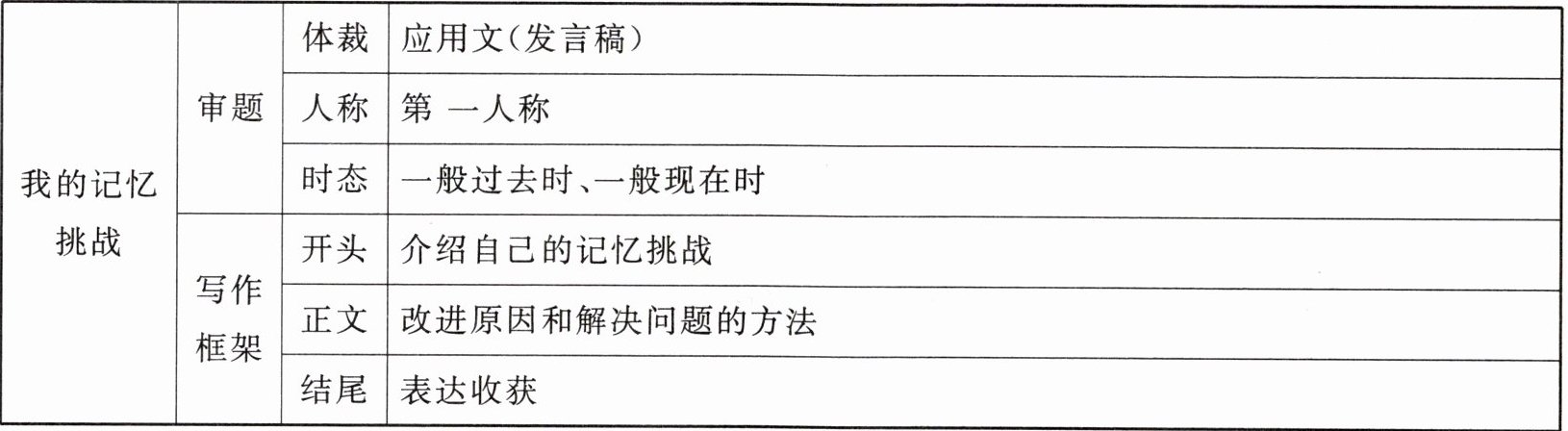
本题为英语应用文写作(发言稿),需先明确审题要求:采用第一人称,时态结合一般过去时(描述挑战与方法)、一般现在时(说明现状与收获);写作框架为开头介绍记忆挑战,正文阐述改进原因与解决方法,结尾表达收获。解题思路是按“短语翻译→句子翻译→篇章组合”的三步法推进:先掌握核心英语短语,再用短语完成符合要求的句子,最后整合为覆盖“挑战、改进原因、方法”要点的发言稿,确保词数达标且无真实人名、校名等信息。
【解析】
1. 短语翻译:根据固定搭配与常用表达,准确完成8个英语短语的翻译;2. 句子翻译:结合给定短语和提示,运用正确时态与固定结构(如try doing sth),完成4个句子的翻译;3. 篇章展示:以“My Memory Challenge”为标题,开头问候并点明记忆挑战(混淆短语含义),正文说明改进原因(短语在听说读写中广泛应用),再用翻译的句子组合成具体方法(尝试写下来、造句并日常使用),结尾表达收获并呼应主题,最后礼貌致谢,保证结构完整、要点齐全、词数符合要求。
【答案】
One possible version:
My Memory Challenge
Hello, everyone! My memory challenge lies in remembering English phrasal verbs. I always mix up the meanings of “look up” and “look for”. I want to improve because these verbs are everywhere in reading and listening.
To start with, to overcome the challenge, I tried writing them down many times, but it was ineffective. Secondly, I started making example sentences and put these phrases into use in my daily conversations. For example, I say “I need to look up this word” instead of just “check”.
Now I know that using new knowledge actively works much better than just copying. Practice makes perfect.
Thanks for listening.
【知识点】
英语应用文写作、英语短语翻译、英语句子翻译
【点评】
本题围绕“记忆挑战”主题设计,通过“短语→句子→篇章”的三步法降低写作难度,明确给出写作框架与核心要点,帮助学生掌握发言稿的写作结构,结合英语学习实际问题,实用性强,适合巩固英语写作能力。
【难度系数】
0.6
