

 登录
登录
探究点1 cut up的用法
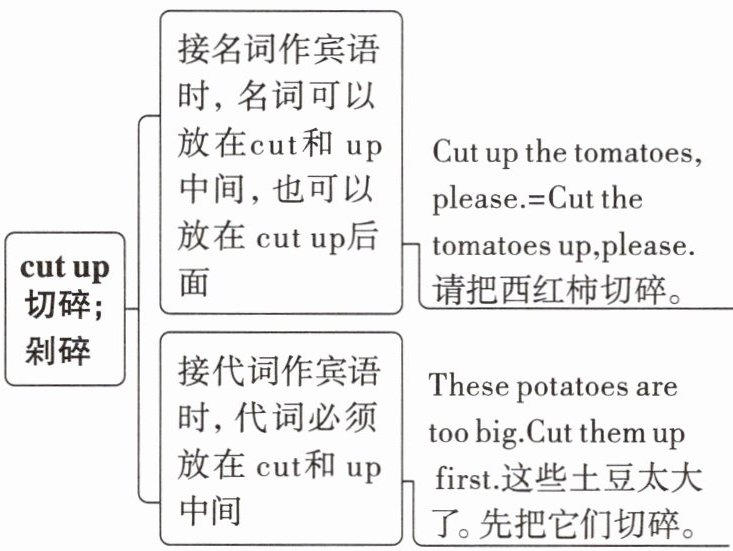
| cut up切碎;剁碎 | 接名词作宾语时,名词可以放在cut和up中间,也可以放在cut up后面 | Cut up the tomatoes, please.= Cut the tomatoes up,please. 请把西红柿切碎。 |
| | 接代词作宾语时,代词必须放在cut和up中间 | These potatoes are too big.Cut them up first.这些土豆太大了。先把它们切碎。 |
[知识拓展]
cut...in/into...意为“将……切成……”。
Peel three apples and then cut them into pieces. 把三个苹果削皮,然后切成块。
[情境应用]
1. Here is a banana. Please ____. We'll make a banana milk shake.
A. cut them up
B. cut up it
C. cut it up
D. cut up them
2. Try to ____ the peppers ____ small pieces. (将……切成……)
1. (
2.
| cut up切碎;剁碎 | 接名词作宾语时,名词可以放在cut和up中间,也可以放在cut up后面 | Cut up the tomatoes, please.= Cut the tomatoes up,please. 请把西红柿切碎。 |
| | 接代词作宾语时,代词必须放在cut和up中间 | These potatoes are too big.Cut them up first.这些土豆太大了。先把它们切碎。 |
[知识拓展]
cut...in/into...意为“将……切成……”。
Peel three apples and then cut them into pieces. 把三个苹果削皮,然后切成块。
[情境应用]
1. Here is a banana. Please ____. We'll make a banana milk shake.
A. cut them up
B. cut up it
C. cut it up
D. cut up them
2. Try to ____ the peppers ____ small pieces. (将……切成……)
1. (
C
)2.
cut;into
答案
1. C
2. cut;into
2. cut;into
解析
1. 题意为:这里有一根香蕉,请____。我们将会制作香蕉奶昔。
根据题意,需要把香蕉切碎,而且香蕉是单数,用it代替。根据cut up的用法,接名词作宾语时,名词可以放在cut和up中间,也可以放在cut up后面,接代词作宾语时,代词必须放在cut和up中间,所以用cut it up。
选项A表示“切碎它们”,代词为复数。选项B表示“切碎它”,代词位置错误。选项D表示“切碎它们”,代词为复数且位置错误。
故第一题应选C. cut it up。
2. 题意为“尝试将辣椒切成小片。”
根据题意,且根据“cut...into”意为“将……切成……”,to后面接动词原形,构成短语“try to do sth”。
故第二题应填cut;into。
根据题意,需要把香蕉切碎,而且香蕉是单数,用it代替。根据cut up的用法,接名词作宾语时,名词可以放在cut和up中间,也可以放在cut up后面,接代词作宾语时,代词必须放在cut和up中间,所以用cut it up。
选项A表示“切碎它们”,代词为复数。选项B表示“切碎它”,代词位置错误。选项D表示“切碎它们”,代词为复数且位置错误。
故第一题应选C. cut it up。
2. 题意为“尝试将辣椒切成小片。”
根据题意,且根据“cut...into”意为“将……切成……”,to后面接动词原形,构成短语“try to do sth”。
故第二题应填cut;into。
探究点2 mix的用法
| mix | 作动词,意为“(使)混合;融合;调配” | Oil and water do not mix. 油和水不相融。 |
| | mix...with...表示“(使)……和……融合” | What happens when you mix eggs with water? 你混合水和鸡蛋的时候会发生什么呢? |
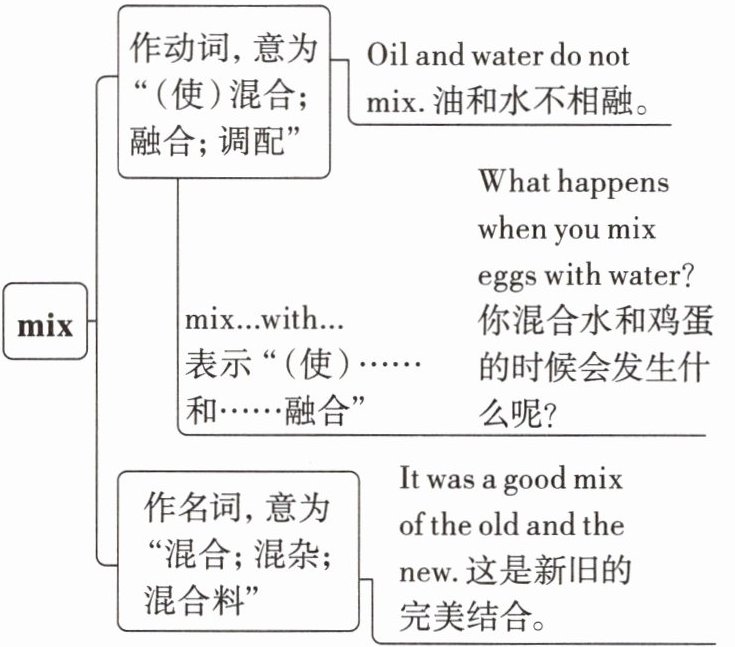
| | 作名词,意为“混合;混杂;混合料” | It was a good mix of the old and the new. 这是新旧的完美结合。 |
[情境应用]
1. If you
2. My mum always
| mix | 作动词,意为“(使)混合;融合;调配” | Oil and water do not mix. 油和水不相融。 |
| | mix...with...表示“(使)……和……融合” | What happens when you mix eggs with water? 你混合水和鸡蛋的时候会发生什么呢? |
| | 作名词,意为“混合;混杂;混合料” | It was a good mix of the old and the new. 这是新旧的完美结合。 |
[情境应用]
1. If you
mix
blue and yellow, you will get green. (mix)2. My mum always
mixes
honey with
warm water for me to drink. (把……和……混合)答案
1. mix 2. mixes; with
解析
1. 句子为if引导的条件状语从句,遵循“主将从现”原则,从句主语为you,谓语动词用原形mix。2. “把……和……混合”对应短语mix...with...,主语My mum为第三人称单数,一般现在时中谓语动词mix用第三人称单数形式mixes。
判断每组单词中画线部分的发音是否相同,相同的写“S”,不同的写“D”
1. go—no(
2. boat—coat(
3. house—soup(
4. snow—cow(
5. hear—bear(
6. sky—ask(
7. school—chair(
8. air—hair(
9. sure—pure(
10. star—fast(
1. go—no(
S
)2. boat—coat(
S
)3. house—soup(
D
)4. snow—cow(
D
)5. hear—bear(
D
)6. sky—ask(
S
)7. school—chair(
D
)8. air—hair(
S
)9. sure—pure(
S
)10. star—fast(
S
)答案
S S D D D S D S S S
解析
1.go(/ɡəʊ/)与no(/nəʊ/)画线部分"o"均发/əʊ/,相同;2.boat(/bəʊt/)与coat(/kəʊt/)画线部分"oa"均发/əʊ/,相同;3.house(/haʊs/)画线"ou"发/aʊ/,soup(/suːp/)画线"ou"发/uː/,不同;4.snow(/snəʊ/)画线"ow"发/əʊ/,cow(/kaʊ/)画线"ow"发/aʊ/,不同;5.hear(/hɪə(r)/)画线"ear"发/ɪə/,bear(/beə(r)/)画线"ear"发/eə/,不同;6.sky(/skaɪ/)与ask(/ɑːsk/)画线"sk"均发/sk/,相同;7.school(/skuːl/)画线"ch"发/k/,chair(/tʃeə(r)/)画线"ch"发/tʃ/,不同;8.air(/eə(r)/)与hair(/heə(r)/)画线"air"均发/eə/,相同;9.sure(/ʃʊə(r)/)与pure(/pjʊə(r)/)画线"ure"均发/ʊə/,相同;10.star(/stɑː(r)/)与fast(/fɑːst/)画线"st"均发/st/,相同。
Ⅰ. 根据句意,用括号中所给词的适当形式填空
1. When water
2. You need two
3. Shake(摇动) the bottle well so that the milk
4. After finishing reading the book Who Moved My
5. How do we
6. My mother
7. Do you want some
8. —How much are these
—They're ten yuan.
9. We have chicken, fish and
1. When water
boils
, it will change into steam(水蒸气). (boil)2. You need two
tablespoons
of honey for the first step. (tablespoon)3. Shake(摇动) the bottle well so that the milk
mixes
with the tea. (mix)4. After finishing reading the book Who Moved My
cheese
, I realize the importance of changing. (cheese)5. How do we
make
chicken soup? (make)6. My mother
baked
a cake for me last Sunday. (bake)7. Do you want some
pepper
in your soup? (pepper)8. —How much are these
tomatoes
? (tomato)—They're ten yuan.
9. We have chicken, fish and
mashed
potatoes for dinner. (mash)答案
1. boils 2. tablespoons 3. mixes 4. cheese 5. make 6. baked 7. pepper 8. tomatoes 9. mashed
解析
1. 主语water是不可数名词,时态为一般现在时,谓语动词用第三人称单数形式boils。
2. 基数词two后接可数名词复数,tablespoon的复数是tablespoons。
3. so that引导目的状语从句,主句是祈使句,从句常用一般现在时,主语milk是不可数名词,谓语用第三人称单数mixes。
4. 《谁动了我的奶酪》是书名,“奶酪”用cheese,不可数名词。
5. 助动词do后接动词原形make。
6. 时间状语last Sunday表明用一般过去时,bake的过去式是baked。
7. pepper“胡椒粉”是不可数名词,some后接不可数名词原形。
8. these后接可数名词复数,tomato的复数是tomatoes。
9. mashed potatoes“土豆泥”,是固定搭配,用过去分词作定语。
2. 基数词two后接可数名词复数,tablespoon的复数是tablespoons。
3. so that引导目的状语从句,主句是祈使句,从句常用一般现在时,主语milk是不可数名词,谓语用第三人称单数mixes。
4. 《谁动了我的奶酪》是书名,“奶酪”用cheese,不可数名词。
5. 助动词do后接动词原形make。
6. 时间状语last Sunday表明用一般过去时,bake的过去式是baked。
7. pepper“胡椒粉”是不可数名词,some后接不可数名词原形。
8. these后接可数名词复数,tomato的复数是tomatoes。
9. mashed potatoes“土豆泥”,是固定搭配,用过去分词作定语。
