

 登录
登录
(续表)
对比维度 | 现在完成时
Present Perfect Tense | 一般过去时
Simple Past Tense
--- | --- | ---
时间状语 | ①for: 表示一段时间,意思是“已经有……”,通常位于句末。
Richard has been in Canada for six months.
(Richard已经在加拿大待了6个月了。)
for后面常接的时间状语:
three days, ten minutes,
an hour, two hours,
a week, four weeks,
a month, six months,
five years, a long time等。
②since: 表示自从过去的一个时间点开始,意思是“自从……开始”,通常位于句末或句首。
Richard has been in Canada since January.
(Richard自从一月份开始就已经在加拿大了。)
since后面常接的时间状语:
Monday, Wednesday,
9 o'clock, 12:30,
24 July, Christmas,
January, I was ten years old,
1985, we arrived等。
③just: 表示短暂时间之前(a short time ago),意思是“刚刚……”,位于助动词have / has和过去分词中间,多用于肯定句。
I have just had dinner.(我刚刚吃过饭。)
④already: 表示在预期之前已经完成(sooner than expected),意思是“已经……”,位于助动词have / has和过去分词中间,多用于肯定句。
a: What time are Laura and Paul coming?
b: They have already arrived.
(a: Laura和Paul什么时间来?b:他们已经到了。)
⑤yet: 表示直到现在(until now),在否定句中的意思是“仍、尚、还”,在疑问句中强调是否已经发生,通常位于句末,多用于否定句和疑问句。
I haven't told him yet.(我还没告诉他。)
Has Nicola started her new job yet?
(Nicola已经开始她的新工作了吗?)
⑥ever: 表示曾经怎样,位于过去分词,多用于疑问句中。
Have you ever played golf?(你曾经打过高尔夫吗?)
⑦never: 表示从来没有,有否定含义,位于助动词have / has和过去分词中间。
My sister has never travelled by plane.
(我姐姐从来没有坐过飞机。) | ①ago: 表示现在、此时此刻之前的时间,意思是“之前”,通常位于句末。
She arrived in Canada six days ago.
(她6天前来的加拿大。)
②yesterday: 表示“昨天”,通常位于句首或句末。
I cleaned my face yesterday.
(我昨天洗脸了。)
Yesterday it rained all morning.
(昨天整个早上都在下雨。)
③last night: 表示“昨晚”,通常位于句首或句末。
We enjoyed the party last night.
(昨晚我们在聚会上玩得很开心。)
④this morning: 表示“今早”,通常位于句首或句末。
This morning I got up at 9 o'clock.
(我今早9点起床。)
⑤last week: 表示“上周”,通常位于句首或句末。
She lost her keys last week.
(她上周把钥匙弄丢了。)
(续表)
对比维度 | 现在完成时
Present Perfect Tense | 一般过去时
Simple Past Tense
特殊疑问句 | —How long has she been in Ireland?
—She has been in Ireland for three days. | —When did Helen arrive in Ireland?
—She arrived in Ireland three days ago.
特殊强调 | ①gone和been的用法
Ben has gone to Spain. (He is in Spain now.)
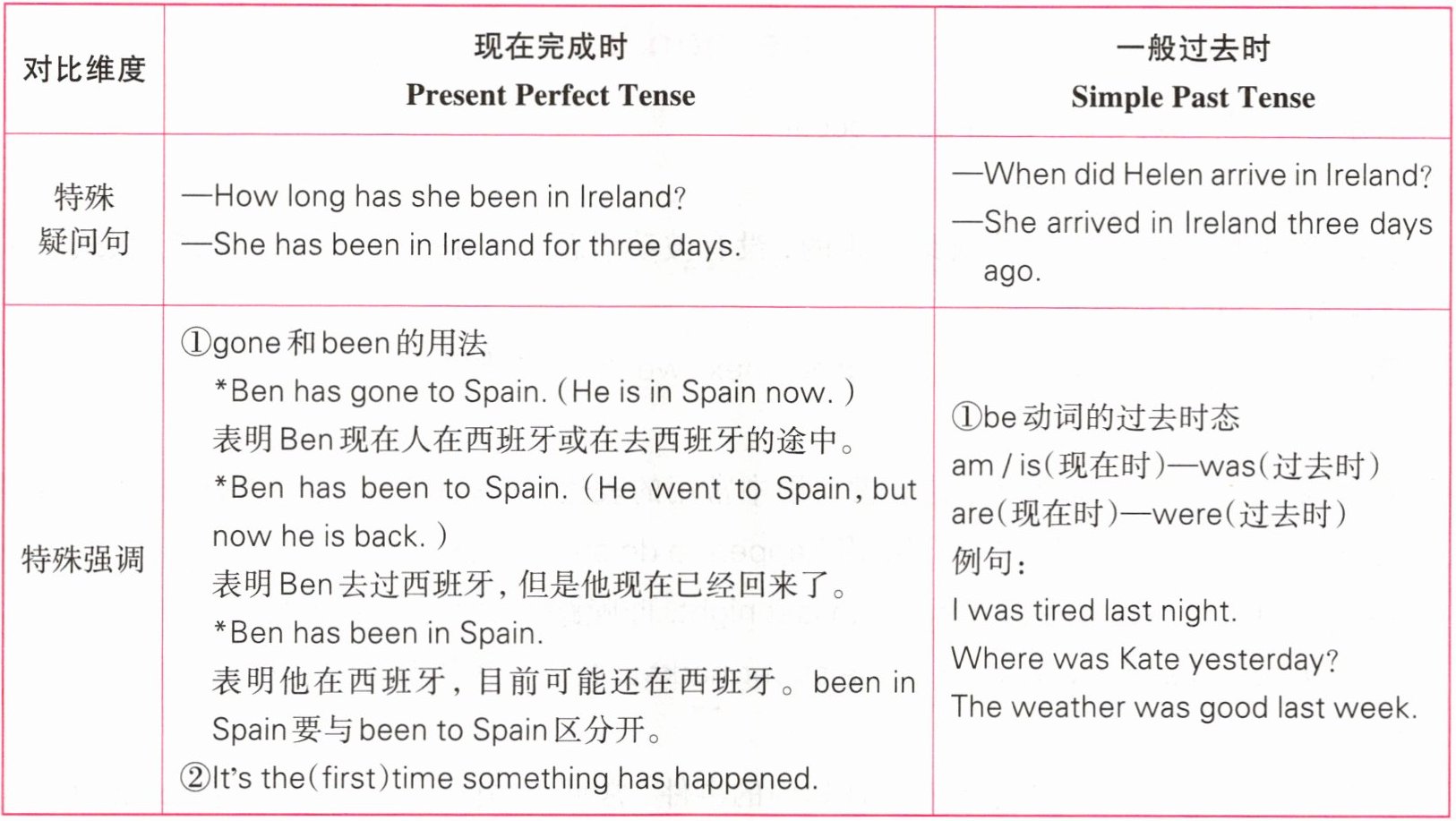 表明Ben现在人在西班牙或在去西班牙的途中。
Ben has been to Spain. (He went to Spain, but now he is back.)
表明Ben去过西班牙,但是他现在已经回来了。
Ben has been in Spain.
表明他在西班牙,目前可能还在西班牙。been in Spain要与been to Spain区分开。
②It's the(first)time something has happened. | ①be动词的过去时态
am / is(现在时)—was(过去时)
are(现在时)—were(过去时)
例句:
I was tired last night.
Where was Kate yesterday?
The weather was good last week.
【即学即练】用括号内动词的正确形式(现在完成时或一般过去时)填空。
(1)She
(2)I
(3)They
(4)Tom
(5)How long
(6)My brother
(7)I
(8)She
(9)They
(10)How long
对比维度 | 现在完成时
Present Perfect Tense | 一般过去时
Simple Past Tense
--- | --- | ---
时间状语 | ①for: 表示一段时间,意思是“已经有……”,通常位于句末。
Richard has been in Canada for six months.
(Richard已经在加拿大待了6个月了。)
for后面常接的时间状语:
three days, ten minutes,
an hour, two hours,
a week, four weeks,
a month, six months,
five years, a long time等。
②since: 表示自从过去的一个时间点开始,意思是“自从……开始”,通常位于句末或句首。
Richard has been in Canada since January.
(Richard自从一月份开始就已经在加拿大了。)
since后面常接的时间状语:
Monday, Wednesday,
9 o'clock, 12:30,
24 July, Christmas,
January, I was ten years old,
1985, we arrived等。
③just: 表示短暂时间之前(a short time ago),意思是“刚刚……”,位于助动词have / has和过去分词中间,多用于肯定句。
I have just had dinner.(我刚刚吃过饭。)
④already: 表示在预期之前已经完成(sooner than expected),意思是“已经……”,位于助动词have / has和过去分词中间,多用于肯定句。
a: What time are Laura and Paul coming?
b: They have already arrived.
(a: Laura和Paul什么时间来?b:他们已经到了。)
⑤yet: 表示直到现在(until now),在否定句中的意思是“仍、尚、还”,在疑问句中强调是否已经发生,通常位于句末,多用于否定句和疑问句。
I haven't told him yet.(我还没告诉他。)
Has Nicola started her new job yet?
(Nicola已经开始她的新工作了吗?)
⑥ever: 表示曾经怎样,位于过去分词,多用于疑问句中。
Have you ever played golf?(你曾经打过高尔夫吗?)
⑦never: 表示从来没有,有否定含义,位于助动词have / has和过去分词中间。
My sister has never travelled by plane.
(我姐姐从来没有坐过飞机。) | ①ago: 表示现在、此时此刻之前的时间,意思是“之前”,通常位于句末。
She arrived in Canada six days ago.
(她6天前来的加拿大。)
②yesterday: 表示“昨天”,通常位于句首或句末。
I cleaned my face yesterday.
(我昨天洗脸了。)
Yesterday it rained all morning.
(昨天整个早上都在下雨。)
③last night: 表示“昨晚”,通常位于句首或句末。
We enjoyed the party last night.
(昨晚我们在聚会上玩得很开心。)
④this morning: 表示“今早”,通常位于句首或句末。
This morning I got up at 9 o'clock.
(我今早9点起床。)
⑤last week: 表示“上周”,通常位于句首或句末。
She lost her keys last week.
(她上周把钥匙弄丢了。)
(续表)
对比维度 | 现在完成时
Present Perfect Tense | 一般过去时
Simple Past Tense
特殊疑问句 | —How long has she been in Ireland?
—She has been in Ireland for three days. | —When did Helen arrive in Ireland?
—She arrived in Ireland three days ago.
特殊强调 | ①gone和been的用法
Ben has gone to Spain. (He is in Spain now.)
表明Ben现在人在西班牙或在去西班牙的途中。Ben has been to Spain. (He went to Spain, but now he is back.)
表明Ben去过西班牙,但是他现在已经回来了。
Ben has been in Spain.
表明他在西班牙,目前可能还在西班牙。been in Spain要与been to Spain区分开。
②It's the(first)time something has happened. | ①be动词的过去时态
am / is(现在时)—was(过去时)
are(现在时)—were(过去时)
例句:
I was tired last night.
Where was Kate yesterday?
The weather was good last week.
【即学即练】用括号内动词的正确形式(现在完成时或一般过去时)填空。
(1)She
finished
(finish) her homework an hour ago.(2)I
have never visited
(never, visit) the Great Wall before.(3)They
have lived
(live) in Beijing since 2010.(4)Tom
broke
(break) his leg last week.(5)How long
have
you known
(know) your best friend?(6)My brother
broke
(break) his phone yesterday.(7)I
haven’t finished
(not finish) my project yet.(8)She
has lived
(live) in Shanghai for five years.(9)They
visited
(visit) the museum last weekend.(10)How long
have
you studied
(study) English?答案
1.finished
2.have never visited
3.have lived
4.broke
5.have; known
6.broke
7.haven’t finished
8.has lived
9.visited
10.have; studied
2.have never visited
3.have lived
4.broke
5.have; known
6.broke
7.haven’t finished
8.has lived
9.visited
10.have; studied
解析
【分析】
这道题考查一般过去时和现在完成时的辨析,解题思路是:根据句子中的时间状语判断时态——若时间状语是过去的具体时间点(如an hour ago、last week等),用一般过去时;若时间状语是for/since引导的时间段,或never、yet、how long等,用现在完成时,再结合主语和动词变形规则确定答案。
【解析】
1. 时间状语an hour ago(一小时前)是过去具体时间,用一般过去时,finish的过去式为finished,故填finished。
2. 时间状语never before(之前从未)是现在完成时标志,主语为I,结构为have+过去分词,故填have never visited。
3. 时间状语since 2010(自从2010年)是现在完成时标志,主语为they,结构为have+过去分词,故填have lived。
4. 时间状语last week(上周)是过去具体时间,用一般过去时,break的过去式为broke,故填broke。
5. How long(多久)是现在完成时标志,特殊疑问句结构为have+主语+过去分词,主语为you,故填have; known。
6. 时间状语yesterday(昨天)是过去具体时间,用一般过去时,break的过去式为broke,故填broke。
7. 时间状语yet(尚未)是现在完成时否定句标志,主语为I,结构为haven’t+过去分词,故填haven’t finished。
8. 时间状语for five years(五年)是现在完成时标志,主语为she,结构为has+过去分词,故填has lived。
9. 时间状语last weekend(上周末)是过去具体时间,用一般过去时,visit的过去式为visited,故填visited。
10. How long(多久)是现在完成时标志,特殊疑问句结构为have+主语+过去分词,主语为you,故填have; studied。
【答案】
1.finished 2.have never visited 3.have lived 4.broke 5.have; known 6.broke 7.haven’t finished 8.has lived 9.visited 10.have; studied
【知识点】
一般过去时、现在完成时
【点评】
本题是英语时态基础练习题,核心考查一般过去时与现在完成时的时态区分,关键在于准确识别时间状语对应的时态标志,是掌握英语时态的基础题型。
【难度系数】
0.3
这道题考查一般过去时和现在完成时的辨析,解题思路是:根据句子中的时间状语判断时态——若时间状语是过去的具体时间点(如an hour ago、last week等),用一般过去时;若时间状语是for/since引导的时间段,或never、yet、how long等,用现在完成时,再结合主语和动词变形规则确定答案。
【解析】
1. 时间状语an hour ago(一小时前)是过去具体时间,用一般过去时,finish的过去式为finished,故填finished。
2. 时间状语never before(之前从未)是现在完成时标志,主语为I,结构为have+过去分词,故填have never visited。
3. 时间状语since 2010(自从2010年)是现在完成时标志,主语为they,结构为have+过去分词,故填have lived。
4. 时间状语last week(上周)是过去具体时间,用一般过去时,break的过去式为broke,故填broke。
5. How long(多久)是现在完成时标志,特殊疑问句结构为have+主语+过去分词,主语为you,故填have; known。
6. 时间状语yesterday(昨天)是过去具体时间,用一般过去时,break的过去式为broke,故填broke。
7. 时间状语yet(尚未)是现在完成时否定句标志,主语为I,结构为haven’t+过去分词,故填haven’t finished。
8. 时间状语for five years(五年)是现在完成时标志,主语为she,结构为has+过去分词,故填has lived。
9. 时间状语last weekend(上周末)是过去具体时间,用一般过去时,visit的过去式为visited,故填visited。
10. How long(多久)是现在完成时标志,特殊疑问句结构为have+主语+过去分词,主语为you,故填have; studied。
【答案】
1.finished 2.have never visited 3.have lived 4.broke 5.have; known 6.broke 7.haven’t finished 8.has lived 9.visited 10.have; studied
【知识点】
一般过去时、现在完成时
【点评】
本题是英语时态基础练习题,核心考查一般过去时与现在完成时的时态区分,关键在于准确识别时间状语对应的时态标志,是掌握英语时态的基础题型。
【难度系数】
0.3
