

 登录
登录
3 Read a biographical story. 阅读一篇人物传记故事。
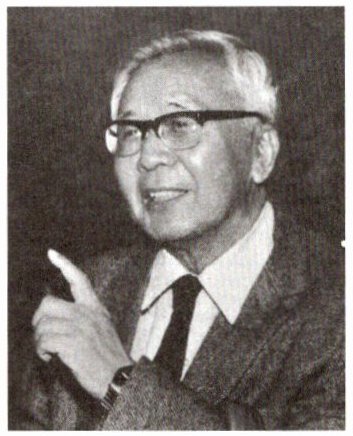
Hua Luogeng: A mathematician’s journey
Hua Luogeng was born on 12 November 1910, into a poor family in Jintan, Jiangsu province. After finishing junior high school, he went to a vocational (职业技术的) school in Shanghai but had to drop out because his family couldn’t afford the fees. He returned home to help his father run a grocery store.
By his late teens, Hua Luogeng had developed a strong interest in maths. Tragically, he got typhoid fever (伤寒热) when he was 19. The illness made his left leg disabled forever. But Hua Luogeng’s passion for maths never went away. Despite poverty and disability, he kept studying — even during long, tiring days at his father’s store. Over the next five years, he taught himself all the maths lessons from high school to early university level. The hard work laid a solid foundation for his future academic pursuits.
In 1930, his paper caught the attention of mathematician Xiong Qinglai, who helped him secure a position at Tsinghua University
in 1931. He began as a library assistant — a rare opportunity for someone without a formal degree. At Tsinghua, with abundant study resources and a good academic environment, he focused on maths research. His talent was so evident that he was quickly promoted to teaching assistant in 1933 and became a lecturer in 1935. In 1938, he was appointed professor at the National Southwestern Associated University.
From the age of 31, Hua made great contributions to maths, publishing an influential book on number theory and winning the First Prize of China’s 1956 National Natural Science Award. In the 1960s, he travelled nationwide to teach practical maths to factory workers.
In 1982, he made history by becoming the first Chinese scientist to be elected as a Foreign Associate of the US National Academy of Sciences. His work has significantly contributed to the development of maths worldwide, and his inspiring life story continues to motivate (激励) people facing challenges.
3-1 Put the following Hua Luogeng’s major life events A to D in the correct order. 将下列华罗庚的人生重大事件按正确的顺序排列,填写序号(A-D)。
A. He was elected as a Foreign Associate of the US National Academy of Sciences.
B. He dropped out of vocational school and helped run a grocery store.
C. He won a top national science prize in China.
D. He became a library assistant at Tsinghua University.
3-2 Complete the table with details about Hua Luogeng’s life. Write no more than three words for each blank. 填写有关华罗庚生平的表格,每空格最多三词。
| Category | Details |
| --- | --- |
| Family background and early life | • Hua Luogeng was born on (1)
• He only finished junior high school.
• He had to (2)
| Late-teen experience | • He had typhoid fever, which made his left leg (3)
• He (4)
| A rapid rise in academic career | • In 1930, his paper was noticed by Xiong Qinglai.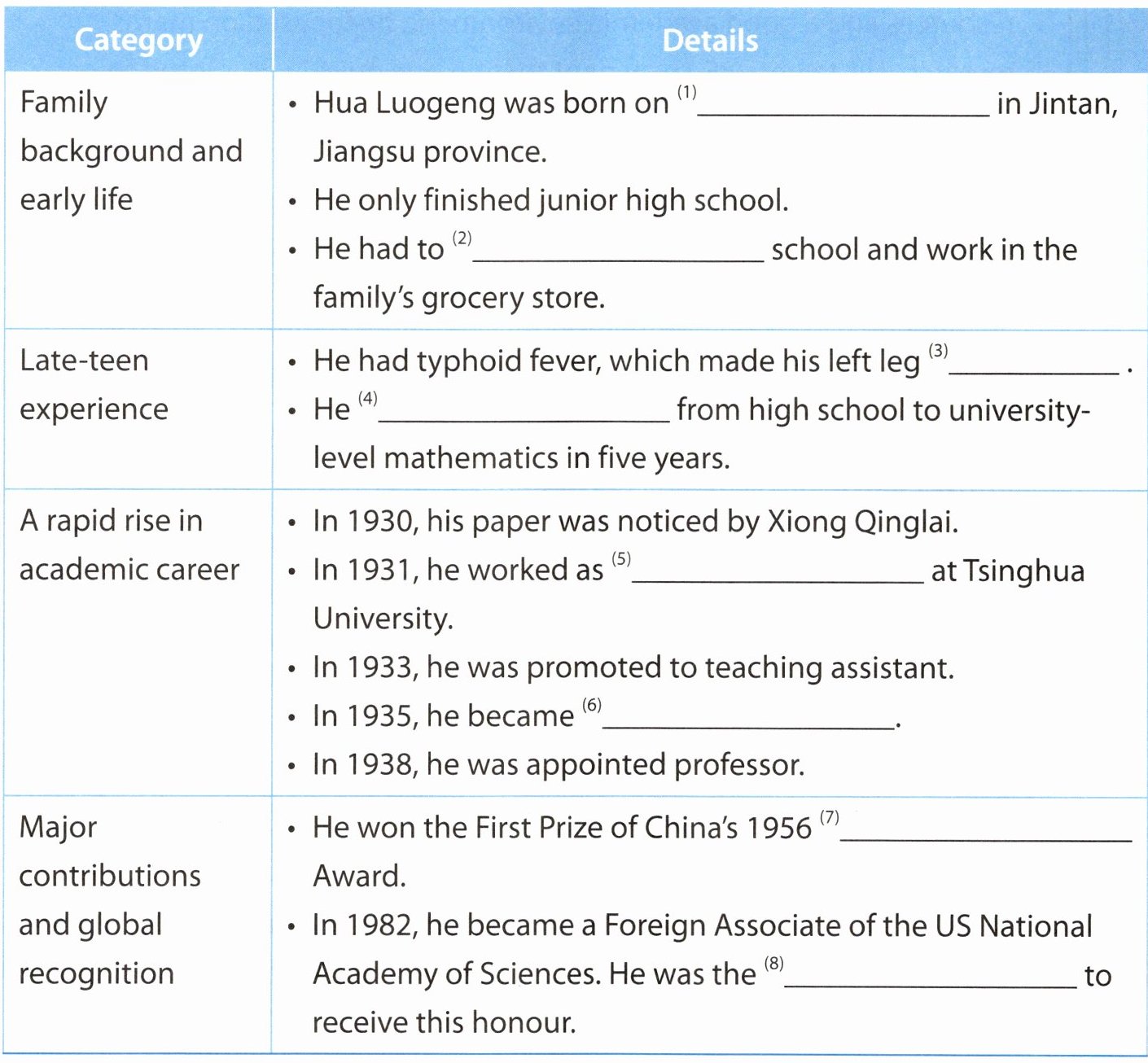
• In 1931, he worked as (5)
• In 1933, he was promoted to teaching assistant.
• In 1935, he became (6)
• In 1938, he was appointed professor. |
| Major contributions and global recognition | • He won the First Prize of China’s 1956 (7)
• In 1982, he became a Foreign Associate of the US National Academy of Sciences. He was the (8)
3-3 Answer the questions. 回答问题。
(1) What kept Hua Luogeng working on maths research despite being poor and disabled?
(2) Hua Luogeng promoted using maths in real life. Why do you think it was important for Hua Luogeng to teach maths directly to factory workers?
Hua Luogeng: A mathematician’s journey
Hua Luogeng was born on 12 November 1910, into a poor family in Jintan, Jiangsu province. After finishing junior high school, he went to a vocational (职业技术的) school in Shanghai but had to drop out because his family couldn’t afford the fees. He returned home to help his father run a grocery store.
By his late teens, Hua Luogeng had developed a strong interest in maths. Tragically, he got typhoid fever (伤寒热) when he was 19. The illness made his left leg disabled forever. But Hua Luogeng’s passion for maths never went away. Despite poverty and disability, he kept studying — even during long, tiring days at his father’s store. Over the next five years, he taught himself all the maths lessons from high school to early university level. The hard work laid a solid foundation for his future academic pursuits.
In 1930, his paper caught the attention of mathematician Xiong Qinglai, who helped him secure a position at Tsinghua University
in 1931. He began as a library assistant — a rare opportunity for someone without a formal degree. At Tsinghua, with abundant study resources and a good academic environment, he focused on maths research. His talent was so evident that he was quickly promoted to teaching assistant in 1933 and became a lecturer in 1935. In 1938, he was appointed professor at the National Southwestern Associated University.
From the age of 31, Hua made great contributions to maths, publishing an influential book on number theory and winning the First Prize of China’s 1956 National Natural Science Award. In the 1960s, he travelled nationwide to teach practical maths to factory workers.
In 1982, he made history by becoming the first Chinese scientist to be elected as a Foreign Associate of the US National Academy of Sciences. His work has significantly contributed to the development of maths worldwide, and his inspiring life story continues to motivate (激励) people facing challenges.
3-1 Put the following Hua Luogeng’s major life events A to D in the correct order. 将下列华罗庚的人生重大事件按正确的顺序排列,填写序号(A-D)。
A. He was elected as a Foreign Associate of the US National Academy of Sciences.
B. He dropped out of vocational school and helped run a grocery store.
C. He won a top national science prize in China.
D. He became a library assistant at Tsinghua University.
B
→ D
→ C
→ A
3-2 Complete the table with details about Hua Luogeng’s life. Write no more than three words for each blank. 填写有关华罗庚生平的表格,每空格最多三词。
| Category | Details |
| --- | --- |
| Family background and early life | • Hua Luogeng was born on (1)
12 November 1910
in Jintan, Jiangsu province.• He only finished junior high school.
• He had to (2)
drop out of/leave
school and work in the family’s grocery store. || Late-teen experience | • He had typhoid fever, which made his left leg (3)
disabled forever
.• He (4)
taught himself/learned by himself
from high school to university-level mathematics in five years. || A rapid rise in academic career | • In 1930, his paper was noticed by Xiong Qinglai.
• In 1931, he worked as (5)
a library assistant
at Tsinghua University.• In 1933, he was promoted to teaching assistant.
• In 1935, he became (6)
a lecturer
.• In 1938, he was appointed professor. |
| Major contributions and global recognition | • He won the First Prize of China’s 1956 (7)
National Natural Science
Award.• In 1982, he became a Foreign Associate of the US National Academy of Sciences. He was the (8)
first Chinese scientist
to receive this honour. |3-3 Answer the questions. 回答问题。
(1) What kept Hua Luogeng working on maths research despite being poor and disabled?
His strong interest in/passion/deep love of maths.
(2) Hua Luogeng promoted using maths in real life. Why do you think it was important for Hua Luogeng to teach maths directly to factory workers?
First, it helped factory workers solve practical production problems, turning maths into a tool for efficiency.
Second, it inspired them to learn new skills — just like Hua Luogeng never gave up.
答案
3-1B → D → C → A
3-2(1) 12 November 1910 (2) drop out of/leave (3) disabled forever (4) taught himself/learned by himself (5) a library assistant (6) a lecturer (7) National Natural Science (8) first Chinese scientist
3-3(Answers may vary.)
(1) His strong interest in/passion/deep love of maths.
(2) First, it helped factory workers solve practical production problems, turning maths into a tool for efficiency. Second, it inspired them to learn new skills — just like Hua Luogeng never gave up.
3-2(1) 12 November 1910 (2) drop out of/leave (3) disabled forever (4) taught himself/learned by himself (5) a library assistant (6) a lecturer (7) National Natural Science (8) first Chinese scientist
3-3(Answers may vary.)
(1) His strong interest in/passion/deep love of maths.
(2) First, it helped factory workers solve practical production problems, turning maths into a tool for efficiency. Second, it inspired them to learn new skills — just like Hua Luogeng never gave up.
解析
【分析】
本题为英语传记类阅读理解题,分为事件排序、细节填空、开放问答三类小题。解题思路如下:
1. 3-1事件排序:需定位每个选项对应原文的时间节点,梳理华罗庚人生事件的先后顺序;
2. 3-2细节填空:需从原文中找到对应空格的具体信息,严格控制每空不超过三个词;
3. 3-3开放问答:需结合原文内容,围绕问题核心(如坚持数学的原因、教工人数学的意义)合理组织语言作答。
【解析】
3-1:先定位各事件时间:B(辍学回家)对应第一段,是最早事件;D(清华图书馆助理)对应1931年,在B之后;C(1956年获国家自然科学一等奖)在D之后;A(1982年当选外籍院士)是最晚事件,故顺序为B→D→C→A。
3-2:逐一对应原文细节:
(1) 原文明确“born on 12 November 1910”,故填对应内容;
(2) 原文“had to drop out because his family couldn’t afford the fees”,故填对应短语;
(3) 原文“The illness made his left leg disabled forever”,故填对应内容;
(4) 原文“he taught himself all the maths lessons from high school to early university level”,故填对应短语;
(5) 原文“he began as a library assistant”,故填对应内容;
(6) 原文“became a lecturer in 1935”,故填对应内容;
(7) 原文“winning the First Prize of China’s 1956 National Natural Science Award”,故填对应内容;
(8) 原文“becoming the first Chinese scientist to be elected as...”,故填对应内容。
3-3:
(1) 原文“But Hua Luogeng’s passion for maths never went away”,提取核心原因作答;
(2) 结合原文“teach practical maths to factory workers”,从解决实际问题、激励他人两方面组织语言。
【答案】
3-1 B → D → C → A
3-2 (1) 12 November 1910 (2) drop out of (3) disabled forever (4) taught himself (5) a library assistant (6) a lecturer (7) National Natural Science (8) first Chinese scientist
3-3 (1) His strong interest in maths. (2) It helped factory workers solve practical production problems and inspired them to learn new skills.
【知识点】
英语阅读理解、传记类文本细节查找、信息排序
【点评】
本题围绕华罗庚的传记展开,考查学生对文本细节的定位能力、时间线梳理能力及开放问题的作答能力,题型贴合初中英语阅读的常见考查形式,注重基础与应用结合。
【难度系数】
0.7
本题为英语传记类阅读理解题,分为事件排序、细节填空、开放问答三类小题。解题思路如下:
1. 3-1事件排序:需定位每个选项对应原文的时间节点,梳理华罗庚人生事件的先后顺序;
2. 3-2细节填空:需从原文中找到对应空格的具体信息,严格控制每空不超过三个词;
3. 3-3开放问答:需结合原文内容,围绕问题核心(如坚持数学的原因、教工人数学的意义)合理组织语言作答。
【解析】
3-1:先定位各事件时间:B(辍学回家)对应第一段,是最早事件;D(清华图书馆助理)对应1931年,在B之后;C(1956年获国家自然科学一等奖)在D之后;A(1982年当选外籍院士)是最晚事件,故顺序为B→D→C→A。
3-2:逐一对应原文细节:
(1) 原文明确“born on 12 November 1910”,故填对应内容;
(2) 原文“had to drop out because his family couldn’t afford the fees”,故填对应短语;
(3) 原文“The illness made his left leg disabled forever”,故填对应内容;
(4) 原文“he taught himself all the maths lessons from high school to early university level”,故填对应短语;
(5) 原文“he began as a library assistant”,故填对应内容;
(6) 原文“became a lecturer in 1935”,故填对应内容;
(7) 原文“winning the First Prize of China’s 1956 National Natural Science Award”,故填对应内容;
(8) 原文“becoming the first Chinese scientist to be elected as...”,故填对应内容。
3-3:
(1) 原文“But Hua Luogeng’s passion for maths never went away”,提取核心原因作答;
(2) 结合原文“teach practical maths to factory workers”,从解决实际问题、激励他人两方面组织语言。
【答案】
3-1 B → D → C → A
3-2 (1) 12 November 1910 (2) drop out of (3) disabled forever (4) taught himself (5) a library assistant (6) a lecturer (7) National Natural Science (8) first Chinese scientist
3-3 (1) His strong interest in maths. (2) It helped factory workers solve practical production problems and inspired them to learn new skills.
【知识点】
英语阅读理解、传记类文本细节查找、信息排序
【点评】
本题围绕华罗庚的传记展开,考查学生对文本细节的定位能力、时间线梳理能力及开放问题的作答能力,题型贴合初中英语阅读的常见考查形式,注重基础与应用结合。
【难度系数】
0.7
