

 登录
登录
【基础篇】
A.假如你将应对一次台风、地震或洪水,请你设计一份家庭应急包清单,用英文标注物品名称及其用途,可以搭配简单的图标辅助。
| Things | Use | Picture |
|--------------|--------------------------------------|---------|
| Bottled water| provide clean water for three days | (水瓶图) |
| Flashlight | provide light when there is no electricity |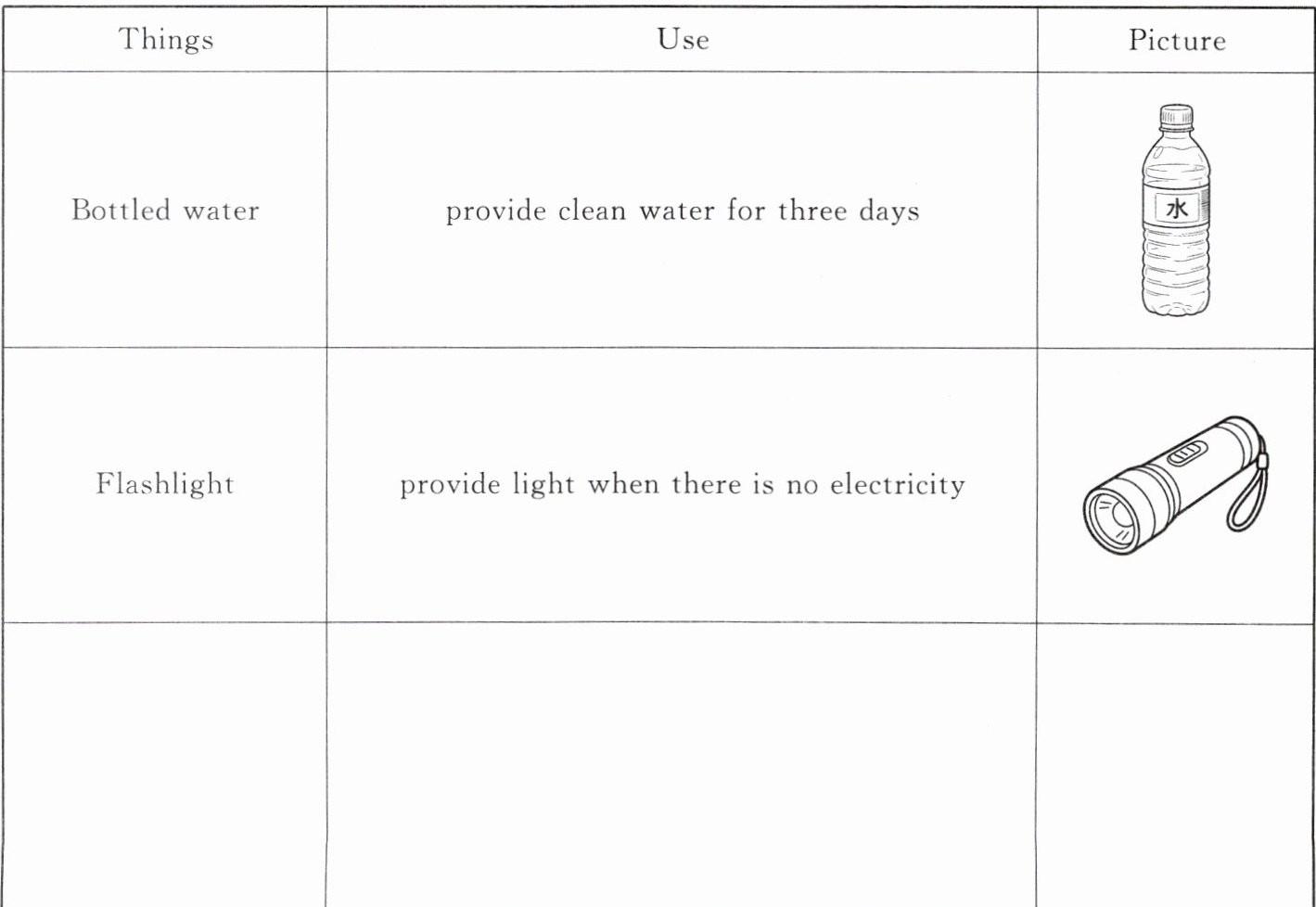 |
|
| | | |
B.了解一些关于自然灾害的信息。
Here are five facts about natural disasters—simple and easy to understand for beginner learners.
Tornadoes can reach speeds of over 300 miles per hour, about 480 kilometres per hour! They are one of the most terrifying natural disasters, with a narrow but destructive path. Tornadoes often form during thunderstorms, and their funnel-shaped clouds can touch the ground for just a few minutes or up to an hour, sweeping away everything in their way.
Earthquakes can occur on every continent—yes, even Antarctica! Although they are most common in "earthquake zones" like the Pacific Ring of Fire, earthquakes can strike anywhere, from the bottom of the ocean to high mountain peaks. The smallest earthquakes are so mild that people can't feel them, but the strongest ones can shake entire cities and even cause the ground to crack.
Flash floods can occur with little or no warning. They are sudden, fast-moving floods usually caused by heavy rain that falls in a short time. Flash floods often happen in mountainous areas(where water flows down quickly) or crowded cities (where roads and buildings leave no space for rainwater to soak into the ground). They can rise in minutes, turning quiet streets into fast rivers.
Sandstorms(or dust storms) are strong winds that pick up huge amounts of sand or dust and carry them across large areas. They are most common in dry regions like deserts. During a bad sandstorm, the wind can blow so hard that you can't see more than a few feet in front of you. Sandstorms can damage crops, cover houses with dust, and even make it hard to breathe.
Droughts are long periods of time with little or no rain. Unlike other natural disasters that happen suddenly, droughts can last for months or even years. They can dry up rivers and lakes, kill crops, and make it hard for people and animals to find water. Droughts affect large areas—sometimes entire countries—and can lead to food shortages. Many places around the world are working on ways to save water to prepare for droughts.
A.假如你将应对一次台风、地震或洪水,请你设计一份家庭应急包清单,用英文标注物品名称及其用途,可以搭配简单的图标辅助。
| Things | Use | Picture |
|--------------|--------------------------------------|---------|
| Bottled water| provide clean water for three days | (水瓶图) |
| Flashlight | provide light when there is no electricity |
|| | | |
B.了解一些关于自然灾害的信息。
Here are five facts about natural disasters—simple and easy to understand for beginner learners.
Tornadoes can reach speeds of over 300 miles per hour, about 480 kilometres per hour! They are one of the most terrifying natural disasters, with a narrow but destructive path. Tornadoes often form during thunderstorms, and their funnel-shaped clouds can touch the ground for just a few minutes or up to an hour, sweeping away everything in their way.
Earthquakes can occur on every continent—yes, even Antarctica! Although they are most common in "earthquake zones" like the Pacific Ring of Fire, earthquakes can strike anywhere, from the bottom of the ocean to high mountain peaks. The smallest earthquakes are so mild that people can't feel them, but the strongest ones can shake entire cities and even cause the ground to crack.
Flash floods can occur with little or no warning. They are sudden, fast-moving floods usually caused by heavy rain that falls in a short time. Flash floods often happen in mountainous areas(where water flows down quickly) or crowded cities (where roads and buildings leave no space for rainwater to soak into the ground). They can rise in minutes, turning quiet streets into fast rivers.
Sandstorms(or dust storms) are strong winds that pick up huge amounts of sand or dust and carry them across large areas. They are most common in dry regions like deserts. During a bad sandstorm, the wind can blow so hard that you can't see more than a few feet in front of you. Sandstorms can damage crops, cover houses with dust, and even make it hard to breathe.
Droughts are long periods of time with little or no rain. Unlike other natural disasters that happen suddenly, droughts can last for months or even years. They can dry up rivers and lakes, kill crops, and make it hard for people and animals to find water. Droughts affect large areas—sometimes entire countries—and can lead to food shortages. Many places around the world are working on ways to save water to prepare for droughts.
答案
答案不唯一,合理即可。
