

 登录
B
Mars has fascinated humans since we first set eyes on it as a star-like object in the night sky. Over the last century, everything we've learned about Mars suggests that the planet was once quite capable of providing ecosystems(生态系统). Unfortunately, the planet is now covered by a thin carbon dioxide atmosphere and cannot support earthly life-forms. The soil contains compounds that would be harmful to life. Although water does exist on Mars, it's locked into the planet's icy polar caps and buried, perhaps a lot, under the Martian surface.
Since the 1960s, humans have sent dozens of spacecraft to study Mars. Early missions were flybys(近天体探测飞行), with spacecraft snapping photos as they travelled past rapidly. Later, probes pulled into orbit around Mars. More recently, landers and rovers have touched down on the surface. But the thin Martian atmosphere makes landing tricky, and more than 60 per cent of such tries have failed. Early highlights of Mars missions include NASA's Mariner 4 spacecraft, which captured the first close-up images of this foreign world in 1965. In 1971, the Soviet space programme sent the first spacecraft, Mars 3, into Martian orbit. It returned about eight months of observations about the planet's atmosphere, weather, and geology(地质状况). The mission also sent a lander to the surface, but it returned data for only about 20 seconds before going quiet. Over the following decades, orbiters returned far more detailed data on the planet's atmosphere and surface, and finally cleared the misunderstanding, widely held by scientists since the late 1800s, that Martian canals(运河) were built by an alien civilisation. They also uncovered some truly dramatic characteristics: the small world owns the largest volcanoes in the solar system, and one of the largest canyons(峡谷).
Once every 26 months, the Earth and Mars are lined up in a way that minimises travel time and expense, enabling spacecraft to make the interplanetary journey in about half a year. Now, three countries are sending spacecraft to Mars: The United Arab Emirates, China, and the United States. All of the robotic activity is, of course, laying the preparation work for sending humans over to the next world. NASA is targeting July 2035 as a reasonable time for sending a spacecraft, aiming to put the first
boots on Mars. Private spaceflight companies such as SpaceX are also getting into the Mars game. Soon, in one way or another, humanity may finally know whether our neighbouring planet ever hosted life—and whether there's a future for our species on another world.
6. Which of the following is a reason for the failure to host life on Mars according to the passage?
A. Carbon dioxide atmosphere wraps Mars.
B. There is no trace of water.
C. The soil is rich in compounds.
D. A thin toxic gas appears in the atmosphere.
7. The underlined word "tricky" can be replaced by "
A. dangerous
B. worrying
C. difficult
D. easy
8. What can we infer from Paragraph 2?
A. All the attempts of landing on Mars failed.
B. An alien civilisation built canals on Mars.
C. No other volcanoes in the universe are larger than those on Mars.
D. Efforts have been made to take a closer look at Mars over decades.
9. What is the current expectation for Mars exploration according to the passage?
A. NASA will send the first astronauts to Mars in 2035.
B. Astronauts will take a walk on Mars in the near future.
C. Private spaceflight companies will create a Mars game.
D. More countries will send spacecraft to Mars.
10. What might be the best time for a new attempt if NASA failed its launch to Mars in 2035?
A. In 2035.
B. In 2036.
C. In 2037.
D. In 2038.
中考趋势 Ⅳ.信息还原(每小题2分,共10分)
从方框中选出能填入空白处的最佳选项。选项中有两项多余。
Future astronauts could potentially depend on food made from bacteria(细菌) that feed on minor planet, to produce a kind of yogurt. While astronauts on the International Space Station have experimented(实验) with growing salad leaves, the vast majority of food consumed in space is transported from Earth. 1 That's why Joshua Pearce at Western University in Ontario, Canada, decided to try using bacteria to change carbon-containing(含碳的) materials from minor planets into eatable food.
This process has not been carried out yet on real minor planets. But Pearce's team has performed similar experiments using bacteria to break down plastic from leftover(残留废弃物) in army food supply bags. 2 The collective bacteria end up looking something like a brown milkshake and the team has also experimented with drying out this material to produce something like yogurt or even a powder.
3 "We did nutritional(营养的) research and it turned out to be almost a perfect food," he said. "It turned out that the bacteria mixture that we were using, more or less, has a third each for the three major nutrients people need."
"If the idea is sound, a 500-metre-wide minor planet similar to Bennu, which NASA visited in 2020, could feed between 600 and 17,000 astronauts for a year," said Pearce.
4
A fully working minor planets food project would require an "industrial-sized smart machine" in space. This would take a long time to get everything in place. 5 They plan to start off with coal and then move to space rocks that have fallen to Earth.
A. It would be impossible for more distant, longer-lasting tasks.
B. So the researchers hope to test the idea on a lower level in the coming year.
C. Future astronauts could soon enjoy a nutritionally perfect diet made from bacteria.
D. While that might not sound delicious, Pearce said the bacteria are well-suited for human needs.
E. They heated the plastic without oxygen and then fed this to a mixture of bacteria that eat carbon.
F. Although there is certainly hope, it is still a very futuristic idea that needs to be thought through.
G. The exact number depends on how effectively the bacteria can break down the minor planet's carbon materials.
1.
Mars has fascinated humans since we first set eyes on it as a star-like object in the night sky. Over the last century, everything we've learned about Mars suggests that the planet was once quite capable of providing ecosystems(生态系统). Unfortunately, the planet is now covered by a thin carbon dioxide atmosphere and cannot support earthly life-forms. The soil contains compounds that would be harmful to life. Although water does exist on Mars, it's locked into the planet's icy polar caps and buried, perhaps a lot, under the Martian surface.
Since the 1960s, humans have sent dozens of spacecraft to study Mars. Early missions were flybys(近天体探测飞行), with spacecraft snapping photos as they travelled past rapidly. Later, probes pulled into orbit around Mars. More recently, landers and rovers have touched down on the surface. But the thin Martian atmosphere makes landing tricky, and more than 60 per cent of such tries have failed. Early highlights of Mars missions include NASA's Mariner 4 spacecraft, which captured the first close-up images of this foreign world in 1965. In 1971, the Soviet space programme sent the first spacecraft, Mars 3, into Martian orbit. It returned about eight months of observations about the planet's atmosphere, weather, and geology(地质状况). The mission also sent a lander to the surface, but it returned data for only about 20 seconds before going quiet. Over the following decades, orbiters returned far more detailed data on the planet's atmosphere and surface, and finally cleared the misunderstanding, widely held by scientists since the late 1800s, that Martian canals(运河) were built by an alien civilisation. They also uncovered some truly dramatic characteristics: the small world owns the largest volcanoes in the solar system, and one of the largest canyons(峡谷).
Once every 26 months, the Earth and Mars are lined up in a way that minimises travel time and expense, enabling spacecraft to make the interplanetary journey in about half a year. Now, three countries are sending spacecraft to Mars: The United Arab Emirates, China, and the United States. All of the robotic activity is, of course, laying the preparation work for sending humans over to the next world. NASA is targeting July 2035 as a reasonable time for sending a spacecraft, aiming to put the first
boots on Mars. Private spaceflight companies such as SpaceX are also getting into the Mars game. Soon, in one way or another, humanity may finally know whether our neighbouring planet ever hosted life—and whether there's a future for our species on another world.
6. Which of the following is a reason for the failure to host life on Mars according to the passage?
A. Carbon dioxide atmosphere wraps Mars.
B. There is no trace of water.
C. The soil is rich in compounds.
D. A thin toxic gas appears in the atmosphere.
7. The underlined word "tricky" can be replaced by "
difficult
".A. dangerous
B. worrying
C. difficult
D. easy
8. What can we infer from Paragraph 2?
A. All the attempts of landing on Mars failed.
B. An alien civilisation built canals on Mars.
C. No other volcanoes in the universe are larger than those on Mars.
D. Efforts have been made to take a closer look at Mars over decades.
9. What is the current expectation for Mars exploration according to the passage?
A. NASA will send the first astronauts to Mars in 2035.
B. Astronauts will take a walk on Mars in the near future.
C. Private spaceflight companies will create a Mars game.
D. More countries will send spacecraft to Mars.
10. What might be the best time for a new attempt if NASA failed its launch to Mars in 2035?
A. In 2035.
B. In 2036.
C. In 2037.
D. In 2038.
中考趋势 Ⅳ.信息还原(每小题2分,共10分)
从方框中选出能填入空白处的最佳选项。选项中有两项多余。
Future astronauts could potentially depend on food made from bacteria(细菌) that feed on minor planet, to produce a kind of yogurt. While astronauts on the International Space Station have experimented(实验) with growing salad leaves, the vast majority of food consumed in space is transported from Earth. 1 That's why Joshua Pearce at Western University in Ontario, Canada, decided to try using bacteria to change carbon-containing(含碳的) materials from minor planets into eatable food.
This process has not been carried out yet on real minor planets. But Pearce's team has performed similar experiments using bacteria to break down plastic from leftover(残留废弃物) in army food supply bags. 2 The collective bacteria end up looking something like a brown milkshake and the team has also experimented with drying out this material to produce something like yogurt or even a powder.
3 "We did nutritional(营养的) research and it turned out to be almost a perfect food," he said. "It turned out that the bacteria mixture that we were using, more or less, has a third each for the three major nutrients people need."
"If the idea is sound, a 500-metre-wide minor planet similar to Bennu, which NASA visited in 2020, could feed between 600 and 17,000 astronauts for a year," said Pearce.
4
A fully working minor planets food project would require an "industrial-sized smart machine" in space. This would take a long time to get everything in place. 5 They plan to start off with coal and then move to space rocks that have fallen to Earth.
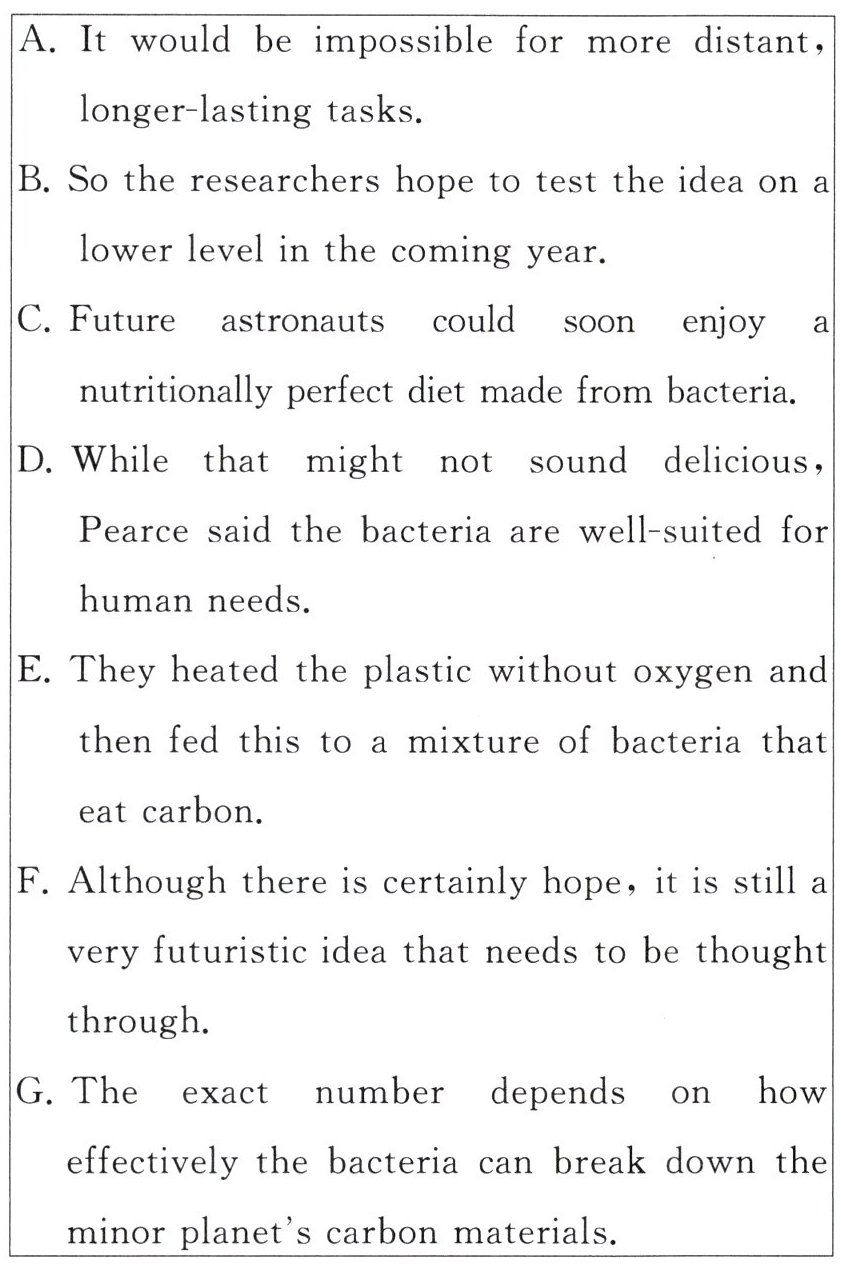
A. It would be impossible for more distant, longer-lasting tasks.
B. So the researchers hope to test the idea on a lower level in the coming year.
C. Future astronauts could soon enjoy a nutritionally perfect diet made from bacteria.
D. While that might not sound delicious, Pearce said the bacteria are well-suited for human needs.
E. They heated the plastic without oxygen and then fed this to a mixture of bacteria that eat carbon.
F. Although there is certainly hope, it is still a very futuristic idea that needs to be thought through.
G. The exact number depends on how effectively the bacteria can break down the minor planet's carbon materials.
1.
A
2. E
3. D
4. G
5. B
答案
B
【文章大意】本文是一篇说明文。文章介绍了人类对火星进行的探测活动。
6. A 细节理解题。根据第一段中的“Unfortunately, the planet is now covered by a thin carbon dioxide atmosphere and cannot support earthly life-forms.”可知,火星上没有生命存在的一个原因是二氧化碳的大气层包裹着火星。故选 A。
7. C 词义猜测题。根据第二段中的“But the thin Martian atmosphere makes landing tricky, and more than 60 per cent of such tries have failed.”可知,火星稀薄的大气层使得大半的探测器登陆失败,所以 tricky 表示“难办的”,与 difficult 意思相近。故选 C。
8. D 推理判断题。根据第二段中的“Since the 1960s, humans have sent dozens of spacecraft to study Mars ... More recently, landers and rovers have touched down on the surface.”可知,几十年来,人们一直在努力近距离观察火星。故选 D。
9. A 细节理解题。根据第三段中的“NASA is targeting July 2035 as a reasonable time for sending a spacecraft, aiming to put the first boots on Mars.”可知,目前对火星探测的预期是,美国宇航局将在 2035 年向火星发送首批航天员。故选 A。
10. C 推理判断题。根据第三段中的“Once every 26 months, the Earth and Mars are lined up in a way that minimises travel time and expense, enabling spacecraft to make the interplanetary journey ...”可知,如果美国宇航局在 2035 年 7 月发射失败,需要时隔 26 个月进行新的尝试,即 2037 年 9 月。故选 C。
Ⅳ. 1.A 2.E 3.D 4.G 5.B
【文章大意】本文是一篇说明文。文章探讨了一种未来航天员可能在太空中获取食物的新方法:利用细菌将小行星中的含碳物质转化为可食用的食物,类似于酸奶或粉末。如果成功,这种方法可以在小行星上大规模生产食物,为未来的太空探索提供支持。
1. A 根据上文“the vast majority of food consumed in space is transported from Earth(在太空食用的大部分食物都需要从地球运送)”,结合下文“That's why ... decided to try using bacteria ... into eatable food.”可知依靠地球运送食物对于更远、耗时更长的太空任务行不通,因此科学家想出新方案。A 选项“对于更远、持续时间更长的任务来说,这是行不通的”承接上下文。故选 A。
2. E 根据上文“Pearce's team has performed similar experiments using bacteria to break down plastic from leftover in army food supply bags.(皮尔斯团队已经开展类似实验,利用细菌分解军用食品包装袋残留废弃物的塑料)”,下文介绍实验最终产物。E 选项介绍具体实验操作:他们在无氧环境下加热塑料,然后将塑料投喂给以碳为食的混合菌群,衔接实验内容。故选 E。
3. D 上文提到菌群最终产物外观类似棕色奶昔,下文“We did nutritional research and it turned out to be almost a perfect food”介绍该产物营养优势。D 选项“虽然听起来也许并不美味,但皮尔斯表示这类细菌产物十分契合人类的需求”,形成转折,承上启下。故选 D。
4. G 根据上文“could feed between 600 and 17,000 astronauts for a year(可供 600 至 17000 名航天员食用一年)”,G 选项“确切数字取决于细菌分解小行星含碳物质的效率”,对上文中浮动的数据进行解释说明。故选 G。
5. B 根据上文“This would take a long time to get everything in place.(想要搭建完整体系需要漫长的筹备时间)”,下文“They plan to start off with coal and then move to space rocks that have fallen to Earth.(他们计划先用煤炭开展实验,之后再使用落到地球的太空岩石)”。B 选项“因此研究人员希望明年先开展初级层面的测试”,承接现状,引出后续计划。故选 B。
