

 登录
一、写出下列各组单词中画线部分的发音,再听录音、跟读并修正答案。
1.
2.
3.
4.
5.
1.
/əʊ/
hotel metro goal2.
/aʊ/
town loud without3.
/ɪə/
tear appear year4.
/eə/
square compare pair5.
/ʊə/
surely tourist lure答案
1./əʊ/ 2./aʊ/ 3./ɪə/ 4./eə/ 5./ʊə/
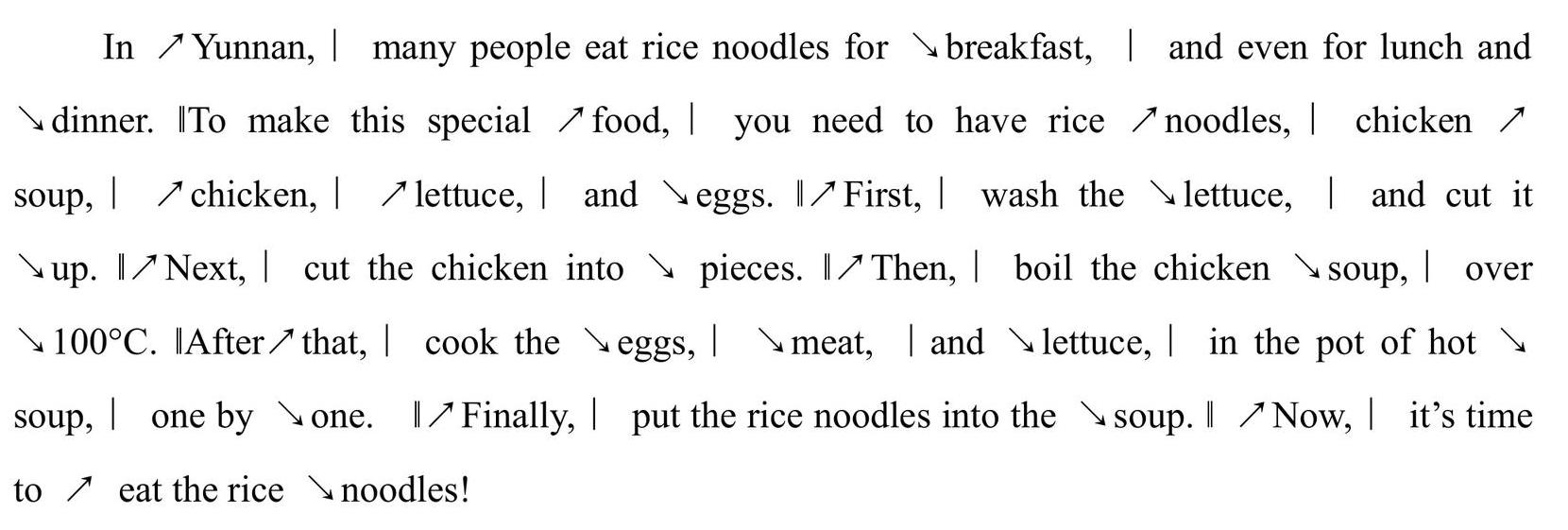
二、用“↑”与“↓”标出句子的语调;用“”与“”标出句子需要停顿的地方,再听录音、跟读并修正答案。
In Yunnan, many people eat rice noodles for breakfast, and even for lunch and dinner. To make this special food, you need to have rice noodles, chicken soup, chicken, lettuce and eggs. First, wash the lettuce and cut it up. Next, cut the chicken into pieces. Then, boil the chicken soup. After that, cook the eggs, meat and lettuce in the pot of hot soup, one by one. Finally, put the rice noodles into the soup. Now, it's time to eat the rice noodles!
答案
三、根据首字母及句意写出完整单词。
1. A s
2. Mr Miller read the i
3. When you h
4. I was so hungry that I ate two large b
5. We process o
6. To make this dish, we need lots of special i
1. A s
imple
action of kindness can help others out and make ourselves feel good.2. Mr Miller read the i
nstruction
again so that everyone could understand it clearly.3. When you h
eat
the ice, it will turn into water.4. I was so hungry that I ate two large b
owls
of noodles in one go.5. We process o
il
from underground and use it to run cars.6. To make this dish, we need lots of special i
ngredients
.答案
1.simple 2.instruction 3.heat 4.bowls 5.oil 6.ingredients
四、回归教材 根据教材 2a 部分(P43)的内容补全短文。
Peter asked Teng Fei to teach him 1.
After 2.
Peter was amazed at how 15.
Peter asked Teng Fei to teach him 1.
(how) to cook
a popular Chinese dish. Teng Fei agreed and taught him to make stir - fried eggs and tomatoes.After 2.
preparing the ingredients
for the dish: three eggs, 3. four tomatoes
, some oil, and some salt and sugar, they started to work. Following Teng Fei's 4. instructions
, Peter started working with the tomatoes and eggs. 5. First
, he 6. cut the tomatoes into small pieces
. 7. Next
, he 8. mixed
the eggs in a bowl. 9. Then
, Teng Fei guided Peter to 10. heat oil
in a pan, 11. stir-fry
the eggs, and 12. take out
the eggs and set them aside. After that, they cooked the tomatoes until they were soft, seasoning (调味) them with salt and sugar. 13. Finally
, Teng Fei asked Peter to 14. put the eggs back into
the pan and mix them with the tomatoes.Peter was amazed at how 15.
simple
it was to make the dish.答案
1.(how) to cook 2.preparing the ingredients 3.four tomatoes 4.instructions 5.First 6.cut the tomatoes into small pieces 7.Next 8.mixed 9.Then 10.heat oil 11.stir-fry 12.take out 13.Finally 14.put the eggs back into15.simple
五、根据短文内容选择最佳选项。
In hot summer, it's really fantastic to eat iced watermelons. However, after enjoying them, do you find it hard to know what to do with the watermelon rinds (外皮) in an eco - friendly (环保的) way? Or when seeing flies flying over the watermelon rinds around the bins (垃圾桶), do you want to help but have no idea where to start?
My best friend Bill had similar problems. His father loves eating watermelons. He eats a lot of them in summer, and he always puts the rinds into bins.
After seeing the cleaners working hard to pick up the heavy bins, Bill said, “There must be a good way to use all the watermelon rinds.”
After a lot of thinking, Bill decided to make something with the rinds. First, he made the rinds into juice. Then he carefully made delicious green cakes with the juice.
Once he tasted the cake, he knew his cakes were great by - products (副产品) of the watermelon eating. And they were nature - friendly too.
Bill brought some of his green cakes to school. At lunch, he shared them with us. “Delicious!” “Wonderful!” Everyone liked the cakes and wondered how he made them.
From then on, Bill doesn't need to worry about the waste from eating watermelons. And everyone always wants more of his special cakes.
▲
(
A. By asking questions.
B. By giving examples.
C. By showing terrible problems.
(
A. He puts them into bins.
B. He uses them to make cakes.
C. He sends them to his classmates.
(
A. Bill truly set an example to his friend!
B. Why not follow Bill's example and try to make special cakes?
C. So have you got any ideas on what to do with watermelon rinds?
(
A. I found a good way to save our living environment.
B. I made very good cakes and everyone enjoyed them.
C. I tried to help others but I worried about the heavy waste.
(
A. Learning to make different dishes.
B. Cleaning up city parks in his free time.
C. Trying doing different things to make his classmates happy.
In hot summer, it's really fantastic to eat iced watermelons. However, after enjoying them, do you find it hard to know what to do with the watermelon rinds (外皮) in an eco - friendly (环保的) way? Or when seeing flies flying over the watermelon rinds around the bins (垃圾桶), do you want to help but have no idea where to start?
My best friend Bill had similar problems. His father loves eating watermelons. He eats a lot of them in summer, and he always puts the rinds into bins.
After seeing the cleaners working hard to pick up the heavy bins, Bill said, “There must be a good way to use all the watermelon rinds.”
After a lot of thinking, Bill decided to make something with the rinds. First, he made the rinds into juice. Then he carefully made delicious green cakes with the juice.
Once he tasted the cake, he knew his cakes were great by - products (副产品) of the watermelon eating. And they were nature - friendly too.
Bill brought some of his green cakes to school. At lunch, he shared them with us. “Delicious!” “Wonderful!” Everyone liked the cakes and wondered how he made them.
From then on, Bill doesn't need to worry about the waste from eating watermelons. And everyone always wants more of his special cakes.
▲
(
A
) 1. How did the writer lead into the topic (引入话题)?A. By asking questions.
B. By giving examples.
C. By showing terrible problems.
(
B
) 2. What does Bill do with watermelon rinds?A. He puts them into bins.
B. He uses them to make cakes.
C. He sends them to his classmates.
(
C
) 3. Which of the following sentences is best to put into “▲”?A. Bill truly set an example to his friend!
B. Why not follow Bill's example and try to make special cakes?
C. So have you got any ideas on what to do with watermelon rinds?
(
B
) 4. What will Bill most probably write in his diary?A. I found a good way to save our living environment.
B. I made very good cakes and everyone enjoyed them.
C. I tried to help others but I worried about the heavy waste.
(
B
) 5. What does Bill most probably like doing in his daily life?A. Learning to make different dishes.
B. Cleaning up city parks in his free time.
C. Trying doing different things to make his classmates happy.
答案
1 - 5 ABCBB
