

 登录
考点2
cost v. 价格为,需支付(某一数量的钱)
一感悟 读句子感悟用法
Her artificial arm was just a simple hook, but it cost $80,000. 她的假肢只是一个简单的钩子,但花了8万美元。(教材·P36)The book cost me twenty yuan. 那本书花费了我20元钱。The cost of living in this city is very high. 在这个城市生活的成本非常高。二探究 抓要点探究归纳(1)cost 用作动词,意为“花费时间(金钱)等”;常用于“Sth cost sb some money/time.”结构中。(2)cost 用作名词,意为“费用,成本,代价”;the cost of意为“……的成本、费用或代价”。三运用 多维度灵活运用(1)—How much does the TV \_\_\_\_\_\_?—Not too much. It's just a second-hand one.A. cost B. spendC. take(2)—Wow, your sweater is very beautiful!—Thank you. I bought it two days ago. It \_\_\_\_\_\_ me $50.
A. took B. cost
C. paid
(3)本次旅行的费用是多少?(汉译英)
______
答案
(1)A (2)B
(3)What's the cost of the trip?
考点3 worse adj. 更糟的,更差的
一感悟 读句子感悟用法
What's worse, children like her grow quickly and need new arms all the time. 更糟糕的是,像她这样的孩子长得快,经常需要更换新的假肢。(教材·P36)
As time goes by, my memory seems to get worse. 随着时间的流逝,我的记忆力似乎变得越来越差。
二探究 抓要点探究归纳
worse为形容词bad和副词badly的比较级,意为“更糟的(地),更差的(地),更坏的(地)”;what's worse意为“更糟糕的是”,用来引出一个更加糟糕或严重的情况。
三运用 多维度灵活运用
(1) Nothing is
(2)—How are you today, Tom?
—I'm even
A. worse B. badly
C. better
(3)更加糟糕的是,他对此一无所知。(汉译英)
一感悟 读句子感悟用法
What's worse, children like her grow quickly and need new arms all the time. 更糟糕的是,像她这样的孩子长得快,经常需要更换新的假肢。(教材·P36)
As time goes by, my memory seems to get worse. 随着时间的流逝,我的记忆力似乎变得越来越差。
二探究 抓要点探究归纳
worse为形容词bad和副词badly的比较级,意为“更糟的(地),更差的(地),更坏的(地)”;what's worse意为“更糟糕的是”,用来引出一个更加糟糕或严重的情况。
三运用 多维度灵活运用
(1) Nothing is
worse
(bad) than being alone.(2)—How are you today, Tom?
—I'm even
A
than before. I don't think this medicine is good for me.A. worse B. badly
C. better
(3)更加糟糕的是,他对此一无所知。(汉译英)
What's worse, he knows nothing about this.
答案
(1)worse (2)A
(3)What's worse, he knows nothing about this.
考点4 lend v.借给,借出
一感悟 读句子感悟用法
I must lend a hand to people like her. 我必须帮助像她这样的人。(教材·P37)
Can you lend me your bike? /Can you lend your bike to me? 你能把你的自行车借给我吗?
I borrowed a book from the library yesterday. 我昨天从图书馆借了一本书。
You can keep the book for two weeks. 这本书你可借阅两周。
二探究 抓要点探究归纳
(1)lend 用作动词,意为“借给,借出”。lend sb a hand/lend a hand to sb 意为“帮助某人做事;给某人搭把手”。
(2)辨析 borrow, lend 与 keep
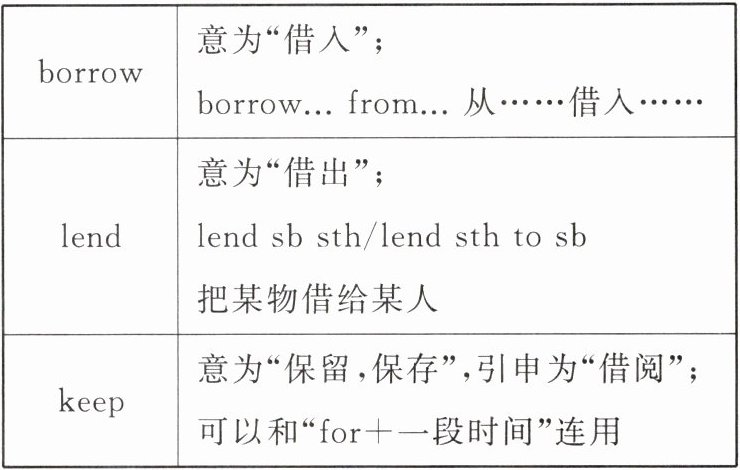
三运用 多维度灵活运用
(1)—Could you
—OK. And you can it for a week.
A. lend; keep B. borrow; lend
C. lend; borrow
(2)Sam
A. sold B. borrowed
C. lent
(3)请帮助我。(汉译英)
一感悟 读句子感悟用法
I must lend a hand to people like her. 我必须帮助像她这样的人。(教材·P37)
Can you lend me your bike? /Can you lend your bike to me? 你能把你的自行车借给我吗?
I borrowed a book from the library yesterday. 我昨天从图书馆借了一本书。
You can keep the book for two weeks. 这本书你可借阅两周。
二探究 抓要点探究归纳
(1)lend 用作动词,意为“借给,借出”。lend sb a hand/lend a hand to sb 意为“帮助某人做事;给某人搭把手”。
(2)辨析 borrow, lend 与 keep
三运用 多维度灵活运用
(1)—Could you
A
me your bike, Tom?—OK. And you can it for a week.
A. lend; keep B. borrow; lend
C. lend; borrow
(2)Sam
B
a computer from me yesterday.A. sold B. borrowed
C. lent
(3)请帮助我。(汉译英)
Please lend me a hand./Please lend a hand to me.
答案
(1)A (2)B
(3) Please lend me a hand./Please lend a hand to me.
