

 登录
五、信息还原(共4小题;每小题1.5分,满分6分)
阅读下面短文,从短文后所给的选项中选出可以填入空白处的最佳选项(选项中有两项为多余选项)。
A proverb(谚语) is a short, well-known saying that expresses a common truth or belief. Proverbs are popular around the world. Many proverbs give advice about how to live. Some proverbs are hundreds of years old, but they are still used today.
Another proverb is "Don't bite off more than you can chew(咀嚼)."
Some people are pessimists(悲观主义者). They always think about how bad things are or will be. Other people are optimists(乐观主义者). They always look on the bright side.
Some people often worry about what they will do in a situation that might happen in the future. We could tell them "Do not cross that bridge until you come to it."
阅读下面短文,从短文后所给的选项中选出可以填入空白处的最佳选项(选项中有两项为多余选项)。
A proverb(谚语) is a short, well-known saying that expresses a common truth or belief. Proverbs are popular around the world. Many proverbs give advice about how to live. Some proverbs are hundreds of years old, but they are still used today.
C
1 We often say the two of them prove(证明) the proverb "The apple does not fall far from the tree."Another proverb is "Don't bite off more than you can chew(咀嚼)."
F
2 I also tell my children "Two wrongs do not make a right." You should not do something bad just because someone did the same as you.Some people are pessimists(悲观主义者). They always think about how bad things are or will be. Other people are optimists(乐观主义者). They always look on the bright side.
E
3 Optimists might say "Every cloud has a silver lining(银色的边)." They can find something good even in a bad situation. Other people are both pessimists and optimists. A
4Some people often worry about what they will do in a situation that might happen in the future. We could tell them "Do not cross that bridge until you come to it."
答案
1. C 2. F 3. E 4. A
解析
【分析】
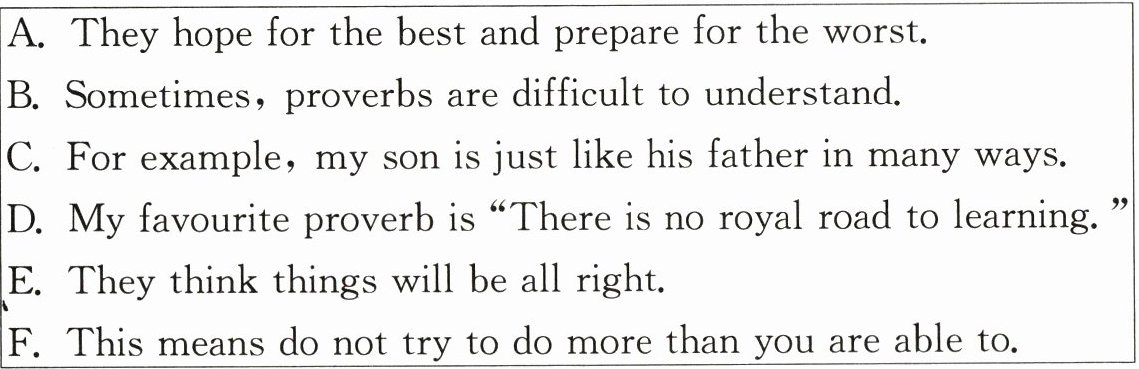
信息还原题需结合上下文的逻辑关系(如举例、解释、对应态度等)解题。第1空后提到谚语“The apple does not fall far from the tree”,需找对应举例;第2空是对“Don't bite off more than you can chew”的解释;第3空对应乐观主义者的态度;第4空对应兼具悲观和乐观的人的做法,据此匹配选项。
【解析】
1. 第1空:后文的谚语“The apple does not fall far from the tree”意为“有其父必有其子”,选项C“For example, my son is just like his father in many ways”是对该谚语的举例说明,符合上下文逻辑,故选C。
2. 第2空:前文出现谚语“Don't bite off more than you can chew”,选项F“This means do not try to do more than you are able to”是对该谚语的含义解释,符合语境,故选F。
3. 第3空:前文说明乐观主义者“look on the bright side”(看光明面),选项E“They think things will be all right”(认为事情会变好)契合乐观者的态度,故选E。
4. 第4空:前文提到有些人兼具悲观和乐观,选项A“They hope for the best and prepare for the worst”(抱最好的希望,做最坏的准备)正好对应这种态度,故选A。
【答案】1.C 2.F 3.E 4.A
【知识点】英语谚语、信息还原、上下文逻辑
【点评】本题考查英语阅读的信息还原能力,需结合上下文逻辑和谚语含义解题,是初中英语常见题型,难度适中。
【难度系数】0.5
