

 登录
登录
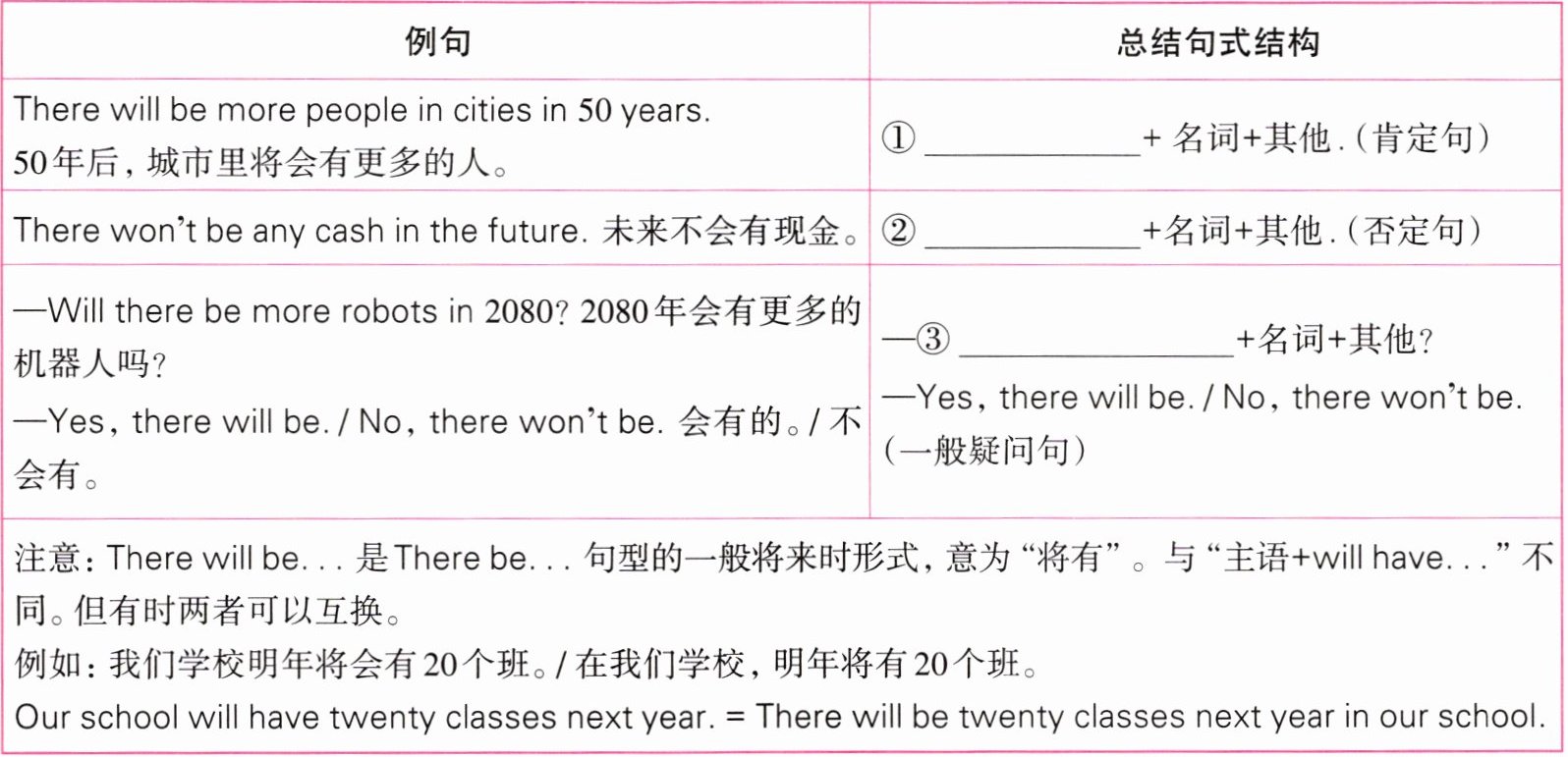
2. 同学们,观察以下例句,你能总结There be句型一般将来时的用法吗?
【即学即练】根据对话内容,用括号中所给词的适当形式填空。
Ming: Shall we imagine what Shanxi (1) (be like) in 20 years?
Kai: Sure! (2) (there be) coal mines(煤矿)?
Ming: Yes, but robots (3) (do) the mining safely. Will there still be ancient cities like Pingyao?
Kai: Of course! And we’re going to use holograms(全息影像) to show their history. What about the traffic?
Ming: (4) (there be) flying taxis between cities. No more traffic jams(交通拥堵)!
Kai: And we (5) (plant) trees everywhere. Shanxi will be greener and smarter in the future!
【即学即练】根据对话内容,用括号中所给词的适当形式填空。
Ming: Shall we imagine what Shanxi (1) (be like) in 20 years?
Kai: Sure! (2) (there be) coal mines(煤矿)?
Ming: Yes, but robots (3) (do) the mining safely. Will there still be ancient cities like Pingyao?
Kai: Of course! And we’re going to use holograms(全息影像) to show their history. What about the traffic?
Ming: (4) (there be) flying taxis between cities. No more traffic jams(交通拥堵)!
Kai: And we (5) (plant) trees everywhere. Shanxi will be greener and smarter in the future!
答案
句式结构总结:
① There will be
② There won't be
③ Will there be
即学即练:
(1) will be like
(2) Will there be
(3) will do / are going to do
(4) There will be / There are going to be
(5) will plant / are going to plant
① There will be
② There won't be
③ Will there be
即学即练:
(1) will be like
(2) Will there be
(3) will do / are going to do
(4) There will be / There are going to be
(5) will plant / are going to plant
解析
【分析】首先观察例句总结的There be句型一般将来时的三种结构:肯定句为There will be,否定句为There won't be,一般疑问句为Will there be。再结合即学即练各句的时间状语(如in 20 years表将来)和句子类型(陈述句、疑问句),判断使用的一般将来时结构,同时注意一般将来时的两种表达形式will do和be going to do的用法。
【解析】1. 第(1)题:时间状语in 20 years表将来,宾语从句用一般将来时,“be like”表示“像……”,故填will be like;2. 第(2)题:是There be句型一般将来时的一般疑问句,对应结构为Will there be,故填Will there be;3. 第(3)题:主语robots,表达将来会做的动作,可用will do或are going to do,故填will do / are going to do;4. 第(4)题:是There be句型一般将来时的肯定句,可用There will be或There are going to be,故填There will be / There are going to be;5. 第(5)题:主语we,表达将来要做的动作,可用will plant或are going to plant,故填will plant / are going to plant。
【答案】句式结构总结:① There will be;② There won't be;③ Will there be;即学即练:(1) will be like;(2) Will there be;(3) will do / are going to do;(4) There will be / There are going to be;(5) will plant / are going to plant
【知识点】There be句型一般将来时;一般将来时的表达
【点评】本题结合例句总结There be句型一般将来时的结构,并通过即学即练考查该结构及一般将来时的用法,需准确判断句子时态和结构,是基础语法题,适合巩固相关知识点。
【难度系数】0.6
【解析】1. 第(1)题:时间状语in 20 years表将来,宾语从句用一般将来时,“be like”表示“像……”,故填will be like;2. 第(2)题:是There be句型一般将来时的一般疑问句,对应结构为Will there be,故填Will there be;3. 第(3)题:主语robots,表达将来会做的动作,可用will do或are going to do,故填will do / are going to do;4. 第(4)题:是There be句型一般将来时的肯定句,可用There will be或There are going to be,故填There will be / There are going to be;5. 第(5)题:主语we,表达将来要做的动作,可用will plant或are going to plant,故填will plant / are going to plant。
【答案】句式结构总结:① There will be;② There won't be;③ Will there be;即学即练:(1) will be like;(2) Will there be;(3) will do / are going to do;(4) There will be / There are going to be;(5) will plant / are going to plant
【知识点】There be句型一般将来时;一般将来时的表达
【点评】本题结合例句总结There be句型一般将来时的结构,并通过即学即练考查该结构及一般将来时的用法,需准确判断句子时态和结构,是基础语法题,适合巩固相关知识点。
【难度系数】0.6
1. 你知道will和be going to的相同之处和不同之处吗?
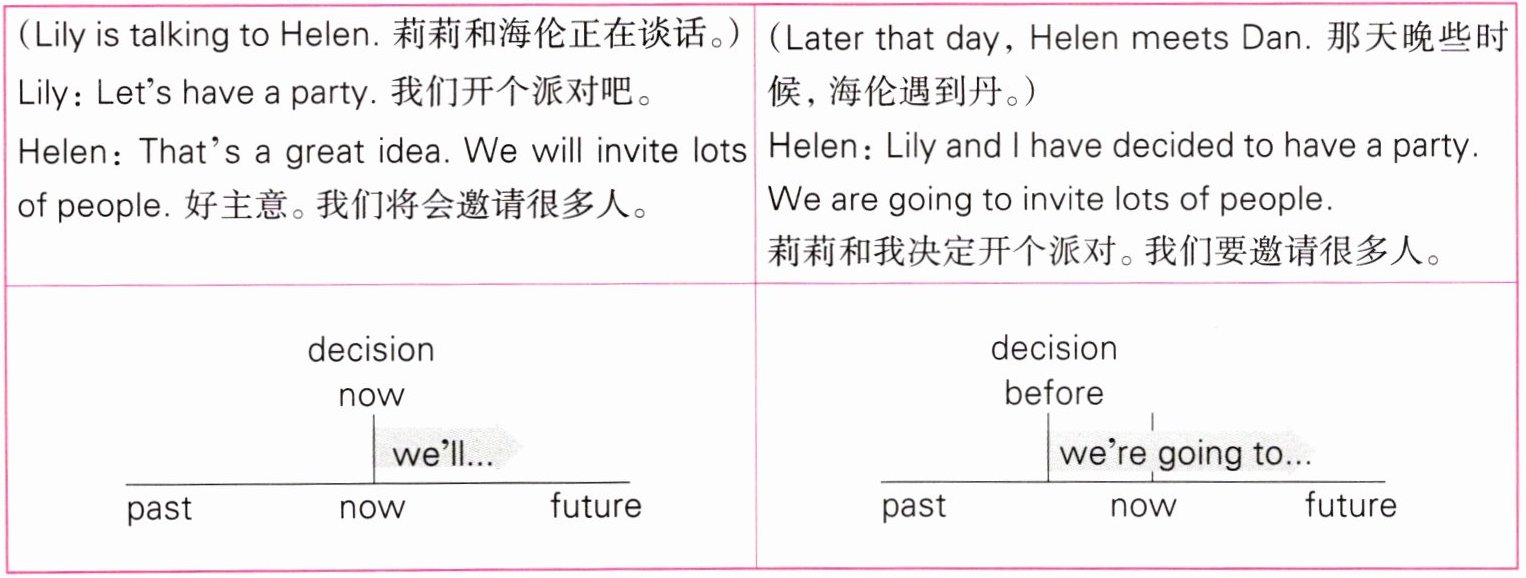
总结: ① 表示说话人临时决定的计划;② 表示经过事先思考的计划。
I feel terrible. I think I am going to be sick. 我感觉很糟糕。我想我要生病了。
当有迹象表明某件事将要发生时,我们用③ 。
【即学即练】根据对话内容,用括号中所给词的适当形式填空。
A: Where are you going? Are you going shopping?
B: Yes, I (1) (buy) something for dinner in the new supermarket.
A: Me too. But I don’t know how to get there.
B: It’s quite easy. I (2) (show) you.
A: Thanks. But look at the clouds. It (3) (rain) soon.
B: Yes. Hurry up, or we will be wet.
总结: ① 表示说话人临时决定的计划;② 表示经过事先思考的计划。
I feel terrible. I think I am going to be sick. 我感觉很糟糕。我想我要生病了。
当有迹象表明某件事将要发生时,我们用③ 。
【即学即练】根据对话内容,用括号中所给词的适当形式填空。
A: Where are you going? Are you going shopping?
B: Yes, I (1) (buy) something for dinner in the new supermarket.
A: Me too. But I don’t know how to get there.
B: It’s quite easy. I (2) (show) you.
A: Thanks. But look at the clouds. It (3) (rain) soon.
B: Yes. Hurry up, or we will be wet.
答案
① will ② be going to ③ be going to
(1) am going to buy
(2) will show
(3) is going to rain
(1) am going to buy
(2) will show
(3) is going to rain
解析
【分析】
解题思路:首先明确一般将来时中will和be going to的核心区别:will用于说话时临时做出的决定;be going to用于事先计划好的安排,或有明显迹象表明即将发生的事情。再结合题目中的对话例子、例句及语境,逐一分析每个空的用法:
1. 总结部分:通过左右两则对话的例子,对应临时决定和事先计划的表达,再结合给定例句的场景,确定③的用法;
2. 即学即练部分:根据每个句子的语境(事先计划/临时决定/有迹象),选择正确的一般将来时结构填空。
【解析】
1. 总结:
① 左边对话中,Lily和Helen临时提议开派对,用了“We'll have a party”,故will表示说话人临时决定的计划;
② 右边对话中,Helen提到已经决定开派对(事先思考后的计划),用了“We're going to have a party”,故be going to表示经过事先思考的计划;
③ 例句中“感觉糟糕(有迹象)”对应用be going to,故有迹象表明某事将要发生时用be going to。
2. 即学即练:
(1) 句意:我要去新超市买晚餐的东西,是事先计划好的动作,主语为I,故填am going to buy;
(2) 句意:我来给你指路,是临时做出的决定,故填will show;
(3) 句意:看那些云,很快要下雨了,有明显迹象(云),主语为it,故填is going to rain。
【答案】
① will ② be going to ③ be going to (1) am going to buy (2) will show (3) is going to rain
【知识点】
一般将来时、will与be going to的用法区别
【点评】
本题考查一般将来时中will和be going to的核心用法差异,需结合语境区分临时决定、事先计划、有迹象三种场景的表达,是初中英语时态的基础考点,难度适中。
【难度系数】
0.6
解题思路:首先明确一般将来时中will和be going to的核心区别:will用于说话时临时做出的决定;be going to用于事先计划好的安排,或有明显迹象表明即将发生的事情。再结合题目中的对话例子、例句及语境,逐一分析每个空的用法:
1. 总结部分:通过左右两则对话的例子,对应临时决定和事先计划的表达,再结合给定例句的场景,确定③的用法;
2. 即学即练部分:根据每个句子的语境(事先计划/临时决定/有迹象),选择正确的一般将来时结构填空。
【解析】
1. 总结:
① 左边对话中,Lily和Helen临时提议开派对,用了“We'll have a party”,故will表示说话人临时决定的计划;
② 右边对话中,Helen提到已经决定开派对(事先思考后的计划),用了“We're going to have a party”,故be going to表示经过事先思考的计划;
③ 例句中“感觉糟糕(有迹象)”对应用be going to,故有迹象表明某事将要发生时用be going to。
2. 即学即练:
(1) 句意:我要去新超市买晚餐的东西,是事先计划好的动作,主语为I,故填am going to buy;
(2) 句意:我来给你指路,是临时做出的决定,故填will show;
(3) 句意:看那些云,很快要下雨了,有明显迹象(云),主语为it,故填is going to rain。
【答案】
① will ② be going to ③ be going to (1) am going to buy (2) will show (3) is going to rain
【知识点】
一般将来时、will与be going to的用法区别
【点评】
本题考查一般将来时中will和be going to的核心用法差异,需结合语境区分临时决定、事先计划、有迹象三种场景的表达,是初中英语时态的基础考点,难度适中。
【难度系数】
0.6
