

 登录
登录
Ⅱ. 阅读理解
A
Compass
The earliest compass was invented during the Warring States Period. It looked like a spoon on a plate, on which 24 directions were marked. Due to magnetism(磁力), its handle(柄) would point south.
Seismograph
In the Eastern Han Dynasty, Zhang Heng invented it to report earthquakes. When a quake took place, the ball inside the dragon mouth would drop into the mouth of the toad(蟾蜍) right under it. It was so smartly designed that only one dragon mouth would open while the rest seven remained shut.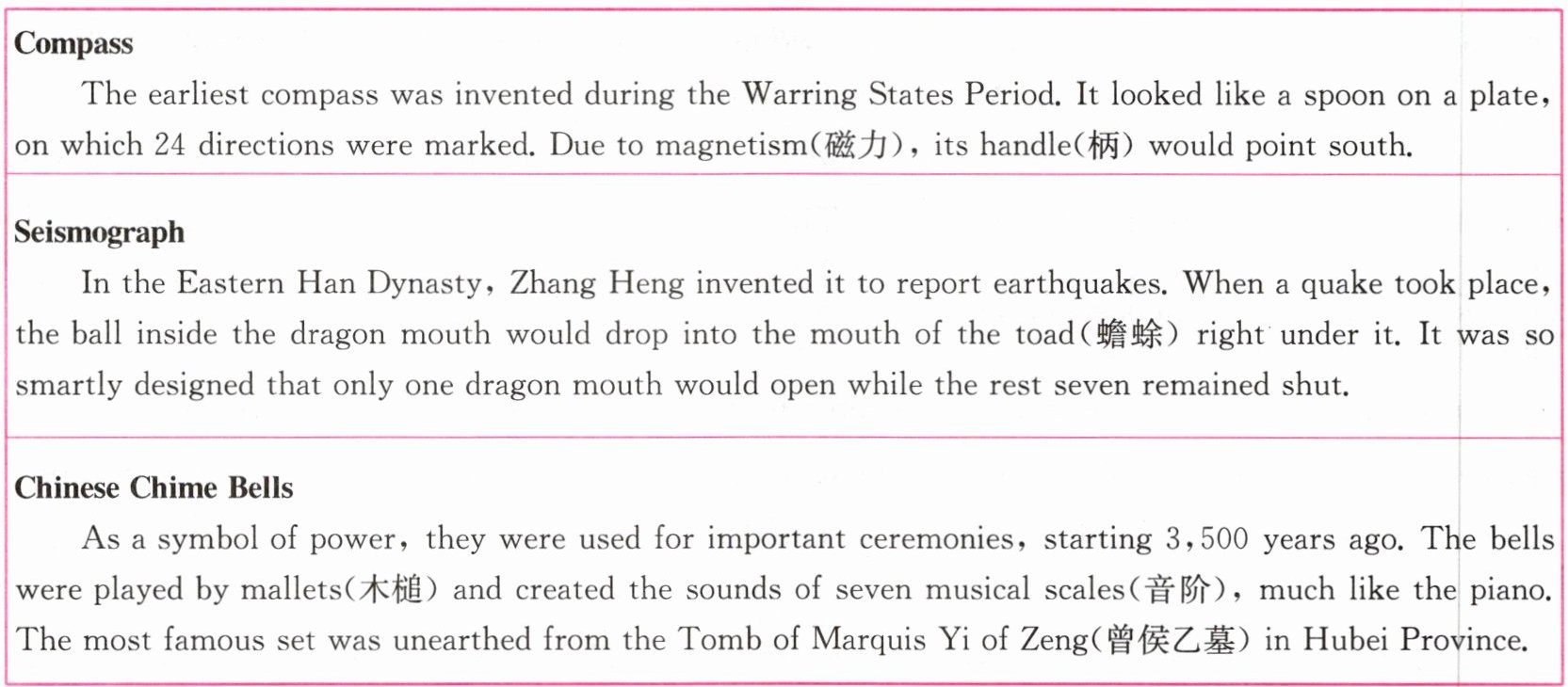
Chinese Chime Bells
As a symbol of power, they were used for important ceremonies, starting 3,500 years ago. The bells were played by mallets(木槌) and created the sounds of seven musical scales(音阶), much like the piano. The most famous set was unearthed from the Tomb of Marquis Yi of Zeng(曾侯乙墓) in Hubei Province.
1. In which picture can we see the compass?
B.
2. How could the seismograph report earthquakes according to the passage?
A. The dragons would talk clearly.
B. The ball would drop into the mouth of the toad.
C. The spoon would point it out.
D. It included 8 dragons and 8 toads.
3. What can we learn from the passage?
A. The compass was the best invention.
B. The bells were used to play music.
C. The compass served as a spoon at ceremonies.
D. Chinese chime bells were only found in Hubei Province.
4. What do all these inventions have in common?
A. They are still widely used every day.
B. They were necessary in people's daily life.
C. They were big and tall instruments.
D. They reflect ancient Chinese wisdom.
5. Where is the passage probably from?
A. A novel.
B. A storybook.
C. A movie review.
D. A magazine.
B
A
Compass
The earliest compass was invented during the Warring States Period. It looked like a spoon on a plate, on which 24 directions were marked. Due to magnetism(磁力), its handle(柄) would point south.
Seismograph
In the Eastern Han Dynasty, Zhang Heng invented it to report earthquakes. When a quake took place, the ball inside the dragon mouth would drop into the mouth of the toad(蟾蜍) right under it. It was so smartly designed that only one dragon mouth would open while the rest seven remained shut.
Chinese Chime Bells
As a symbol of power, they were used for important ceremonies, starting 3,500 years ago. The bells were played by mallets(木槌) and created the sounds of seven musical scales(音阶), much like the piano. The most famous set was unearthed from the Tomb of Marquis Yi of Zeng(曾侯乙墓) in Hubei Province.
1. In which picture can we see the compass?
B.
2. How could the seismograph report earthquakes according to the passage?
A. The dragons would talk clearly.
B. The ball would drop into the mouth of the toad.
C. The spoon would point it out.
D. It included 8 dragons and 8 toads.
3. What can we learn from the passage?
A. The compass was the best invention.
B. The bells were used to play music.
C. The compass served as a spoon at ceremonies.
D. Chinese chime bells were only found in Hubei Province.
4. What do all these inventions have in common?
A. They are still widely used every day.
B. They were necessary in people's daily life.
C. They were big and tall instruments.
D. They reflect ancient Chinese wisdom.
5. Where is the passage probably from?
A. A novel.
B. A storybook.
C. A movie review.
D. A magazine.
B
答案
1-5 CBBDD
解析
【分析】
做这类英语阅读理解题,需先通读原文把握核心内容,再针对每个题目,通过题干关键词回原文定位,对比原文信息与选项,排除错误选项得出答案。不同题型对应不同技巧:细节题直接找原文原句;推断题需结合原文合理推导;主旨题要梳理整体内容。
【解析】
1. 第1题:题干问哪个图是指南针,原文对指南针的描述是“它看起来像盘子上的勺子”,结合插图对应,答案为B。
2. 第2题:题干问地动仪如何报告地震,原文明确提到“当地震发生时,龙口内的球会掉进下方蟾蜍的嘴里”,对应选项B;A选项“龙会说话”原文未提及,C是指南针的功能,D选项“8个龙和蟾蜍”与原文“只有一个龙口会打开”不符,故排除。
3. 第3题:逐一分析选项:A选项“指南针是最好的发明”原文未提及;B选项“编钟被用来演奏音乐”对应原文“编钟用木槌演奏,发出七声音阶的声音”,正确;C选项“指南针用于仪式”错误,用于仪式的是编钟;D选项“编钟只在湖北发现”错误,原文说最著名的编钟在湖北,并非仅在湖北,故答案为B。
4. 第4题:找三项发明的共同点:A选项“现在仍广泛使用”错误,地动仪、编钟未日常使用;B选项“是日常生活必需”错误,不符合;C选项“又大又高”原文未提及;D选项“反映古代中国智慧”符合对三项古代发明的描述,故答案为D。
5. 第5题:判断文章来源:文章介绍古代中国发明,属于科普类内容,最可能来自杂志;A小说、B故事书、C影评均不符合,故答案为D。
【答案】
CBBDD
【知识点】
英语阅读理解、细节理解题、主旨大意题
【点评】
本题围绕中国古代三项发明展开,题型涵盖细节理解、推理判断、主旨大意,侧重考查学生快速定位原文信息、辨析选项与原文匹配度的能力,整体难度适中。
【难度系数】
0.7
做这类英语阅读理解题,需先通读原文把握核心内容,再针对每个题目,通过题干关键词回原文定位,对比原文信息与选项,排除错误选项得出答案。不同题型对应不同技巧:细节题直接找原文原句;推断题需结合原文合理推导;主旨题要梳理整体内容。
【解析】
1. 第1题:题干问哪个图是指南针,原文对指南针的描述是“它看起来像盘子上的勺子”,结合插图对应,答案为B。
2. 第2题:题干问地动仪如何报告地震,原文明确提到“当地震发生时,龙口内的球会掉进下方蟾蜍的嘴里”,对应选项B;A选项“龙会说话”原文未提及,C是指南针的功能,D选项“8个龙和蟾蜍”与原文“只有一个龙口会打开”不符,故排除。
3. 第3题:逐一分析选项:A选项“指南针是最好的发明”原文未提及;B选项“编钟被用来演奏音乐”对应原文“编钟用木槌演奏,发出七声音阶的声音”,正确;C选项“指南针用于仪式”错误,用于仪式的是编钟;D选项“编钟只在湖北发现”错误,原文说最著名的编钟在湖北,并非仅在湖北,故答案为B。
4. 第4题:找三项发明的共同点:A选项“现在仍广泛使用”错误,地动仪、编钟未日常使用;B选项“是日常生活必需”错误,不符合;C选项“又大又高”原文未提及;D选项“反映古代中国智慧”符合对三项古代发明的描述,故答案为D。
5. 第5题:判断文章来源:文章介绍古代中国发明,属于科普类内容,最可能来自杂志;A小说、B故事书、C影评均不符合,故答案为D。
【答案】
CBBDD
【知识点】
英语阅读理解、细节理解题、主旨大意题
【点评】
本题围绕中国古代三项发明展开,题型涵盖细节理解、推理判断、主旨大意,侧重考查学生快速定位原文信息、辨析选项与原文匹配度的能力,整体难度适中。
【难度系数】
0.7
