

 登录
登录
四、阅读理解
A
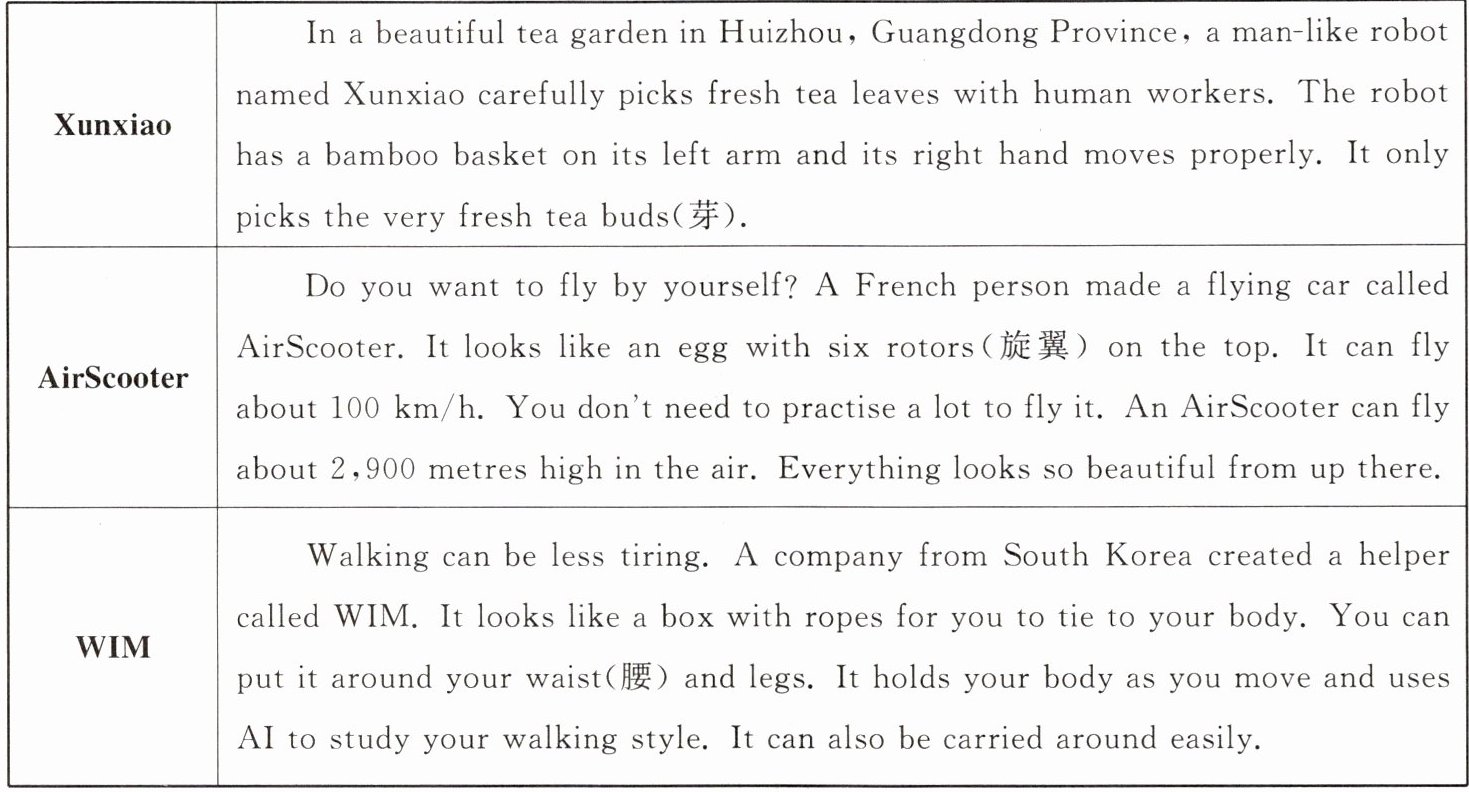
(
A. Water the tea plants.
B. Pick fresh tea buds.
C. Check up on human workers.
D. Carry heavy bamboo baskets.
(
A. About 100 km. B. About 6 km. C. About 14 km. D. About 2.9 km.
(
A. A small box with ropes.
B. A round egg with rotors.
C. A big robot with a tongue.
D. A man-like robot with arms.
A
(
B
)1. What can Xunxiao do in the tea garden?A. Water the tea plants.
B. Pick fresh tea buds.
C. Check up on human workers.
D. Carry heavy bamboo baskets.
(
D
)2. How high can AirScooter fly?A. About 100 km. B. About 6 km. C. About 14 km. D. About 2.9 km.
(
A
)3. What does WIM look like?A. A small box with ropes.
B. A round egg with rotors.
C. A big robot with a tongue.
D. A man-like robot with arms.
答案
1. B 2. D 3. A
解析
【分析】
这是三道英语阅读理解细节题,解题思路为:先明确每道题的问题,再带着问题到原文中定位对应信息,将原文信息与选项对比,选出匹配的答案。第1题需定位Xunxiao在茶园的行为,第2题定位AirScooter的飞行高度,第3题定位WIM的外观描述。
【解析】
1. 根据原文第一段“In a beautiful tea garden... It only picks the very fresh tea buds.”可知,Xunxiao的工作是采摘新鲜茶芽,对应选项B;A(浇水)、C(检查工人)、D(扛竹篮)均与原文不符,故选B。
2. 根据原文第二段“An AirScooter can fly about 2,900 metres high in the air.”,2900米等于2.9公里,对应选项D;A是飞行速度,B、C数值错误,故选D。
3. 根据原文第三段“A company from South Korea created a helper called WIM. It looks like a box with ropes...”可知,WIM看起来像带绳子的小盒子,对应选项A;B是AirScooter的外观,C、D不符合WIM的描述,故选A。
【答案】
1. B 2. D 3. A
【知识点】
英语阅读理解、细节理解题
【点评】
本题为基础细节类阅读理解题,考查学生快速定位原文信息的能力,难度较低,只要仔细查找原文对应内容即可答对。
【难度系数】
0.9
这是三道英语阅读理解细节题,解题思路为:先明确每道题的问题,再带着问题到原文中定位对应信息,将原文信息与选项对比,选出匹配的答案。第1题需定位Xunxiao在茶园的行为,第2题定位AirScooter的飞行高度,第3题定位WIM的外观描述。
【解析】
1. 根据原文第一段“In a beautiful tea garden... It only picks the very fresh tea buds.”可知,Xunxiao的工作是采摘新鲜茶芽,对应选项B;A(浇水)、C(检查工人)、D(扛竹篮)均与原文不符,故选B。
2. 根据原文第二段“An AirScooter can fly about 2,900 metres high in the air.”,2900米等于2.9公里,对应选项D;A是飞行速度,B、C数值错误,故选D。
3. 根据原文第三段“A company from South Korea created a helper called WIM. It looks like a box with ropes...”可知,WIM看起来像带绳子的小盒子,对应选项A;B是AirScooter的外观,C、D不符合WIM的描述,故选A。
【答案】
1. B 2. D 3. A
【知识点】
英语阅读理解、细节理解题
【点评】
本题为基础细节类阅读理解题,考查学生快速定位原文信息的能力,难度较低,只要仔细查找原文对应内容即可答对。
【难度系数】
0.9
B
Artificial intelligence, or AI, is a really cool technology that tries to copy how people think and do things. It's becoming a big part of our lives, making things better in the world.
▲ For example, you might have seen virtual assistants(虚拟助手) like Siri or Alexa on your phone or smart speaker. They use AI to answer questions, make plans, and play music.
One of the best things about AI is that it can do many things on its own, which saves time and makes things work better. In business, AI tools help analyse lots of data(数据) quickly and give useful information to help companies succeed.
AI isn't just for business. For example, AI can help doctorsdiagnose illnesses more correctly and quickly. It can also help banks identify fake money(假币) and stop bad people stealing money. On the roads, AI can analyse information in real time to make traffic better.
Although AI is very useful, it also brings some problems, like making people lose their jobs. So we must work hard to make sure AI is used in good ways and doesn't hurt anyone.
As AI grows and changes, it can make life simpler and bring us all closer together. Enjoying AI means we get to use smart machines that help us make a smarter and cooler world. Everything is possible. As we continue to develop AI, we'll see even more amazing things that will improve our lives.
(
A. AI will be more important than humans.
B. AI mainly does some dangerous jobs.
C. AI does lots of different things in our lives.
D. AI will change the way we live in the future.
(
A. AI's wide use.
B. The future of AI.
C. Problems of AI.
D. The relationship between humans and AI.
(
A. Cheap but useless.
B. Common but expensive.
C. Useful but not common.
D. Helpful but not perfect.
(
A. To introduce the history of AI.
B. To discuss the good and bad points of AI.
C. To say we shouldn't use AI in many places.
D. To provide a way to solve the problems of AI.
读后词汇拓展 猜出第四大题中画波浪线单词的词性和中文意思,并收入自己的小词典。
diagnose
Artificial intelligence, or AI, is a really cool technology that tries to copy how people think and do things. It's becoming a big part of our lives, making things better in the world.
▲ For example, you might have seen virtual assistants(虚拟助手) like Siri or Alexa on your phone or smart speaker. They use AI to answer questions, make plans, and play music.
One of the best things about AI is that it can do many things on its own, which saves time and makes things work better. In business, AI tools help analyse lots of data(数据) quickly and give useful information to help companies succeed.
AI isn't just for business. For example, AI can help doctors
Although AI is very useful, it also brings some problems, like making people lose their jobs. So we must work hard to make sure AI is used in good ways and doesn't hurt anyone.
As AI grows and changes, it can make life simpler and bring us all closer together. Enjoying AI means we get to use smart machines that help us make a smarter and cooler world. Everything is possible. As we continue to develop AI, we'll see even more amazing things that will improve our lives.
(
C
)4. Which of the following can be put into "▲"?A. AI will be more important than humans.
B. AI mainly does some dangerous jobs.
C. AI does lots of different things in our lives.
D. AI will change the way we live in the future.
(
A
)5. What does Paragraph 4 mainly talk about?A. AI's wide use.
B. The future of AI.
C. Problems of AI.
D. The relationship between humans and AI.
(
D
)6. How does the writer like AI?A. Cheap but useless.
B. Common but expensive.
C. Useful but not common.
D. Helpful but not perfect.
(
B
)7. What's the main purpose of this passage?A. To introduce the history of AI.
B. To discuss the good and bad points of AI.
C. To say we shouldn't use AI in many places.
D. To provide a way to solve the problems of AI.
读后词汇拓展 猜出第四大题中画波浪线单词的词性和中文意思,并收入自己的小词典。
diagnose
v.诊断
答案
4. C 5. A 6. D 7. B
读后词汇拓展
v.诊断
读后词汇拓展
v.诊断
解析
【分析】
本题为英语阅读理解题,包含句子还原、段落主旨、作者态度、写作目的及词汇考查题型,需结合文章上下文逻辑、段落内容、作者观点及词汇语境逐一分析:
1. 第4题是句子还原题,需找承上启下的句子:空格前说明AI成为生活重要部分,空格后列举AI在生活中的具体应用例子,因此空格句需衔接“AI在生活中的应用”内容;
2. 第5题是段落主旨题,需概括第4段核心:该段介绍AI在医疗、银行、交通领域的应用,核心是AI的广泛应用;
3. 第6题是作者态度题,需结合全文观点:文中既提到AI的益处,也指出其存在的问题,因此作者认为AI有用但不完美;
4. 第7题是写作目的题,需梳理文章结构:文章先介绍AI定义,再阐述优势,最后说明问题,核心是讨论AI的优缺点;
5. 词汇题需结合语境判断diagnose的词性和词义,该词用于描述AI辅助医生的行为,为动词,意为“诊断”。
【解析】
4. 空格前说明AI成为生活重要部分,空格后列举AI在生活中的具体应用,C选项“AI在我们生活中做很多不同的事”承上启下,符合逻辑;A选项“AI比人类重要”文中未提及,B选项“AI只做危险工作”与文意不符,D选项“AI将改变未来生活”侧重未来,后文是当下例子,故选C。
5. 第4段分别介绍AI在医疗、银行、交通领域的应用,核心是AI的广泛应用,A选项符合;B选项“AI的未来”对应第6段,C选项“AI的问题”对应第5段,D选项“人与AI的关系”未体现,故选A。
6. 作者既肯定AI的益处,也指出其问题,因此态度是“有用但不完美”,D选项符合;A选项“便宜无用”、B选项“普通但昂贵”、C选项“有用但不普遍”均与文意不符,故选D。
7. 文章先介绍AI定义,再阐述优势,最后说明问题,核心是讨论AI的优缺点,B选项符合;A选项“AI的历史”未提及,C选项“不应使用AI”与文意相悖,D选项“解决AI问题的方法”未详细说明,故选B。
词汇题:diagnose为动词,意为“诊断”。
【答案】
4.C 5.A 6.D 7.B;读后词汇拓展:v.诊断
【知识点】
英语阅读理解(句子还原、主旨大意、作者态度、写作目的),词汇词性与词义
【点评】
本题围绕人工智能展开,考查学生对英语文章的逻辑理解、主旨把握及词汇掌握能力,题型贴合初中英语阅读常见考点,需学生理清文章结构与作者观点。
【难度系数】
0.6
本题为英语阅读理解题,包含句子还原、段落主旨、作者态度、写作目的及词汇考查题型,需结合文章上下文逻辑、段落内容、作者观点及词汇语境逐一分析:
1. 第4题是句子还原题,需找承上启下的句子:空格前说明AI成为生活重要部分,空格后列举AI在生活中的具体应用例子,因此空格句需衔接“AI在生活中的应用”内容;
2. 第5题是段落主旨题,需概括第4段核心:该段介绍AI在医疗、银行、交通领域的应用,核心是AI的广泛应用;
3. 第6题是作者态度题,需结合全文观点:文中既提到AI的益处,也指出其存在的问题,因此作者认为AI有用但不完美;
4. 第7题是写作目的题,需梳理文章结构:文章先介绍AI定义,再阐述优势,最后说明问题,核心是讨论AI的优缺点;
5. 词汇题需结合语境判断diagnose的词性和词义,该词用于描述AI辅助医生的行为,为动词,意为“诊断”。
【解析】
4. 空格前说明AI成为生活重要部分,空格后列举AI在生活中的具体应用,C选项“AI在我们生活中做很多不同的事”承上启下,符合逻辑;A选项“AI比人类重要”文中未提及,B选项“AI只做危险工作”与文意不符,D选项“AI将改变未来生活”侧重未来,后文是当下例子,故选C。
5. 第4段分别介绍AI在医疗、银行、交通领域的应用,核心是AI的广泛应用,A选项符合;B选项“AI的未来”对应第6段,C选项“AI的问题”对应第5段,D选项“人与AI的关系”未体现,故选A。
6. 作者既肯定AI的益处,也指出其问题,因此态度是“有用但不完美”,D选项符合;A选项“便宜无用”、B选项“普通但昂贵”、C选项“有用但不普遍”均与文意不符,故选D。
7. 文章先介绍AI定义,再阐述优势,最后说明问题,核心是讨论AI的优缺点,B选项符合;A选项“AI的历史”未提及,C选项“不应使用AI”与文意相悖,D选项“解决AI问题的方法”未详细说明,故选B。
词汇题:diagnose为动词,意为“诊断”。
【答案】
4.C 5.A 6.D 7.B;读后词汇拓展:v.诊断
【知识点】
英语阅读理解(句子还原、主旨大意、作者态度、写作目的),词汇词性与词义
【点评】
本题围绕人工智能展开,考查学生对英语文章的逻辑理解、主旨把握及词汇掌握能力,题型贴合初中英语阅读常见考点,需学生理清文章结构与作者观点。
【难度系数】
0.6
