

 登录
登录
Ⅲ. Listen and choose. (“小小探索家”们在准备“我为太空代言”的发言稿。听录音,从方框中选出合适的选项补全Amy和齐诚关于太空书籍的对话。)
Amy: Hi, Qi Cheng! I hear you're reading a book about space these days. Is it interesting?
Qi Cheng: Yes, it's really amazing. I learn so many new things about stars and planets.
Amy: 1.
Qi Cheng: I learn about Earth, the Moon, Mars and many other planets in space.
Amy: 2.
Qi Cheng: Yes, I do. I'm very interested in Chinese space heroes.
Amy: 3.
Qi Cheng: They work on the space station, do science experiments and teach students on Earth.
Amy: 4.
Qi Cheng: I want to be a scientist and explore space in the future.
A. Do you like taikonauts?
B. What do you want to be in the future?
C. What do you learn about from the book?
D. What do taikonauts do in space?
Amy: Hi, Qi Cheng! I hear you're reading a book about space these days. Is it interesting?
Qi Cheng: Yes, it's really amazing. I learn so many new things about stars and planets.
Amy: 1.
C
Qi Cheng: I learn about Earth, the Moon, Mars and many other planets in space.
Amy: 2.
A
Qi Cheng: Yes, I do. I'm very interested in Chinese space heroes.
Amy: 3.
D
Qi Cheng: They work on the space station, do science experiments and teach students on Earth.
Amy: 4.
B
Qi Cheng: I want to be a scientist and explore space in the future.
A. Do you like taikonauts?
B. What do you want to be in the future?
C. What do you learn about from the book?
D. What do taikonauts do in space?
答案
1. C 2. A 3. D 4. B
Ⅳ. Read, choose and write. ( “小小探索家”们找到了一些珍贵的资料,这些资料记录着太阳系的秘密。现在,请大家阅读教材第60—61页的内容,完成下面的任务。)
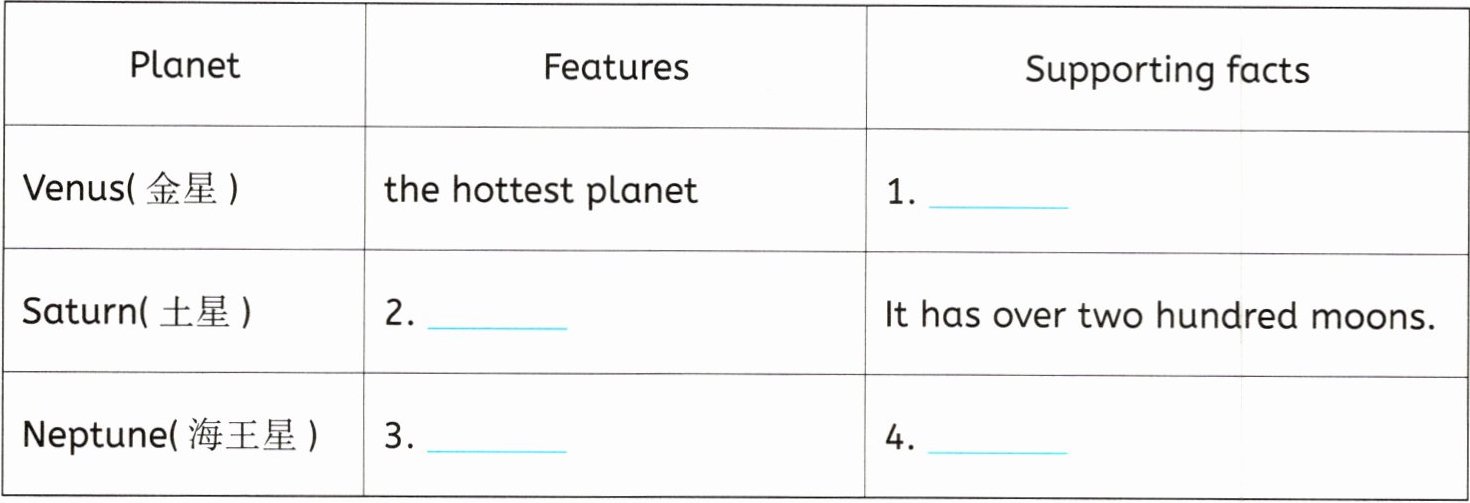
任务一:根据阅读内容,把表格补充完整。(填序号)
Features( 特征 )
① has the fastest wind
② has growing space junk
③ a planet with many moons
Supporting facts( 支撑事实 )
a. It has over ten moons.
b. It has a temperature of about $467°\mathrm{C}$.
c. Its winds can reach over 2,000 kilometres per hour.
任务二:根据阅读内容,选出正确的答案。
(
A. Mercury( 水星 ) is the hottest planet in the solar system.
B. The Great Red Spot( 大红斑 ) on Jupiter( 木星 ) may be over 300 years old.
(
A. Saturn( 土星 ) has only two hundred moons for sure.
B. Footprints on the Moon could stay there for a very long time.
任务三:结合阅读内容和你知道的太阳系知识,回答下面两个问题。
Do you want to visit a planet in the solar system? Why or why not?
任务一:根据阅读内容,把表格补充完整。(填序号)
Features( 特征 )
① has the fastest wind
② has growing space junk
③ a planet with many moons
Supporting facts( 支撑事实 )
a. It has over ten moons.
b. It has a temperature of about $467°\mathrm{C}$.
c. Its winds can reach over 2,000 kilometres per hour.
任务二:根据阅读内容,选出正确的答案。
(
B
)1. Which is TRUE about the solar system( 太阳系 )?A. Mercury( 水星 ) is the hottest planet in the solar system.
B. The Great Red Spot( 大红斑 ) on Jupiter( 木星 ) may be over 300 years old.
(
B
)2. What can we learn from the reading?A. Saturn( 土星 ) has only two hundred moons for sure.
B. Footprints on the Moon could stay there for a very long time.
任务三:结合阅读内容和你知道的太阳系知识,回答下面两个问题。
Do you want to visit a planet in the solar system? Why or why not?
Yes, I want to visit Jupiter.
Because it has a big storm called
the Great Red Spot. It must be very
amazing to see it.(答案合理即可)
答案
任务一: 1. b 2. ③ 3. ① 4. c
任务二: 1. B 2. B
任务三: Yes, I want to visit Jupiter.
Because it has a big storm called
the Great Red Spot. It must be very
amazing to see it.(答案合理即可)
任务二: 1. B 2. B
任务三: Yes, I want to visit Jupiter.
Because it has a big storm called
the Great Red Spot. It must be very
amazing to see it.(答案合理即可)
解析
【分析】
本题是关于太阳系行星知识的英语阅读理解题,分为三个任务。任务一需根据行星特征匹配对应支撑事实:金星是最热的行星,对应其高温数据;土星特征为拥有很多卫星,对应其卫星数量;海王星特征为拥有最快的风,对应其风速数据。任务二为选择题,需结合太阳系常识判断选项正误:最热行星是金星而非水星,土星卫星超200个,木星大红斑的相关知识。任务三为开放题,需结合太阳系知识表达是否想拜访某行星及原因,答案合理即可。
【解析】
任务一:1. 金星是最热的行星,支撑事实为温度约467℃,对应b;2. 土星特征是有很多卫星,对应序号③;3. 海王星特征是有最快的风,对应序号①;4. 海王星风速超2000公里每小时,对应c。任务二:1. A选项水星是最热行星错误,B选项木星大红斑可能超300年正确,选B;2. A选项土星只有200个卫星错误,B选项月球脚印会留存很久正确,选B。任务三:结合太阳系知识,合理表达即可,示例答案符合要求。
【答案】
任务一: 1. b 2. ③ 3. ① 4. c;任务二: 1. B 2. B;任务三: Yes, I want to visit Jupiter. Because it has a big storm called the Great Red Spot. It must be very amazing to see it.(答案合理即可)
【知识点】
太阳系行星知识、英语阅读理解、信息匹配
【点评】
本题考查学生对太阳系行星相关知识的掌握及英语信息处理能力,通过任务形式巩固行星特征与对应事实的匹配,开放题鼓励学生结合知识拓展表达,难度适中。
【难度系数】
0.6
本题是关于太阳系行星知识的英语阅读理解题,分为三个任务。任务一需根据行星特征匹配对应支撑事实:金星是最热的行星,对应其高温数据;土星特征为拥有很多卫星,对应其卫星数量;海王星特征为拥有最快的风,对应其风速数据。任务二为选择题,需结合太阳系常识判断选项正误:最热行星是金星而非水星,土星卫星超200个,木星大红斑的相关知识。任务三为开放题,需结合太阳系知识表达是否想拜访某行星及原因,答案合理即可。
【解析】
任务一:1. 金星是最热的行星,支撑事实为温度约467℃,对应b;2. 土星特征是有很多卫星,对应序号③;3. 海王星特征是有最快的风,对应序号①;4. 海王星风速超2000公里每小时,对应c。任务二:1. A选项水星是最热行星错误,B选项木星大红斑可能超300年正确,选B;2. A选项土星只有200个卫星错误,B选项月球脚印会留存很久正确,选B。任务三:结合太阳系知识,合理表达即可,示例答案符合要求。
【答案】
任务一: 1. b 2. ③ 3. ① 4. c;任务二: 1. B 2. B;任务三: Yes, I want to visit Jupiter. Because it has a big storm called the Great Red Spot. It must be very amazing to see it.(答案合理即可)
【知识点】
太阳系行星知识、英语阅读理解、信息匹配
【点评】
本题考查学生对太阳系行星相关知识的掌握及英语信息处理能力,通过任务形式巩固行星特征与对应事实的匹配,开放题鼓励学生结合知识拓展表达,难度适中。
【难度系数】
0.6
