

 登录
登录
探究点 与show有关的短语的用法
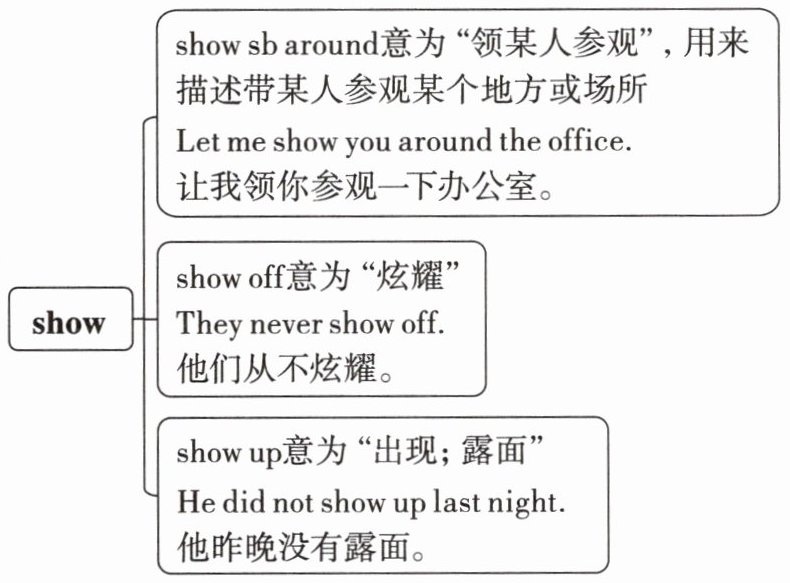
show sb around意为“领某人参观”,用来描述带某人参观某个地方或场所
Let me show you around the office.
让我领你参观一下办公室。
show off意为“炫耀”
They never show off.
他们从不炫耀。
show up意为“出现;露面”
He did not show up last night.
他昨晚没有露面。
情境应用
1. David couldn’t wait to ______ his new watch as soon as he arrived here.
A. show off
B. depend on
C. warm up
D. hang up
(
2. All the guests arrived at the party but the host didn’t ______.(露面)
3. He was glad to ______ the school.(领我们参观)
show sb around意为“领某人参观”,用来描述带某人参观某个地方或场所
Let me show you around the office.
让我领你参观一下办公室。
show off意为“炫耀”
They never show off.
他们从不炫耀。
show up意为“出现;露面”
He did not show up last night.
他昨晚没有露面。
情境应用
1. David couldn’t wait to ______ his new watch as soon as he arrived here.
A. show off
B. depend on
C. warm up
D. hang up
(
A
)2. All the guests arrived at the party but the host didn’t ______.(露面)
show up
3. He was glad to ______ the school.(领我们参观)
show us around
答案
1. A;2. show up;3. show us around
解析
1. 句意:大卫一到这儿就迫不及待地炫耀他的新手表。选项A“show off”意为“炫耀”,符合语境;B“depend on”依靠;C“warm up”热身;D“hang up”挂断。故选A。
2. “露面”对应短语“show up”,助动词didn’t后接动词原形,故填show up。
3. “领我们参观”对应短语“show us around”,be glad to后接动词原形,故填show us around。
2. “露面”对应短语“show up”,助动词didn’t后接动词原形,故填show up。
3. “领我们参观”对应短语“show us around”,be glad to后接动词原形,故填show us around。
找出画线部分与其他单词发音不同的选项
(
B. little
C. listen
D. middle
(
B. health
C. reason
D. speaker
(
B. message
C. rehearsal
D. seven
(
B. face
C. communication
D. apple
(
B. often
C. local
D. soft
(
A
) 1. A. signB. little
C. listen
D. middle
(
B
) 2. A. eagleB. health
C. reason
D. speaker
(
C
) 3. A. textB. message
C. rehearsal
D. seven
(
D
) 4. A. ableB. face
C. communication
D. apple
(
C
) 5. A. possibleB. often
C. local
D. soft
答案
1. A
2. B
3. C
4. D
5. C
2. B
3. C
4. D
5. C
解析
1. A. sign /aɪ/ - B. little /ɪ/ - C. listen /ɪ/ - D. middle /ɪ/
2. A. eagle /iː/ - B. health /e/ - C. reason /iː/ - D. speaker /iː/
3. A. text /e/ - B. message /e/ - C. rehearsal /ɪ/ 或 /i/(美式发音)- D. seven /e/
(C 项发音与其他不同, 但考虑到八年级学生可能不熟悉 rehearsal 的发音, 所以主要比较 A, B, D 都是 /e/ )
4. A. able /eɪ/ - B. face /eɪ/ - C. communication /eɪ/ - D. apple /æ/
5. A. possible /ɒ/ - B. often /ɒ/ - C. local /əʊ/(在某些口音中可能不同, 但标准发音为 /oʊ/)- D. soft /ɒ/
2. A. eagle /iː/ - B. health /e/ - C. reason /iː/ - D. speaker /iː/
3. A. text /e/ - B. message /e/ - C. rehearsal /ɪ/ 或 /i/(美式发音)- D. seven /e/
(C 项发音与其他不同, 但考虑到八年级学生可能不熟悉 rehearsal 的发音, 所以主要比较 A, B, D 都是 /e/ )
4. A. able /eɪ/ - B. face /eɪ/ - C. communication /eɪ/ - D. apple /æ/
5. A. possible /ɒ/ - B. often /ɒ/ - C. local /əʊ/(在某些口音中可能不同, 但标准发音为 /oʊ/)- D. soft /ɒ/
Ⅰ. 根据句意,用括号中所给词的适当形式填空
1. The
2. Listen to the
3. When I’m
4. We should use English as often as possible in daily
5. He will
1. The
sign
on the wall tells us not to take photos here. (sign)2. Listen to the
speaker
carefully, or you will miss the important point of his talk. (speak)3. When I’m
tired
, I enjoy reading on the sofa for a rest. (tire)4. We should use English as often as possible in daily
communication
. (communicate)5. He will
probably
go to the library to read books at the weekend. (probable)答案
1. sign
2. speaker
3. tired
4. communication
5. probably
2. speaker
3. tired
4. communication
5. probably
解析
1. 句意“墙上的____告诉我们不要在这拍照”,定冠词the后需接名词,sign“标志”符合题意。
2. “仔细听____,否则你会错过他谈话的要点”,定冠词the后需接名词,根据“his talk”可推断此处指听“演讲者”,speak的名词形式speaker符合题意。
3. “当我累的时候,我喜欢在沙发上看书休息”,tire的形容词形式有two(两个(种))即tired和tiring,tired“感到累的”常用于修饰人,tiring“令人困倦的”,常用来修饰物,此处主语为I,故填tired。
4. “我们在日常____中应该尽可能经常地使用英语”,daily communicatio(n可作 “交流,沟通”解,此时为不可数名词。)“日常交流”符合题意,故填communication。
5. “他周末可能会去图书馆看书”,go为动词,此处需用副词修饰,probable的副词形式为probably。
2. “仔细听____,否则你会错过他谈话的要点”,定冠词the后需接名词,根据“his talk”可推断此处指听“演讲者”,speak的名词形式speaker符合题意。
3. “当我累的时候,我喜欢在沙发上看书休息”,tire的形容词形式有two(两个(种))即tired和tiring,tired“感到累的”常用于修饰人,tiring“令人困倦的”,常用来修饰物,此处主语为I,故填tired。
4. “我们在日常____中应该尽可能经常地使用英语”,daily communicatio(n可作 “交流,沟通”解,此时为不可数名词。)“日常交流”符合题意,故填communication。
5. “他周末可能会去图书馆看书”,go为动词,此处需用副词修饰,probable的副词形式为probably。
Ⅱ. 将下列句子中汉语部分译成英语,注意使用适当的形式
1. We must arrive at school
2. Many young people like to use
3. We should talk
4. I
5. We visited Chongqing last winter. We tasted the
1. We must arrive at school
on time
and not be late.(按时)2. Many young people like to use
text messages
to communicate nowadays.(短信)3. We should talk
face to face
with our parents so that we can understand each other better.(面对面)4. I
picked up
my grandmother at the station yesterday and I was very happy to see her.(开车接)5. We visited Chongqing last winter. We tasted the
local food
hot pot and it was really delicious.(当地的食物)答案
1. on time
2. text messages
3. face to face
4. picked up
5. local food
2. text messages
3. face to face
4. picked up
5. local food
解析
1. "按时"常用短语"on time",在句中作状语。
2. "短信"对应的英语是"text messages",此处表示泛指,用复数形式。
3. "面对面"的固定短语是"face to face",在句中修饰动词"talk"。
4. "开车接"用短语"pick up",根据时间状语"yesterday"可知用一般过去时,pick的过去式是"picked"。
5. "当地的食物"中"当地的"是"local","食物"是"food","local food"修饰"hot pot"。
2. "短信"对应的英语是"text messages",此处表示泛指,用复数形式。
3. "面对面"的固定短语是"face to face",在句中修饰动词"talk"。
4. "开车接"用短语"pick up",根据时间状语"yesterday"可知用一般过去时,pick的过去式是"picked"。
5. "当地的食物"中"当地的"是"local","食物"是"food","local food"修饰"hot pot"。
