

 登录
登录
3 Read the article from a magazine in the USA. 阅读一篇美国杂志文章。
Why do prices often end in “.99”?
Have you noticed how many prices end in “.99”? A toy might cost $19.99 instead of $20, or a snack might be $4.99 instead of $5. It looks like only a tiny difference, but have you ever thought about why stores do this?
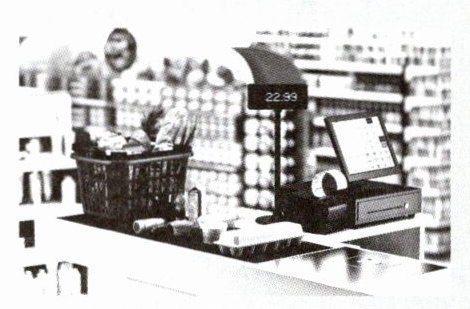
This pricing method is called “Charm pricing”. It means setting prices just below a round number, like $19.99. Even though $19.99 and $20 are almost the same, people feel that $19.99 is much cheaper. That one cent can change how we feel about the price!
Why does this trick work? Economists explain it with something called the “Left - digit effect”. When we read numbers, our brain looks at the first digit first. So when we see $19.99, our mind focuses on “19” instead of rounding it up to “20”. It feels like a better deal, even though the difference is small.Charm pricing is used almost everywhere. Online shops often set prices like $99.99 or $49.99. Clothing stores may sell a shirt for $29.99. Even technology companies sell phones at $999 instead of $1,000. People often believe they are paying less, so they are more willing (愿意) to buy.
There is even a real example. A store in the USA once tried using only round numbers for all their products. But customers didn’t like it, and sales dropped. Later, the store returned to charm pricing like $49.99 — and sales quickly went up again!Of course, charm pricing doesn’t work equally (同样地) well for all products. It is most common with everyday items, discounts or low - to mid - priced goods. But when it comes to luxury products, such as jewellery or designer bags, stores prefer to use round numbers, like $8,000, because round prices make things look more special and high - class.
Next time you go shopping, look closely at the price tags. That little “.99” may be doing more work than you think!
3-1 Tick (√) the examples mentioned in the article. 勾选文章中提到的例子。
□ A. A phone is sold at 999 instead of 1,000.
□ B. A USA store tried round numbers, but sales went down.
□ C. A shirt may cost 29.99 in clothing stores.
□ D. A supermarket sells apples for 1 each.
□ E. A designer bag is priced at 8,000 to look more special.
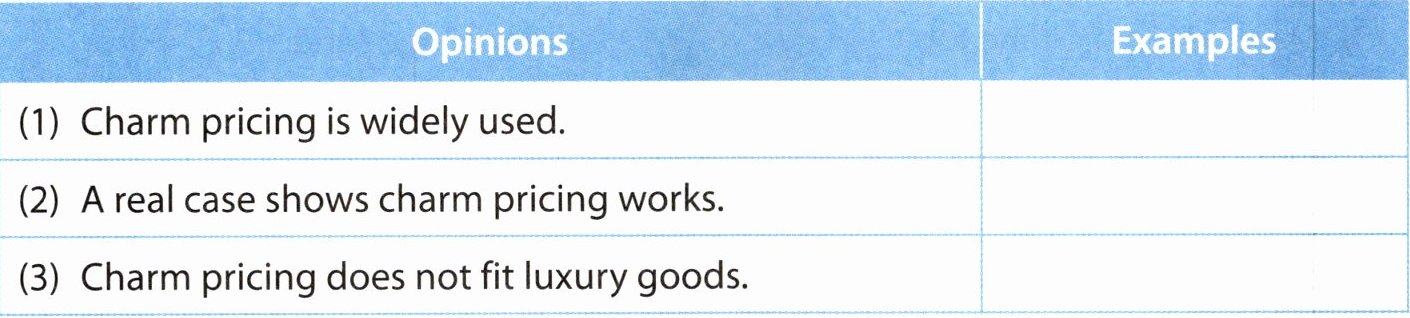
3-2 Match the examples A to E you ticked in Exercise 3-1 with the following opinions. 将练习 3-1 中你勾选出的例子与下列观点配对,填写序号(A-E)。
3-3 Explain the following terms according to the article. 根据文章内容解释下列术语。
(1) Charm pricing:
(2) Left - digit effect:
(3) Round price:
3-4 Answer the questions. 回答问题。
What do you think of prices ending in “.99”? Do you believe it really makes things cheaper, or is it just a trick? Why?
Why do prices often end in “.99”?
Have you noticed how many prices end in “.99”? A toy might cost $19.99 instead of $20, or a snack might be $4.99 instead of $5. It looks like only a tiny difference, but have you ever thought about why stores do this?
This pricing method is called “Charm pricing”. It means setting prices just below a round number, like $19.99. Even though $19.99 and $20 are almost the same, people feel that $19.99 is much cheaper. That one cent can change how we feel about the price!
Why does this trick work? Economists explain it with something called the “Left - digit effect”. When we read numbers, our brain looks at the first digit first. So when we see $19.99, our mind focuses on “19” instead of rounding it up to “20”. It feels like a better deal, even though the difference is small.Charm pricing is used almost everywhere. Online shops often set prices like $99.99 or $49.99. Clothing stores may sell a shirt for $29.99. Even technology companies sell phones at $999 instead of $1,000. People often believe they are paying less, so they are more willing (愿意) to buy.
There is even a real example. A store in the USA once tried using only round numbers for all their products. But customers didn’t like it, and sales dropped. Later, the store returned to charm pricing like $49.99 — and sales quickly went up again!Of course, charm pricing doesn’t work equally (同样地) well for all products. It is most common with everyday items, discounts or low - to mid - priced goods. But when it comes to luxury products, such as jewellery or designer bags, stores prefer to use round numbers, like $8,000, because round prices make things look more special and high - class.
Next time you go shopping, look closely at the price tags. That little “.99” may be doing more work than you think!
3-1 Tick (√) the examples mentioned in the article. 勾选文章中提到的例子。
□ A. A phone is sold at 999 instead of 1,000.
□ B. A USA store tried round numbers, but sales went down.
□ C. A shirt may cost 29.99 in clothing stores.
□ D. A supermarket sells apples for 1 each.
□ E. A designer bag is priced at 8,000 to look more special.
3-2 Match the examples A to E you ticked in Exercise 3-1 with the following opinions. 将练习 3-1 中你勾选出的例子与下列观点配对,填写序号(A-E)。
3-3 Explain the following terms according to the article. 根据文章内容解释下列术语。
(1) Charm pricing:
(2) Left - digit effect:
(3) Round price:
3-4 Answer the questions. 回答问题。
What do you think of prices ending in “.99”? Do you believe it really makes things cheaper, or is it just a trick? Why?
答案
3-1:A√ B√ C√ E√
3-2:(1)A,C;(2)B;(3)E
3-3:(1)Setting prices just below a round number. (2)When we read numbers, our brain looks at the first digit first, so we focus on the first digit instead of rounding it up. (3)A round number, like 20, 1,000 or 8,000.
3-4:I think it's just a trick. It doesn't really make things cheaper because the difference is very small (only one cent). It works because of the left-digit effect, making people feel the price is lower by focusing on the first digit.
3-2:(1)A,C;(2)B;(3)E
3-3:(1)Setting prices just below a round number. (2)When we read numbers, our brain looks at the first digit first, so we focus on the first digit instead of rounding it up. (3)A round number, like 20, 1,000 or 8,000.
3-4:I think it's just a trick. It doesn't really make things cheaper because the difference is very small (only one cent). It works because of the left-digit effect, making people feel the price is lower by focusing on the first digit.
解析
3-1题需从文章中找出提到的例子。A项手机售价999而非1000,第四段提及;B项美国商店尝试整数定价销量下降,第五段提及;C项服装店衬衫29.99,第四段提及;E项设计师包8000显特别,第六段提及;D项未提及。3-2题中,(1)“Charm pricing广泛使用”对应A、C(科技公司、服装店例子);(2)“真实案例显示有效”对应B(商店销量变化);(3)“不适合奢侈品”对应E(设计师包定价)。3-3题根据文章第二段、第三段、第六段分别解释术语。3-4题结合文章“left-digit effect”及价格差异小的特点回答。
