登录
9. (徐州中考改编)若函数$y=-2x^2$的图象过点$P(1,c)$,将该函数图象向右平移,当它再次经过点$P$时,所得的图象对应的函数表达式为________。
答案
9. $y=-2(x-2)^2$ 解析:$\because$ 函数$y=-2x^2$的图象过点$P$,把点$P(1,c)$代入,得$c=-2$,$\therefore P(1,-2)$.设平移后的抛物线表达式为$y=-2(x-b)^2$.把点$P(1,-2)$代入,得$-2=-2(1-b)^2$,解得$b=0$(舍去)或$b=2$.$\therefore$ 将该函数图象向右平移,当它再次经过点$P$时,所得的图象对应的函数表达式为$y=-2(x-2)^2$.
10. 点A(s,t)在二次函数$y=2(x-m)^2$($m$为常数)的图象上,$s-m=t(t≠0)$。当$s-1≤x≤s+2$时,二次函数的最大值与最小值的差为
$\frac{25}{2}$
。答案
10. $\frac{25}{2}$ 解析:$\because$ 点$A(s,t)$在二次函数$y=2(x-m)^2$($m$为常数)的图象上,$\therefore t=2(s-m)^2$.$\because s-m=t(t≠0)$,$\therefore t=2t^2$,解得$t_1=\frac{1}{2}$,$t_2=0$(舍去),$\therefore s=m+\frac{1}{2}$.$\because s-1≤ x≤ s+2$,$s=m+\frac{1}{2}$,$\therefore m+\frac{1}{2}-1≤ x≤ m+\frac{1}{2}+2$,即$m-\frac{1}{2}≤ x≤ m+\frac{5}{2}$.$\because$ 抛物线的对称轴为直线$x=m$,且开口向上,$\therefore$ 当$x=m+\frac{5}{2}$时,$y$有最大值,$y_{最大值}=2×(\frac{5}{2})^2=\frac{25}{2}$;当$x=m$时,$y$有最小值,$y_{最小值}=0$.故二次函数的最大值与最小值的差为$\frac{25}{2}$.
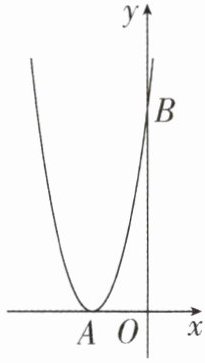
11. 如图,二次函数$y=(x+4)^2$的图象与x轴交于点A,与y轴交于点B.(1)求点A,B的坐标.(2)求抛物线的对称轴.(3)在对称轴上是否存在一点P,使以P,A,O,B为顶点的四边形为平行四边形?若存在,求出点P的坐标;若不存在,请说明理由.
答案
(1) 令$y=0$,则$(x+4)^2=0$,解得$x=-4$,$\therefore A(-4,0)$.令$x=0$,则$y=(0+4)^2=16$,$\therefore B(0,16)$.$\therefore A(-4,0)$,$B(0,16)$.
(2) $\because$ 二次函数的表达式为$y=(x+4)^2$,$\therefore$ 抛物线的对称轴为直线$x=-4$.
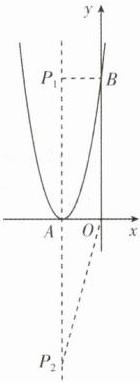
(3) $\because B(0,16)$,$\therefore OB=16$.$\because$ 对称轴上一点$P$,使以$P,A,O,B$为顶点的四边形为平行四边形,$\therefore OB=AP=16$,$OB// AP$,$\therefore$ 存在如图四边形$P_1AOB$和四边形$P_2ABO$两种平行四边形.$\because$ 抛物线的对称轴为直线$x=-4$,$\therefore$ 此时$P_1(-4,16)$,$P_2(-4,-16)$.
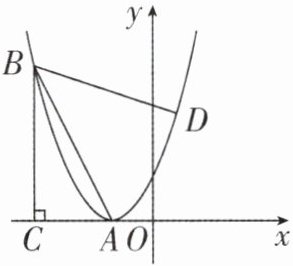
12. (2025·广州期中)如图, 抛物线 $y=(x+1)^2$ 的顶点为A,过点A左侧抛物线上一点B作 $BC ⊥ x$ 轴于点C,且 $BC=2AC$.
(1) $AC=$
(2)若D是抛物线上的一点且 $∠ ABD=45°$,求点D的坐标.
(1) $AC=$
$2$
;(2)若D是抛物线上的一点且 $∠ ABD=45°$,求点D的坐标.
答案
12. (1) 2 解析:设$AC=a$,$\because$ 抛物线$y=(x+1)^2$的顶点$A$的坐标是$(-1,0)$,则点$C$的坐标是$(-1-a,0)$.当$x=-1-a$时,$y=(-1-a+1)^2=a^2$,$\therefore BC=a^2$.$\because BC=2AC$,$\therefore a^2=2a$,解得$a=2$或$a=0$(不符合题意,舍去),$\therefore AC=2$.
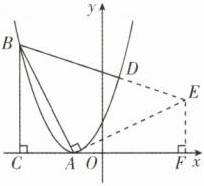
(2) 如图,过点$A$作$AE⊥ AB$,与$BD$的延长线交于点$E$,$\because ∠ ABD=45°$,$\therefore AE=AB$,作$EF⊥ x$轴于点$F$,$\therefore ∠ BAE=90°$,$\therefore ∠ BAC+∠ EAF=90°$.$\because BC⊥ x$轴,$\therefore ∠ BCA=90°$,$\therefore ∠ BAC+∠ ABC=90°$,$\therefore ∠ ABC=∠ EAF$.在$△ ABC$和$△ EAF$中,$\begin{cases}∠ ACB=∠ EFA=90°,\\∠ ABC=∠ EAF,\\AB=AE,\end{cases}$ $\therefore △ ABC≌△ EAF(\mathrm{AAS})$,$\therefore BC=AF$,$AC=EF$.由(1)可知$a=2$,$\therefore$ 点$C$的坐标是$(-3,0)$,点$B$的坐标是$(-3,4)$,$\therefore AF=BC=4$.$\because$ 点$A$的坐标是$(-1,0)$,$\therefore AO=1$,$\therefore OF=AF-AO=4-1=3$.由(1)可知$AC=2$,$\therefore EF=2$,$\therefore$ 点$E$的坐标是$(3,2)$.设直线$BE$的表达式是$y=kx+b(k≠0)$,把点$B$的坐标$(-3,4)$和点$E$的坐标$(3,2)$代入$y=kx+b(k≠0)$,可得$\begin{cases}-3k+b=4,\\3k+b=2,\end{cases}$ 解得$\begin{cases}k=-\dfrac{1}{3},\\b=3,\end{cases}$ $\therefore$ 直线$BE$的表达式是$y=-\dfrac{1}{3}x+3$.解方程组$\begin{cases}y=-\dfrac{1}{3}x+3,\\y=(x+1)^2,\end{cases}$ 可得$\begin{cases}x_1=\dfrac{2}{3},\\y_1=\dfrac{25}{9},\end{cases}$ $\begin{cases}x_2=-3,\\y_2=4\end{cases}$ (与点$B$重合,舍去),$\therefore$ 点$D$的坐标是$(\dfrac{2}{3},\dfrac{25}{9})$.