

 登录
I 用所给单词的适当形式填空。
1. The leaves are
2.
3. I
4. Autumn is
5. Each season has its own
1. The leaves are
turning
(turn) yellow.2.
Flowers
(flower) come out in spring.3. I
don't
(do not) like autumn. Sometimes it makes
(make) me sad.4. Autumn is
coming
(come)!5. Each season has its own
beauty
(beautiful).答案
1. turning 2. Flowers 3. don't; makes 4. coming 5. beauty
解析
【分析】
本题考查动词形式变化、名词单复数及词性转换,需结合句子时态、主谓一致和词性要求分析:1. 句子为现在进行时,需用动词现在分词;2. 谓语为原形,主语需用复数;3. 结合一般现在时的否定和第三人称单数变化;4. 现在进行时表将来,用动词现在分词;5. own后接名词,需转换词性。
【解析】
1. 句子是现在进行时,结构为“be + 现在分词”,turn的现在分词是turning,故填turning。
2. 谓语动词come为原形,主语需用复数,flower的复数是Flowers,句首大写,故填Flowers。
3. 第一空:一般现在时,主语I的否定形式用don't;第二空:主语it是第三人称单数,谓语动词make变makes,故填don't; makes。
4. 现在进行时可表将来,结构为“be + 现在分词”,come的现在分词是coming,故填coming。
5. own是形容词,后接名词,beautiful的名词形式是beauty,故填beauty。
【答案】
1. turning 2. Flowers 3. don't; makes 4. coming 5. beauty
【知识点】
现在进行时、一般现在时、词性转换
【点评】
本题为基础语法题,考查时态结构、主谓一致及词性转换,需掌握核心语法规则即可解答。
【难度系数】
0.6
Ⅱ. 根据句子描述,给拼图排序。
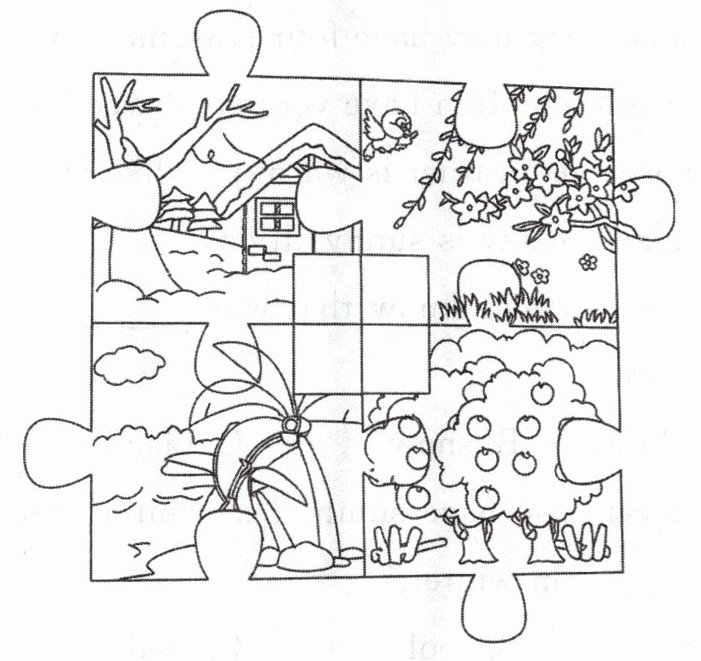
1. Lily’s favourite season is summer. It’s sunny and hot.
2. In this season, you can make a snowman with your friends.
3. In this season, flowers come out and the weather gets warm.
4. We can eat lots of fruit in this season. It’s a season of harvest.
1. Lily’s favourite season is summer. It’s sunny and hot.
2. In this season, you can make a snowman with your friends.
3. In this season, flowers come out and the weather gets warm.
4. We can eat lots of fruit in this season. It’s a season of harvest.
答案
解析
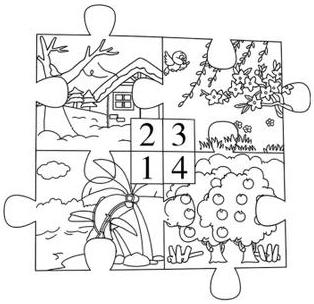
【分析】要解决拼图排序问题,需先根据句子描述匹配对应季节,再按季节的自然先后顺序排列拼图。第一步:分析每个句子对应的季节:句子1描述炎热晴朗,对应夏天;句子2描述堆雪人,对应冬天;句子3描述花开温暖,对应春天;句子4描述丰收吃水果,对应秋天。第二步:匹配拼图与季节:标有数字3的拼图有花和小鸟,是春天场景;标有数字1的拼图有椰子树,是夏天场景;标有数字4的拼图有苹果树,是秋天场景;标有数字2的拼图有房屋,是冬天场景。第三步:按“春→夏→秋→冬”的季节顺序排列,得到结果。
【解析】1. 句子与季节匹配:句子1对应夏天,句子2对应冬天,句子3对应春天,句子4对应秋天;2. 拼图与季节匹配:拼图3为春天,拼图1为夏天,拼图4为秋天,拼图2为冬天;3. 季节先后顺序为春、夏、秋、冬,因此拼图排序为3、1、4、2。
【答案】3、1、4、2
【知识点】季节认知,句子理解
【点评】本题结合季节场景考查句子理解与逻辑排序,需要学生掌握不同季节的典型特征,难度适中,适合小学英语学习阶段的练习。
【难度系数】0.5
【解析】1. 句子与季节匹配:句子1对应夏天,句子2对应冬天,句子3对应春天,句子4对应秋天;2. 拼图与季节匹配:拼图3为春天,拼图1为夏天,拼图4为秋天,拼图2为冬天;3. 季节先后顺序为春、夏、秋、冬,因此拼图排序为3、1、4、2。
【答案】3、1、4、2
【知识点】季节认知,句子理解
【点评】本题结合季节场景考查句子理解与逻辑排序,需要学生掌握不同季节的典型特征,难度适中,适合小学英语学习阶段的练习。
【难度系数】0.5
Ⅲ. 阅读短文,完成下列任务。
In England, people often talk about the weather because they can experience(经历)four seasons in one day. In the morning, the weather is warm just like in spring. An hour later, black clouds come and then it rains hard. The weather gets a little cold. In the late afternoon, the sun begins to shine, the weather gets sunny, and it is like in summer at this time of day.
In England, people can also have summer in winter, or have winter in summer. So in winter they can swim sometimes, and sometimes in summer they should take warm clothes.
When you go to England, you will see that some English people usually take an umbrella(伞)or a raincoat with them on a sunny morning, but you should not laugh at them.
If you don't take an umbrella or a raincoat, you will regret(后悔)later in the day.
任务一:根据短文内容,选择正确的选项。
(
A. Because they may have four seasons in one day.
B. Because they often have very good weather.
C. Because the weather is warm just like in spring.
D. Because the sky is sunny all day.
(
A. sunshine B. snow C. black clouds D. wind
(
A. warm B. cool C. cold D. rainy
(
A. their friends ask them to do so
B. it often rains in England
C. they are going to sell them
D. they are their favourite things
任务二:根据实际情况,回答问题。
What's your favourite season in China? Why?
In England, people often talk about the weather because they can experience(经历)four seasons in one day. In the morning, the weather is warm just like in spring. An hour later, black clouds come and then it rains hard. The weather gets a little cold. In the late afternoon, the sun begins to shine, the weather gets sunny, and it is like in summer at this time of day.
In England, people can also have summer in winter, or have winter in summer. So in winter they can swim sometimes, and sometimes in summer they should take warm clothes.
When you go to England, you will see that some English people usually take an umbrella(伞)or a raincoat with them on a sunny morning, but you should not laugh at them.
If you don't take an umbrella or a raincoat, you will regret(后悔)later in the day.
任务一:根据短文内容,选择正确的选项。
(
A
)1. Why do people in England often talk about the weather?A. Because they may have four seasons in one day.
B. Because they often have very good weather.
C. Because the weather is warm just like in spring.
D. Because the sky is sunny all day.
(
C
)2. From the story we know that when black clouds
come(s), there is a heavy rain.A. sunshine B. snow C. black clouds D. wind
(
A
)3. “People can also have summer in winter” means “It is sometimes too warm
in winter.”A. warm B. cool C. cold D. rainy
(
B
)4. On a sunny morning, some English people usually take a raincoat or an umbrella with them because it often rains in England
.A. their friends ask them to do so
B. it often rains in England
C. they are going to sell them
D. they are their favourite things
任务二:根据实际情况,回答问题。
What's your favourite season in China? Why?
略
答案
任务一:1. A 2. C 3. A 4. B
任务二:略
任务二:略
解析
【分析】
本题分为任务一(细节理解选择题)和任务二(开放性问答)。任务一需回到原文定位对应信息,逐一匹配选项;任务二结合自身实际情况回答即可。
1. 第1题:定位原文首句找谈论天气的原因;
2. 第2题:定位原文中大雨来临的标志;
3. 第3题:理解“冬天有夏天”的含义,结合原文冬天能游泳的信息;
4. 第4题:定位原文英国人带伞的原因;
任务二:围绕中国最喜欢的季节及原因作答,符合实际即可。
【解析】
任务一:
1. 原文第一句“In England, people often talk about the weather because they can experience four seasons in one day.”明确说明原因,对应选项A,故选A。
2. 原文“An hour later, black clouds come and then it rains hard.”指出乌云来后会下大雨,对应选项C,故选C。
3. 原文“So in winter they can swim sometimes”说明冬天有时暖和,像夏天,对应选项A,故选A。
4. 全文讲述英国天气多变,随时可能下雨,所以晴天也带伞,对应选项B,故选B。
任务二:
本题为开放性问题,需结合自身实际回答,例如:My favourite season in China is autumn. Because it is cool and the sky is blue, I can pick apples with my family.(答案不唯一,符合要求即可)
【答案】
任务一:1. A 2. C 3. A 4. B
任务二:略
【知识点】
英语阅读理解、细节理解题
【点评】
本题为基础英语阅读题,侧重考查学生从原文提取关键信息的能力,题目难度较低,贴近生活实际,适合巩固英语阅读基础。
【难度系数】
0.8
