登录
【例2】如图,在平面直角坐标系中,点B的坐标为(a,b),且a,b满足$\sqrt{a+2b-6}+(a-b)^2=0$。
(1)求点B的坐标;
(2)点A为y轴上一动点,过点B作BC⊥AB,交x轴正半轴于点C,求证BA=BC。
[听课笔记]
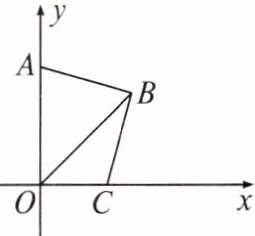
(1)求点B的坐标;
(2)点A为y轴上一动点,过点B作BC⊥AB,交x轴正半轴于点C,求证BA=BC。
[听课笔记]
答案
1. 解 $\because \sqrt{a+2b-6}+(a-b)^2=0,$
$\therefore \begin{cases} a+2b-6=0,\\ a-b=0, \end{cases}$
$\therefore a=2,b=2,\therefore$ 点 B 的坐标为$(2,2).$
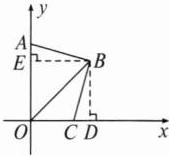
2. 证明 如图,过点 B 作 $BE⊥ y$ 轴交 y 轴于点 E,作 $BD⊥ x$ 轴交 x 轴于点 D,$\therefore ∠ EBD=90°.$
由(1)知点 B 的坐标为$(2,2)$,$\therefore BE=BD=2.$
$\because ∠ ABE+∠ EBC=90°,∠ EBC+∠ CBD=90°,$
$\therefore ∠ ABE=∠ CBD.$
在$△ ABE$ 和$△ CBD$ 中,$\begin{cases} ∠ ABE=∠ CBD,\\ BE=BD,\\ ∠ AEB=∠ CDB, \end{cases}$
$\therefore △ ABE≌ △ CBD(\mathrm{ASA}),$
$\therefore BA=BC.$
【对点训练2】如图,在四边形ABCD中,AB = AD,BC=DC,E,F分别为AB,AD的中点,连接EC,FC.
(1) ∠B与∠D相等吗?请说明理由.
(2) 求证EC=FC.
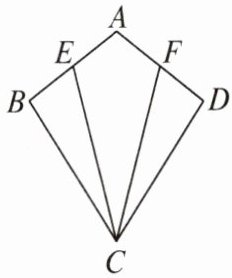
(1) ∠B与∠D相等吗?请说明理由.
(2) 求证EC=FC.
答案
1. 解 $∠ B$ 与 $∠ D$ 相等,理由如下:连接 AC,在$△ ABC$ 和$△ ADC$ 中,$\begin{cases} AB=AD,\\ BC=DC,\\ AC=AC, \end{cases}$
$\therefore △ ABC≌ △ ADC(\mathrm{SSS}),\therefore ∠ B=∠ D.$
2. 证明 $\because$ 点 E,F 分别是 AB,AD 的中点,$\therefore AE=\frac{1}{2}AB,AF=\frac{1}{2}AD. \because AB=AD,\therefore AE=AF.$
由(1)知$△ ABC≌ △ ADC,\therefore ∠ EAC=∠ FAC.$
在$△ AEC$ 和$△ AFC$ 中,$\begin{cases} AE=AF,\\ ∠ EAC=∠ FAC,\\ AC=AC, \end{cases}$
$\therefore △ AEC≌ △ AFC(\mathrm{SAS}),\therefore EC=FC.$
【例3】如图,在$△ ABC$中,$D$,$E$分别是边$AB$,$AC$延长线上的点,$AP$平分$∠ BAC$,$BP$平分$∠ CBD$,求证:$CP$平分$∠ BCE$。
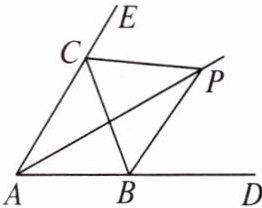
[听课笔记]
[听课笔记]
答案
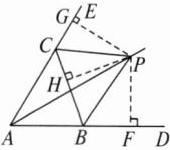
证明 过点 P 作 $PF⊥ AD$,$PG⊥ AE$,$PH⊥ BC$,垂足分别为 F,G,H.
$\because AP$ 平分 $∠ BAC$,且 $PF⊥ AD,PG⊥ AE,\therefore PF=PG.$
$\because BP$ 平分 $∠ CBD,PF⊥ AD,PH⊥ BC,$
$\therefore PF=PH. \therefore PG=PH. \because PG⊥ AE,PH⊥ BC,$
$\therefore$ 点 P 在 $∠ BCG$ 的平分线上,即 CP 平分 $∠ BCE.$
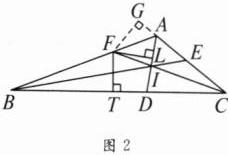
【对点训练3】如图,在$△ ABC$中,$∠ BAC = 120°$,$BE$,$CF$是$△ ABC$的角平分线,它们相交于点$I$。
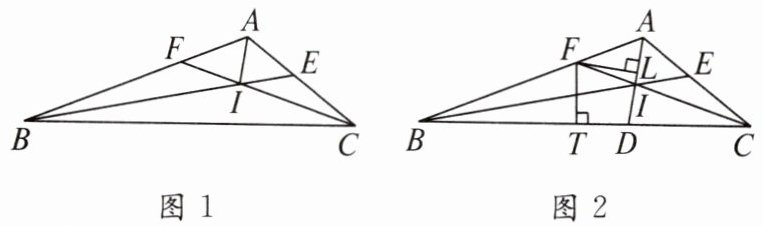
(1)如图1,连接$AI$,求证:点$I$在$∠ BAC$的平分线上;
(2)如图2,延长$AI$交$BC$于点$D$,过点$F$作$FT ⊥ BC$于点$T$,$FL ⊥ AD$于点$L$。求证$FT=FL$。
(1)如图1,连接$AI$,求证:点$I$在$∠ BAC$的平分线上;
(2)如图2,延长$AI$交$BC$于点$D$,过点$F$作$FT ⊥ BC$于点$T$,$FL ⊥ AD$于点$L$。求证$FT=FL$。
答案
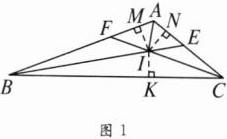
1. 证明 如图 1,过点 I 作 $IM⊥ AB,IN⊥ AC,IK⊥ BC$,垂足分别为 M,N,K.
$\because BE,CF$ 是$△ ABC$ 的角平分线,$\therefore IK=IM,IK=IN,$
$\therefore IN=IM,\therefore$ 点 I 在 $∠ BAC$ 的平分线上.
2. 如图 2,过点 F 作 $FG⊥ AG$ 交 CA 的延长线于点 G,
$\because CF$ 是$△ ABC$ 的角平分线,$FT⊥ BC,FG⊥ CA,$
$\therefore FT=FG.$
$\because ∠ BAC=120°,\therefore ∠ GAF=180°-∠ BAC=60°.$
由(1)知 AD 是 $∠ BAC$ 的平分线,
$\therefore ∠ BAD=\frac{1}{2}∠ BAC=\frac{1}{2}× 120°=60°,$
$\therefore ∠ BAD=∠ GAF.$
在$△ FGA$ 和$△ FLA$ 中,$\begin{cases} ∠ G=∠ FLA,\\ ∠ FAG=∠ FAL,\\ FA=FA, \end{cases}$
$\therefore △ FGA≌ △ FLA,\therefore FL=FG,$ 即 $FT=FL.$