

 登录
2. housework /'haʊswɜːk/ n. 家务劳动
☆教材中的短语:做家务
☆教材中的句子:
萨姆经常帮助他妈妈做家务。
☆教材中的短语:做家务
do housework
☆教材中的句子:
萨姆经常帮助他妈妈做家务。
Sam often helps his mother with housework.
答案
do housework; Sam often helps his mother with housework.
3. while /waɪl/ n. 一段时间;一会儿
conj. 在……期间;当……的时候
☆教材中的短语:一会儿
☆教材中的句子:他通常弹一会儿吉他。
conj. 在……期间;当……的时候
☆教材中的短语:一会儿
for a while
☆教材中的句子:他通常弹一会儿吉他。
He usually plays the guitar for a while.
答案
for a while; He usually plays the guitar for a while.
4. weekend /ˌwiːk'end/ n. 周末
词形转换:复数形式
☆教材中的短语:在周末
同义短语
☆教材中的句子:
周末你通常几点起床?
词形转换:复数形式
weekends
☆教材中的短语:在周末
on/at the weekend
同义短语
on/at weekends
☆教材中的句子:
周末你通常几点起床?
What time do you usually get up at weekends?
答案
weekends; on/at the weekend; on/at weekends; What time do you usually get up at weekends?
1. 观察表格中的例句及答语,找到特殊疑问词 what/what time/when 的用法。
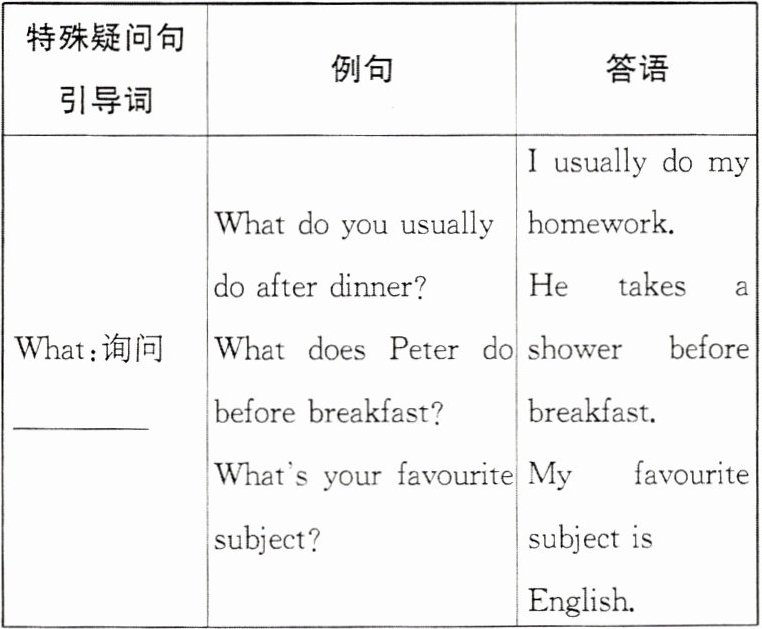
|特殊疑问句引导词|例句|答语|
|What:询问
|What time:询问
|When:询问
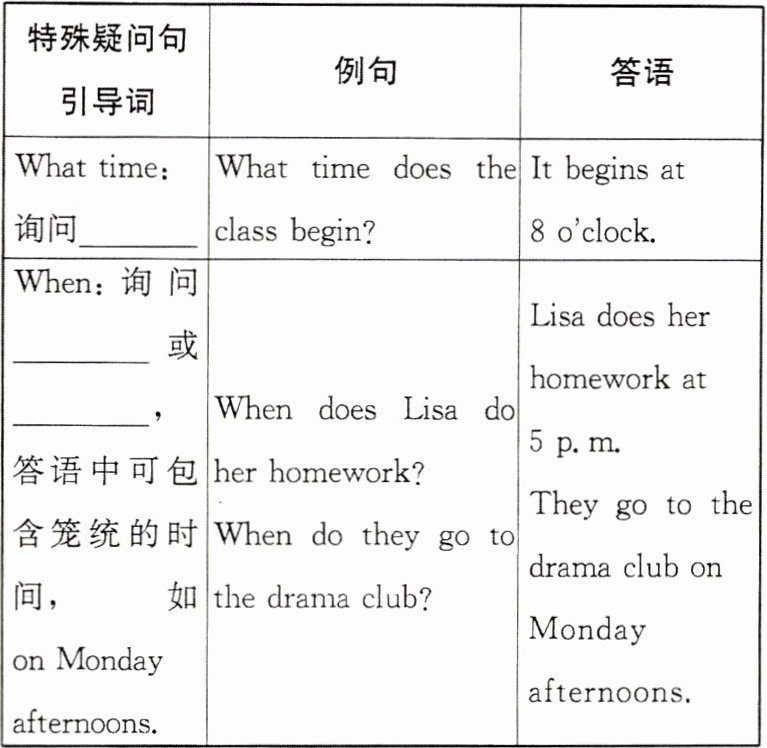
|特殊疑问句引导词|例句|答语|
|What:询问
事物
|What do you usually do after dinner?What does Peter do before breakfast?What's your favourite subject?|I usually do my homework.He takes a shower before breakfast.My favourite subject is English.||What time:询问
具体时刻
|What time does the class begin?|It begins at 8 o'clock.||When:询问
具体时刻
或时间段
,答语中可包含笼统的时间,如 on Monday afternoons.|When does Lisa do her homework?When do they go to the drama club?|Lisa does her homework at 5 p. m.They go to the drama club on Monday afternoons.|答案
事物;具体时刻;具体时刻或时间段
2. 区别 what time/when/ what 引导的特殊疑问句
|特殊疑问词|用法|
|What time|询问时间范围较窄,只限于
|When|询问时间范围较宽,既可以是
|What|可用来询问
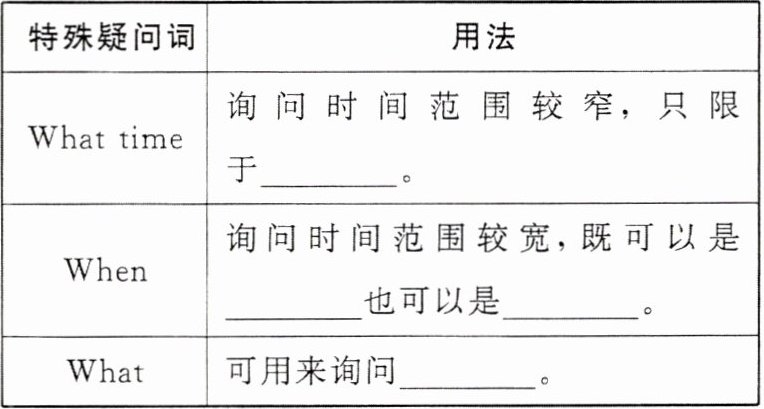
注:通常置于时间前的介词有 at、in、on 等,at 后接具体时刻,in 后可接一天中的某个时间段,on 后可接具体某一天。
|特殊疑问词|用法|
|What time|询问时间范围较窄,只限于
具体时刻
。||When|询问时间范围较宽,既可以是
具体时刻
也可以是时间段
。||What|可用来询问
事物
。|注:通常置于时间前的介词有 at、in、on 等,at 后接具体时刻,in 后可接一天中的某个时间段,on 后可接具体某一天。
答案
具体时刻;具体时刻;时间段;事物
1. 观察上面的表格后,填空。
| |句式结构|
|What time|What time +
|When|When +
|What|What +
| |句式结构|
|What time|What time +
do/does
+ 主语 + 动词原形
+ 其他?What time + be
+ 主语 + 其他?||When|When +
do/does
+ 主语 + 动词原形
+ 其他?When + be
+ 主语 + 其他?||What|What +
do/does
+ 主语 + 动词原形
+ 其他?What + be
+ 主语 + 其他?|答案
do/does 动词原形;be; do/does 动词原形;be; do/does 动词原形;be
