

 登录
三、Read and complete the tasks. 读一读教材第83—84页的文章,完成下列学习任务。
任务一 根据文章内容,将表格补充完整。
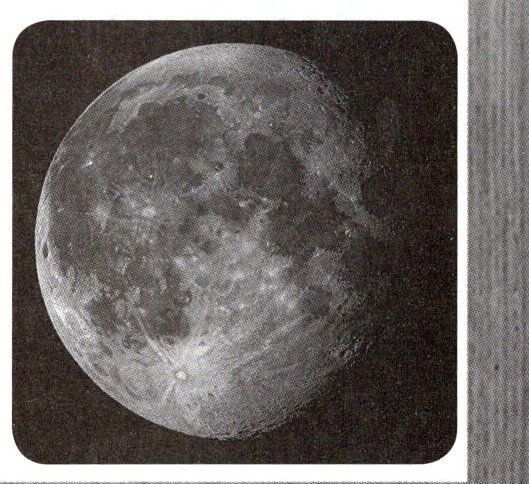
About the Moon
❀Surface(表面): 1.
almost no water or air
no rain or wind
❀Temperature: 2.
❀Gravity: $ \frac{1}{6} $ of that on the Earth
任务二 根据文章内容,以下哪一项不是有关月球的表述?在选项前的方框里画“√”。
A. The Moon travels around the Earth.
B. There is almost no water or air on the Moon.
C. The temperature changes a lot between day and night.
D. It has beautiful rings(光环) made of ice and small rocks around it.
E. Chang’e-5 probe brought moon samples(样本) back to the Earth.
任务三 查一查关于月球的资料,判断以下信息是(T)否(F)正确。
1 The Moon can’t give out light by itself(它自己). •
2 The Moon is much bigger than(比……大) the Earth. •
3 Luna is the ancient name for the Moon. •
4 In 1969, Armstrong became the first man to walk on the Moon. •
任务一 根据文章内容,将表格补充完整。
About the Moon
❀Surface(表面): 1.
No living creatures, covered with rocks and craters
almost no water or air
no rain or wind
❀Temperature: 2.
The temperature changes a lot between day and night
the highest temperature on the moon reaches about 127℃ in daytime, and the lowest drops to about -183℃ at night
❀Gravity: $ \frac{1}{6} $ of that on the Earth
任务二 根据文章内容,以下哪一项不是有关月球的表述?在选项前的方框里画“√”。
A. The Moon travels around the Earth.
B. There is almost no water or air on the Moon.
C. The temperature changes a lot between day and night.
D. It has beautiful rings(光环) made of ice and small rocks around it.
E. Chang’e-5 probe brought moon samples(样本) back to the Earth.
任务三 查一查关于月球的资料,判断以下信息是(T)否(F)正确。
1 The Moon can’t give out light by itself(它自己). •
2 The Moon is much bigger than(比……大) the Earth. •
3 Luna is the ancient name for the Moon. •
4 In 1969, Armstrong became the first man to walk on the Moon. •
答案
任务一
1. No living creatures, covered with rocks and craters, there is almost no water or air, no rain or wind
2. The temperature changes a lot between day and night; the highest temperature on the moon reaches about $127°\mathrm{C}$ in daytime, and the lowest drops to about $-183°\mathrm{C}$ at night
任务二
在D选项前的方框内画√
解析:由冰和小岩石组成的美丽光环是土星的典型特征,不属于月球,其余A、B、C、E选项的表述均符合月球的相关事实。
任务三
1. The Moon can't give out light by itself(它自己). → T解析:月球是地球的卫星,本身不发光,我们观测到的月光实际是月球反射的太阳光。
2. The Moon is much bigger than(比……大) the Earth. → F解析:月球体积远小于地球,体积大约仅为地球的$\frac{1}{49}$。
3. Luna is the ancient name for the Moon. → T解析:Luna是拉丁语体系里对月球的传统古称,现在也常作为月球的官方代称使用。
4. In 1969, Armstrong became the first man to walk on the Moon. → T解析:1969年阿波罗11号载人登月任务中,阿姆斯特朗成为人类历史上首个踏上月球表面的人。
