

 登录
登录
五、从方框中选择合适的单词补全短文(有一个多余)。
named Chinese the eating a lived
Long ago in China, there 1.
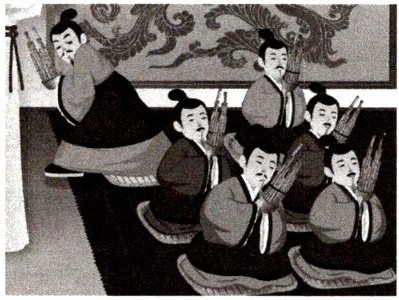
The king often put hundreds of players together to perform grand(美妙的)music. And he treated his musicians very well.
A man 3.
Whenever the band played for the king, Nanguo just stood there and pretended(假装)to play like the others. Nobody knew that he was making no sound at all. After the concerts(演奏会), he always enjoyed 5.
Eventually, the king died and his son became the new king.
Although the new king also liked music, he wanted something different. He ordered(命令)the musicians to play one by one, rather than(而不是)all together.
Upon hearing the news, Nanguo fled(逃跑)the palace immediately.
named Chinese the eating a lived
Long ago in China, there 1.
lived
a king who was very fond(喜爱)of music. His favourite pastime(娱乐)was listening to his musicians(乐师)play a 2. Chinese
instrument(乐器)called the Yu(竽).The king often put hundreds of players together to perform grand(美妙的)music. And he treated his musicians very well.
A man 3.
named
Nanguo did not know how to play 4. the
instrument. But he really wanted to be treated to the king's grand meals. So he found a way to join the king's band(乐队).Whenever the band played for the king, Nanguo just stood there and pretended(假装)to play like the others. Nobody knew that he was making no sound at all. After the concerts(演奏会), he always enjoyed 5.
eating
and drinking with everyone else.Eventually, the king died and his son became the new king.
Although the new king also liked music, he wanted something different. He ordered(命令)the musicians to play one by one, rather than(而不是)all together.
Upon hearing the news, Nanguo fled(逃跑)the palace immediately.
答案
1. lived 2. Chinese 3. named 4. the 5. eating
解析
【分析】
首先通读短文,明确短文是“滥竽充数”的故事,再结合每个空格的语境、语法规则,从给定单词(named、Chinese、the、eating、a、lived)中筛选合适的词,注意有一个多余项。第1空需用there be句型的过去式表达“有一位国王”;第2空需形容词修饰乐器;第3空需表达“名叫……的人”;第4空需特指前文提到的乐器;第5空需结合固定搭配选择。
【解析】
1. 句子“Long ago in China, there ___ a king...”是there be句型的过去时,表达“某地有某人”,用lived构成there lived...结构,符合语法,故选lived。
2. 空格修饰名词instrument,需形容词,Chinese意为“中国的”,符合“中国乐器”的语境,故选Chinese。
3. 空格后是人名Nanguo,named作后置定语表示“名叫……的”,符合用法,故选named。
4. 此处特指前文提到的乐器Yu(竽),需用定冠词the,故选the。
5. 固定搭配enjoy doing sth,空格后是drinking,对应选eating,构成“enjoy eating and drinking”,符合语境,故选eating。
【答案】
1. lived 2. Chinese 3. named 4. the 5. eating
【知识点】
词汇运用、冠词用法、固定搭配
【点评】
本题为选词填空题型,结合经典故事语境,考察学生对词汇、冠词及固定搭配的掌握,难度适中,学生可通过分析语境和语法规则完成作答。
【难度系数】
0.7
首先通读短文,明确短文是“滥竽充数”的故事,再结合每个空格的语境、语法规则,从给定单词(named、Chinese、the、eating、a、lived)中筛选合适的词,注意有一个多余项。第1空需用there be句型的过去式表达“有一位国王”;第2空需形容词修饰乐器;第3空需表达“名叫……的人”;第4空需特指前文提到的乐器;第5空需结合固定搭配选择。
【解析】
1. 句子“Long ago in China, there ___ a king...”是there be句型的过去时,表达“某地有某人”,用lived构成there lived...结构,符合语法,故选lived。
2. 空格修饰名词instrument,需形容词,Chinese意为“中国的”,符合“中国乐器”的语境,故选Chinese。
3. 空格后是人名Nanguo,named作后置定语表示“名叫……的”,符合用法,故选named。
4. 此处特指前文提到的乐器Yu(竽),需用定冠词the,故选the。
5. 固定搭配enjoy doing sth,空格后是drinking,对应选eating,构成“enjoy eating and drinking”,符合语境,故选eating。
【答案】
1. lived 2. Chinese 3. named 4. the 5. eating
【知识点】
词汇运用、冠词用法、固定搭配
【点评】
本题为选词填空题型,结合经典故事语境,考察学生对词汇、冠词及固定搭配的掌握,难度适中,学生可通过分析语境和语法规则完成作答。
【难度系数】
0.7
六、阅读短文,判断正(T)误(F)。
Long ago, there was a wise man called Zengzi. He always told the truth and kept his promises(遵守诺言). Everyone around him said he was an honest person.
One morning, Zengzi's wife needed to go to the market to buy food. Their little son cried loudly and wanted to follow her. Zengzi's wife had no time to take the boy, so she smiled and said to her son, "Stay at home quietly. When I come back from the market, I will kill our pig and cook delicious pork for you." Hearing this, the little boy stopped crying at once.
After shopping, Zengzi's wife was surprised to see Zengzi holding a knife and getting ready to kill the pig. She ran up to him quickly and stopped him. "I just told a lie to the kid. Don't kill our pig!" she said.
But Zengzi shook his head. He told his wife, "We cannot tell lies to our son. If we do, our son will not believe us any more. Honesty is the most important thing for everyone."
Then Zengzi killed the pig as he promised and cooked the pork for the whole family. This old story tells us that we should always be honest and keep every promise we make.
(
(
(
(
(
Long ago, there was a wise man called Zengzi. He always told the truth and kept his promises(遵守诺言). Everyone around him said he was an honest person.
One morning, Zengzi's wife needed to go to the market to buy food. Their little son cried loudly and wanted to follow her. Zengzi's wife had no time to take the boy, so she smiled and said to her son, "Stay at home quietly. When I come back from the market, I will kill our pig and cook delicious pork for you." Hearing this, the little boy stopped crying at once.
After shopping, Zengzi's wife was surprised to see Zengzi holding a knife and getting ready to kill the pig. She ran up to him quickly and stopped him. "I just told a lie to the kid. Don't kill our pig!" she said.
But Zengzi shook his head. He told his wife, "We cannot tell lies to our son. If we do, our son will not believe us any more. Honesty is the most important thing for everyone."
Then Zengzi killed the pig as he promised and cooked the pork for the whole family. This old story tells us that we should always be honest and keep every promise we make.
(
T
) 1. Zengzi was a man with honesty.(
F
) 2. Zengzi's wife planned to cook pork for the boy before going out.(
T
) 3. The little boy wanted to go to the market with his mother.(
F
) 4. Zengzi thought it was OK to tell lies to kids.(
T
) 5. The story teaches us to keep our promises and tell the truth.答案
1. T 2. F 3. T 4. F 5. T
解析
【分析】本题是阅读理解正误判断题,解题思路为:首先通读短文掌握主要内容,再针对每道小题将题干表述与原文对应内容逐一比对,判断是否一致,从而得出正确结果。
【解析】1. 题干“Zengzi是一个诚实的人”,对应原文第一段“Everyone around him said he was an honest person”,与原文一致,判断为T;2. 题干“Zengzi的妻子计划出门前给男孩做猪肉”,对应原文第二段,妻子是为哄哭闹的儿子才谎称回来杀猪,并非真计划,与原文不符,判断为F;3. 题干“小男孩想和妈妈一起去市场”,对应原文第二段“wanted to follow her”,与原文一致,判断为T;4. 题干“Zengzi认为对孩子撒谎没问题”,对应原文第四段“We cannot tell lies to our son”,与原文不符,判断为F;5. 题干“这个故事教我们要遵守诺言、讲真话”,对应原文最后一段“we should always be honest and keep every promise we make”,与原文一致,判断为T。
【答案】1.T 2.F 3.T 4.F 5.T
【知识点】短文阅读理解、细节信息判断、正误辨析
【点评】本题侧重考查学生对短文细节信息的提取与理解能力,通过题干与原文内容比对即可完成判断,整体难度较低。
【难度系数】0.8
【解析】1. 题干“Zengzi是一个诚实的人”,对应原文第一段“Everyone around him said he was an honest person”,与原文一致,判断为T;2. 题干“Zengzi的妻子计划出门前给男孩做猪肉”,对应原文第二段,妻子是为哄哭闹的儿子才谎称回来杀猪,并非真计划,与原文不符,判断为F;3. 题干“小男孩想和妈妈一起去市场”,对应原文第二段“wanted to follow her”,与原文一致,判断为T;4. 题干“Zengzi认为对孩子撒谎没问题”,对应原文第四段“We cannot tell lies to our son”,与原文不符,判断为F;5. 题干“这个故事教我们要遵守诺言、讲真话”,对应原文最后一段“we should always be honest and keep every promise we make”,与原文一致,判断为T。
【答案】1.T 2.F 3.T 4.F 5.T
【知识点】短文阅读理解、细节信息判断、正误辨析
【点评】本题侧重考查学生对短文细节信息的提取与理解能力,通过题干与原文内容比对即可完成判断,整体难度较低。
【难度系数】0.8
