

 登录
C
Whether you're telling someone how to get to your house or telling a stranger how to get to a local museum, you should know how to give directions. Giving good directions is not as easy as you think. Do you know how to give good directions? If you don't, here are some tips for you.
Draw a map. If you have trouble describing directions to someone who doesn't know your words, such as a foreigner, you can draw a map. A map will allow people to easily know where they're going. It also allows them to clearly understand how to get to the place. For new visitors, reading maps seems much easier than understanding words, especially for visitors from a foreign country.
Give the simplest route. There might be several ways to get to the same place. If a person asks you the way to the place, you'd better give the simplest route. The simplest route has fewer turns, even if it takes more time. If the route has more turns, the person may get lost again.
Use important and hard-to-miss landmarks (地标). When a person asks you the way to a certain place, it's wise to use landmarks. Landmarks could be parks, bridges, mountains, schools or restaurants. Landmarks will let the person quickly understand where he or she is. Using landmarks can help the person find the right way easily.
Don't suggest routes you haven't taken. When you give directions to a person, you must tell the person the route you are familiar with. Never ask the person to take a route you've never taken. If you are not familiar with the route, it might be the wrong direction.
62. Which is the best way to give directions to a foreigner?
A. Drawing a map.
B. Using landmarks.
C. Showing street names.
D. Leading him to the policeman.
63. What does the underlined word "route" mean?
A. A way or direction between places.
B. A way used for passing information.
C. The places they are passing by on the way.
D. The places they are going to reach.
64. How does the writer explain what the landmark is?
A. By using sayings.
B. By listing numbers.
C. By asking questions.
D. By giving examples.
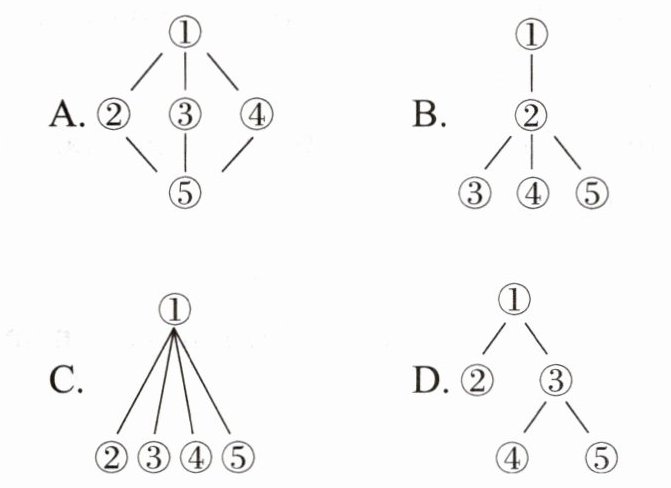
65. Which of the following shows the structure of the text?
Whether you're telling someone how to get to your house or telling a stranger how to get to a local museum, you should know how to give directions. Giving good directions is not as easy as you think. Do you know how to give good directions? If you don't, here are some tips for you.
Draw a map. If you have trouble describing directions to someone who doesn't know your words, such as a foreigner, you can draw a map. A map will allow people to easily know where they're going. It also allows them to clearly understand how to get to the place. For new visitors, reading maps seems much easier than understanding words, especially for visitors from a foreign country.
Give the simplest route. There might be several ways to get to the same place. If a person asks you the way to the place, you'd better give the simplest route. The simplest route has fewer turns, even if it takes more time. If the route has more turns, the person may get lost again.
Use important and hard-to-miss landmarks (地标). When a person asks you the way to a certain place, it's wise to use landmarks. Landmarks could be parks, bridges, mountains, schools or restaurants. Landmarks will let the person quickly understand where he or she is. Using landmarks can help the person find the right way easily.
Don't suggest routes you haven't taken. When you give directions to a person, you must tell the person the route you are familiar with. Never ask the person to take a route you've never taken. If you are not familiar with the route, it might be the wrong direction.
62. Which is the best way to give directions to a foreigner?
A. Drawing a map.
B. Using landmarks.
C. Showing street names.
D. Leading him to the policeman.
63. What does the underlined word "route" mean?
A. A way or direction between places.
B. A way used for passing information.
C. The places they are passing by on the way.
D. The places they are going to reach.
64. How does the writer explain what the landmark is?
A. By using sayings.
B. By listing numbers.
C. By asking questions.
D. By giving examples.
65. Which of the following shows the structure of the text?
答案
62. A 63. A 64. D 65. C
解析
【分析】
首先逐题梳理解题思路:1. 第62题:定位原文第二段关键信息,明确给不懂语言的外国人指路的最优方式;2. 第63题:结合第三段语境猜测词义,理解route的含义;3. 第64题:分析第四段说明地标的方式,判断论证方法;4. 第65题:梳理文章段落逻辑,确定总分结构对应的选项。
【解析】
1. 第62题:根据原文第二段“If you have trouble describing directions to someone who doesn't know your words, such as a foreigner, you can draw a map.”,可知给外国人指路最好的方法是画地图,故选A。
2. 第63题:第三段提到去同一地点有多种路径,需选最简单的路线,结合语境,route指两地之间的路径或方向,故选A。
3. 第64题:第四段通过列举“parks, bridges, mountains, schools or restaurants”等具体事物说明地标,属于举例子的论证方法,故选D。
4. 第65题:文章第一段总起引出“如何给出好的指路建议”的话题,后续四段分述四个具体建议,为总分结构,对应选项C的结构,故选C。
【答案】
62. A 63. A 64. D 65. C
【知识点】
英语阅读理解、词义猜测、语篇结构
【点评】
本题为英语阅读理解综合题,考查细节查找、词义猜测、论证方法及语篇结构分析,需要学生精准定位原文信息并结合语境推理判断,难度适中。
【难度系数】
0.6
