

 登录
Ⅰ. 根据句意及首字母或汉语提示完成单词。
1. He is a TV r
2. They go home at a
3. We know the s
4. The sun r
5. She usually
1. He is a TV r
reporter
and works long hours.2. They go home at a
around
17:30 every day.3. We know the s
saying
, "An apple a day keeps the doctor away".4. The sun r
rises
in the east.5. She usually
stays
(待) at home after work.答案
1. reporter
2. around
3. saying
4. rises
5. stays
解析
【分析】
解题思路:先通读每个句子理解句意,再结合给出的首字母或汉语提示,分析所需单词的词性、形式(如时态、单复数),最终确定正确单词:1. 结合职业语境和首字母确定名词;2. 结合时间表达和首字母确定副词;3. 结合谚语含义和首字母确定名词;4. 结合客观事实的时态要求和首字母确定动词第三人称单数;5. 结合汉语提示和主语的人称、时态确定动词形式。
【解析】
1. 句意:他是一名电视记者,工作很长时间。结合首字母r和职业语境,填名词reporter;
2. 句意:他们每天大约17:30回家。结合首字母a和时间表达需求,填副词around;
3. 句意:我们知道这句谚语:“一天一苹果,医生远离我”。结合首字母s和谚语含义,填名词saying;
4. 句意:太阳从东方升起。描述客观事实用一般现在时,主语the sun是第三人称单数,结合首字母r,填动词rise的第三人称单数形式rises;
5. 句意:她下班后通常待在家里。汉语提示“待”对应动词stay,主语she是第三人称单数,一般现在时,填stays。
【答案】
1. reporter
2. around
3. saying
4. rises
5. stays
【知识点】
词汇运用;动词时态;名词辨析
【点评】
本题考查英语基础词汇的运用,涉及职业名词、时间副词、谚语类名词及动词第三人称单数形式,是常见的基础题型,侧重考查学生的词汇积累和语境运用能力。
【难度系数】
0.8
Ⅱ. 根据所给汉语提示完成句子,每空一词。
1. 你通常几点起床?
2. Tom 什么时候上课?
3. 我每天6点做作业。
I
4. 我们九点睡觉。
We
5. 现在几点了?
1. 你通常几点起床?
What
time
do you usually get up?2. Tom 什么时候上课?
When
does Tom have class?3. 我每天6点做作业。
I
do
homework
at 6 o'clock every day.4. 我们九点睡觉。
We
go
to
bed
at 9 o'clock.5. 现在几点了?
What
time
is it now?What's
the
time
now?答案
1. What time
2. When
3. do homework
4. go to bed
5. What time; What's the time
解析
【分析】
本题考查英语时间相关的疑问表达及固定短语搭配,解题时需先理解每个句子的汉语含义,再匹配对应的英语知识点:对具体时间点提问用What time,对宽泛时间提问用When,日常活动的固定短语需准确记忆,问时间的常用句型有两种,结合每空一词的要求填写正确内容即可。
【解析】
1. 询问“几点”(具体时间点),用疑问词组What time;
2. 询问“什么时候”(宽泛时间),用疑问副词When;
3. “做作业”的固定短语是do homework,主语为I,一般现在时,动词用原形;
4. “睡觉”的固定短语是go to bed,主语为We,一般现在时,动词用原形;
5. 询问“现在几点了”的两种常用表达:What time is it? 和What's the time?,对应汉语意思。
【答案】
1. What time
2. When
3. do homework
4. go to bed
5. What time; What's the time
【知识点】
时间疑问词、固定短语搭配、一般现在时
【点评】
本题为英语基础题型,聚焦日常时间相关的核心表达,考查学生对基础句型和短语的掌握,难度较低,适合巩固英语基础知识。
【难度系数】
0.8
Ⅲ.阅读下面短文,从方框中选择适当的词填空。
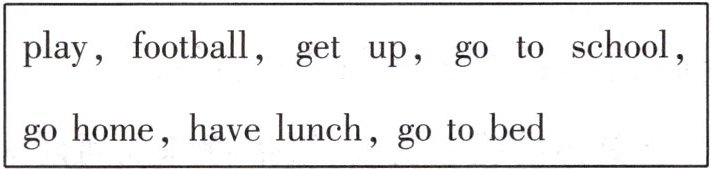
Hi! I'm Han Lin. I'm thirteen and I'm a student from the No.7 Middle School. I 1.
At 11 o'clock, we have a break and I talk with my friends. They go to the sports field and 3.
We start lessons in the afternoon at 1:00. We have two lessons in the afternoon. Then we 5.
In the evening, I have dinner with my family at 6:00. I often do my homework at 7:30. I 6.
Hi! I'm Han Lin. I'm thirteen and I'm a student from the No.7 Middle School. I 1.
go to school
on weekdays, but not on Saturdays and Sundays. This is my school day. I 2. get up
at 7:00 in the morning and have breakfast at 7:30. My school is next to my house. I walk to school. We start our class at 8 o'clock. We have three lessons in the morning. My favourite subject is art.At 11 o'clock, we have a break and I talk with my friends. They go to the sports field and 3.
play football
, but I don't like football. We 4. have lunch
in the dining hall at 12 o'clock. I like school lunch! We have chicken, fish, beef and rice with vegetables, or hamburgers.We start lessons in the afternoon at 1:00. We have two lessons in the afternoon. Then we 5.
go home
at 4:30.In the evening, I have dinner with my family at 6:00. I often do my homework at 7:30. I 6.
go to bed
at 9:30.答案
1. go to school
2. get up
3. play football
4. have lunch
5. go home
6. go to bed
解析
【分析】先通读短文,理解每个句子的语境,明确每个空需要表达的日常活动,再结合方框给出的动词短语,根据一般现在时(主语为I,用动词原形)的用法,逐一匹配合适的短语填入空格。
【解析】1. 根据前文“我是学生,在工作日”,可知此处表达“上学”,故填go to school;2. 后文提到7:30吃早饭,所以此处是“起床”,填get up;3. 前文说去运动场,后文提到不喜欢足球,所以此处是“踢足球”,填play football;4. 后文提到在餐厅,所以是“吃午饭”,填have lunch;5. 下午课程结束后4:30,应该是“回家”,填go home;6. 晚上9:30,是“睡觉”,填go to bed。
【答案】1. go to school 2. get up 3. play football 4. have lunch 5. go home 6. go to bed
【知识点】动词短语、一般现在时
【点评】本题考查日常活动相关的动词短语运用,需结合上下文语境选择合适的短语,难度较低,适合基础练习。
【难度系数】0.2
