

 登录
登录
一、完形填空
KEY→P2
范畴:人与自我 主题:自我管理 体裁:记叙文 难度:★★★★ 建议用时:7分钟 评价:/10
A rich man asked an old man to advise his son to keep away from his bad habits. The old man took the son for a slow walk through a 1.
Stopping suddenly, he asked the boy to pull out a 2 plant growing in the garden. The boy held the plant between his two fingers and 3 pulled it out. The old man then asked him to pull out a slightly(略微) bigger plant. The boy pulled hard and the plant came out with the roots. "Now pull out that one," said the old man, 4 the biggest plant. The boy had to use all his strength to pull it out.
Next, the old man, pointing to a big tree, said, "Now pull this one out." The boy held it and 5 to pull it out. But the tree would not move. "It's 6," said the boy, out of breath.
"So it is like bad 7," said the old man. "When they are young, it is easy to pull them out. 8 when they take hold, they cannot be controlled." The old man's words 9 the boy's life.
From the above story, the 10 we can learn is that we shouldn't let bad habits grow in ourselves. Drop them while we are in control of them, or they will get control over us.
(
(
(
(
(
(
(
(
(
(
KEY→P2
范畴:人与自我 主题:自我管理 体裁:记叙文 难度:★★★★ 建议用时:7分钟 评价:/10
A rich man asked an old man to advise his son to keep away from his bad habits. The old man took the son for a slow walk through a 1.
Stopping suddenly, he asked the boy to pull out a 2 plant growing in the garden. The boy held the plant between his two fingers and 3 pulled it out. The old man then asked him to pull out a slightly(略微) bigger plant. The boy pulled hard and the plant came out with the roots. "Now pull out that one," said the old man, 4 the biggest plant. The boy had to use all his strength to pull it out.
Next, the old man, pointing to a big tree, said, "Now pull this one out." The boy held it and 5 to pull it out. But the tree would not move. "It's 6," said the boy, out of breath.
"So it is like bad 7," said the old man. "When they are young, it is easy to pull them out. 8 when they take hold, they cannot be controlled." The old man's words 9 the boy's life.
From the above story, the 10 we can learn is that we shouldn't let bad habits grow in ourselves. Drop them while we are in control of them, or they will get control over us.
(
C
)1. A. park B. forest C. garden D. mountain(
A
)2. A. small B. strong C. green D. beautiful(
C
)3. A. hardly B. never C. easily D. loudly(
A
)4. A. pointing to B. waiting for C. looking after D. worrying about(
C
)5. A. refused B. feared C. tried D. liked(
D
)6. A. dangerous B. fantastic C. meaningless D. impossible(
A
)7. A. habits B. ideas C. plans D. hopes(
D
)8. A. And B. So C. Or D. But(
C
)9. A. saved B. hurt C. changed D. improved(
A
)10. A. lesson B. word C. subject D. programme答案
1.C 2.A 3.C 4.A 5.C 6.D 7.A 8.D 9.C 10.A
一位长者通过让一位有坏习惯的男孩拔大小不同的植物来教育他要及早改掉坏习惯。这个故事告诉我们:不要让坏习惯肆意发展,在能控制的情况下,我们要及时改掉坏习惯。
1. C 由下文中的 in the garden 可知,此处指的是花园。这位长者带着这个富人的儿子穿过花园漫步。
2. A 由下句中的 The boy held the plant between his two fingers 可知,这个男孩用两根手指就能夹住这棵植物。由此推知,这棵植物应该很小。
3. C 由上下文可以判断,男孩轻易地就把它拔了出来。
4. A 由长者所说的话 Now pull out that one 及下文的 pointing to a big tree 可知,这时长者指着最大的那棵植物让男孩将其拔出来。
5. C 长者让男孩拔一棵大树,男孩抱住大树,试图将它拔出来。
6. D 上文中谈到男孩试图去拔这棵树,但是这棵树根本没动。由此可知,这个男孩气喘吁吁地说拔起这棵大树是不可能的。
7. A 由文章的开头“A rich man asked an old man to advise his son to keep away from his bad habits.”可知,长者通过拔树的例子来告诉这个男孩,这棵大树就像(养成的)坏习惯。
8. D 由语境可知,当它们年幼时,很容易被拔出来。但当它们长牢固时,就无法被控制住了。空处前后句意构成转折关系。
9. C 长者通过拔植物的例子教育男孩要及早改掉坏习惯。由此可知,长者的话应该是改变了这个男孩的人生。
10. A 由下文总结的教训可知,这里指的是我们能从上面的故事中得到教训。
一位长者通过让一位有坏习惯的男孩拔大小不同的植物来教育他要及早改掉坏习惯。这个故事告诉我们:不要让坏习惯肆意发展,在能控制的情况下,我们要及时改掉坏习惯。
1. C 由下文中的 in the garden 可知,此处指的是花园。这位长者带着这个富人的儿子穿过花园漫步。
2. A 由下句中的 The boy held the plant between his two fingers 可知,这个男孩用两根手指就能夹住这棵植物。由此推知,这棵植物应该很小。
3. C 由上下文可以判断,男孩轻易地就把它拔了出来。
4. A 由长者所说的话 Now pull out that one 及下文的 pointing to a big tree 可知,这时长者指着最大的那棵植物让男孩将其拔出来。
5. C 长者让男孩拔一棵大树,男孩抱住大树,试图将它拔出来。
6. D 上文中谈到男孩试图去拔这棵树,但是这棵树根本没动。由此可知,这个男孩气喘吁吁地说拔起这棵大树是不可能的。
7. A 由文章的开头“A rich man asked an old man to advise his son to keep away from his bad habits.”可知,长者通过拔树的例子来告诉这个男孩,这棵大树就像(养成的)坏习惯。
8. D 由语境可知,当它们年幼时,很容易被拔出来。但当它们长牢固时,就无法被控制住了。空处前后句意构成转折关系。
9. C 长者通过拔植物的例子教育男孩要及早改掉坏习惯。由此可知,长者的话应该是改变了这个男孩的人生。
10. A 由下文总结的教训可知,这里指的是我们能从上面的故事中得到教训。
二、阅读理解
A
KEY→P3
范畴:人与自我 主题:理财意识 体裁:应用文 难度:★★★ 建议用时:6分钟 评价:/3
In many countries, you can only get a proper, full-time job if you are 16 or 18 years old or above. But there are things that teenagers in some places can do to earn some pocket money. Here are a few ideas.
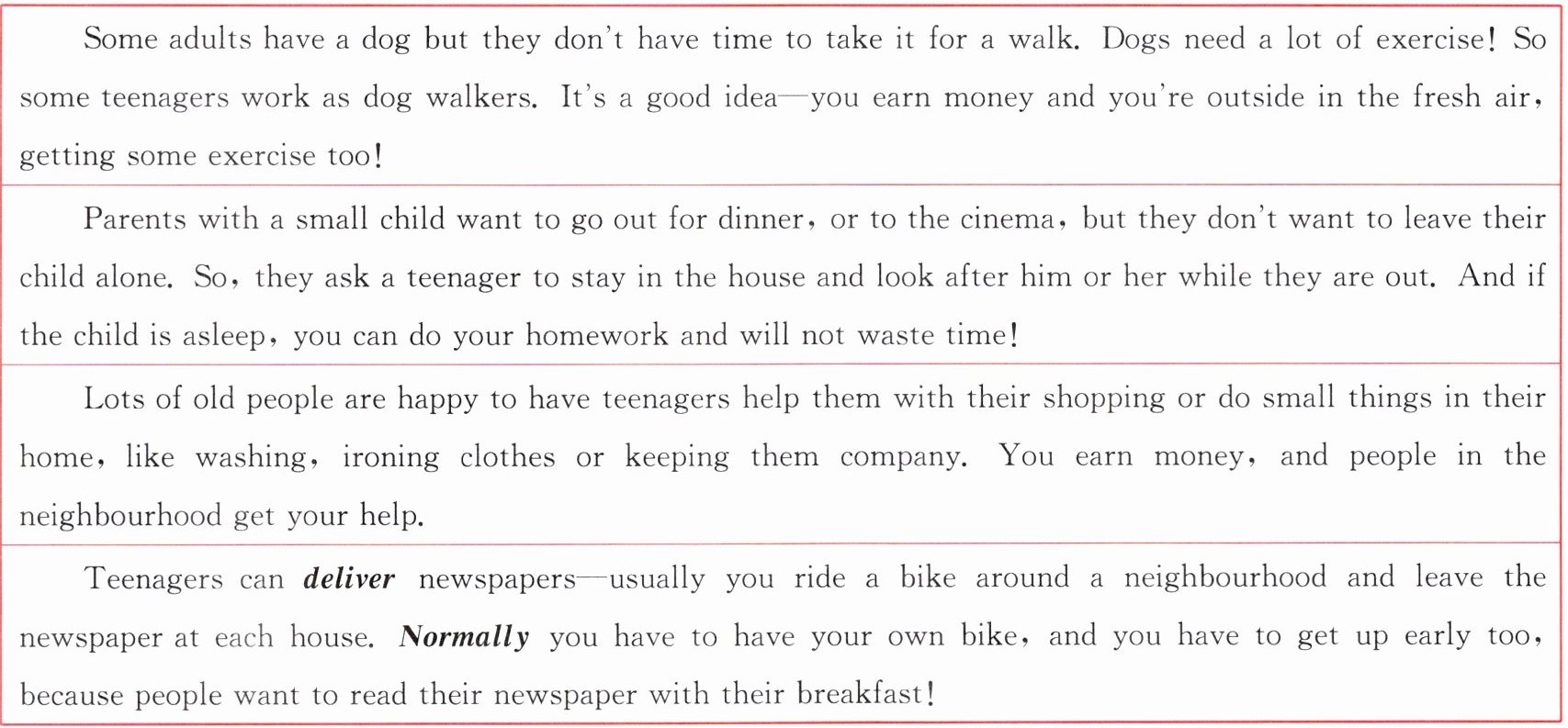
They're all great ideas. Just choose one of them to earn some money. Then you can spend it or save it!
素材来源:《英曼英语》
(
A. Watch TV. B. Do homework. C. Go shopping. D. Play games.
(
A. B. C. D.
(
A. How teenagers can make pocket money.
B. Why teenagers need pocket money.
C. When teenagers can get a full-time job.
D. Where teenagers can find jobs.
A
KEY→P3
范畴:人与自我 主题:理财意识 体裁:应用文 难度:★★★ 建议用时:6分钟 评价:/3
In many countries, you can only get a proper, full-time job if you are 16 or 18 years old or above. But there are things that teenagers in some places can do to earn some pocket money. Here are a few ideas.
They're all great ideas. Just choose one of them to earn some money. Then you can spend it or save it!
素材来源:《英曼英语》
(
B
)1. What can a teenager do when the child is asleep while babysitting?A. Watch TV. B. Do homework. C. Go shopping. D. Play games.
(
D
)2. 新考法·图片理解 Which do teenagers usually need to have to deliver newspapers?A.
B. C. D.(
A
)3. What is the main idea of the passage?A. How teenagers can make pocket money.
B. Why teenagers need pocket money.
C. When teenagers can get a full-time job.
D. Where teenagers can find jobs.
答案
1.B 2.D 3.A
本文主要介绍了青少年赚取零花钱的途径,具体包括:为没时间的成年人遛狗;帮外出的父母照看小孩;帮助老人;骑自行车在社区送报纸。
1. B 细节理解题。文中提到“And if the child is asleep, you can do your homework and will not waste time!”,所以当孩子睡着时,青少年可以做作业。
2. D 图片理解题。文章指出 Normally you have to have your own bike,说明送报纸通常需要自己有自行车。
3. A 主旨大意题。文章主要介绍了青少年可以通过遛狗、照看小孩、帮助老人、送报纸等方式赚取零花钱,核心内容是青少年赚取零花钱的方法。
本文主要介绍了青少年赚取零花钱的途径,具体包括:为没时间的成年人遛狗;帮外出的父母照看小孩;帮助老人;骑自行车在社区送报纸。
1. B 细节理解题。文中提到“And if the child is asleep, you can do your homework and will not waste time!”,所以当孩子睡着时,青少年可以做作业。
2. D 图片理解题。文章指出 Normally you have to have your own bike,说明送报纸通常需要自己有自行车。
3. A 主旨大意题。文章主要介绍了青少年可以通过遛狗、照看小孩、帮助老人、送报纸等方式赚取零花钱,核心内容是青少年赚取零花钱的方法。
