

 登录
A
Wang Xizhi was one of the most famous calligraphers(书法家)during Eastern Jin Dynasty of China. When he was very young, he practised his art every day and never stopped. Because of his achievements, he has been honored as one of China's sages of calligraphy(书圣).
Once, Wang Xizhi wrote on the wood for an engraver(雕刻师)to cut. Then the engraver found the ink had penetrated(渗透)one centimetre(厘米)into the wood. Now we often use "Ru Mu San Fen" to express sharp ideas or useful views. It is very popular among people.
In the Warring States Period, the State of Qin had a fight with the State of Zhao. Some talented people were needed to ask for help from Chu. Then Mao Sui — the man who believed he was the right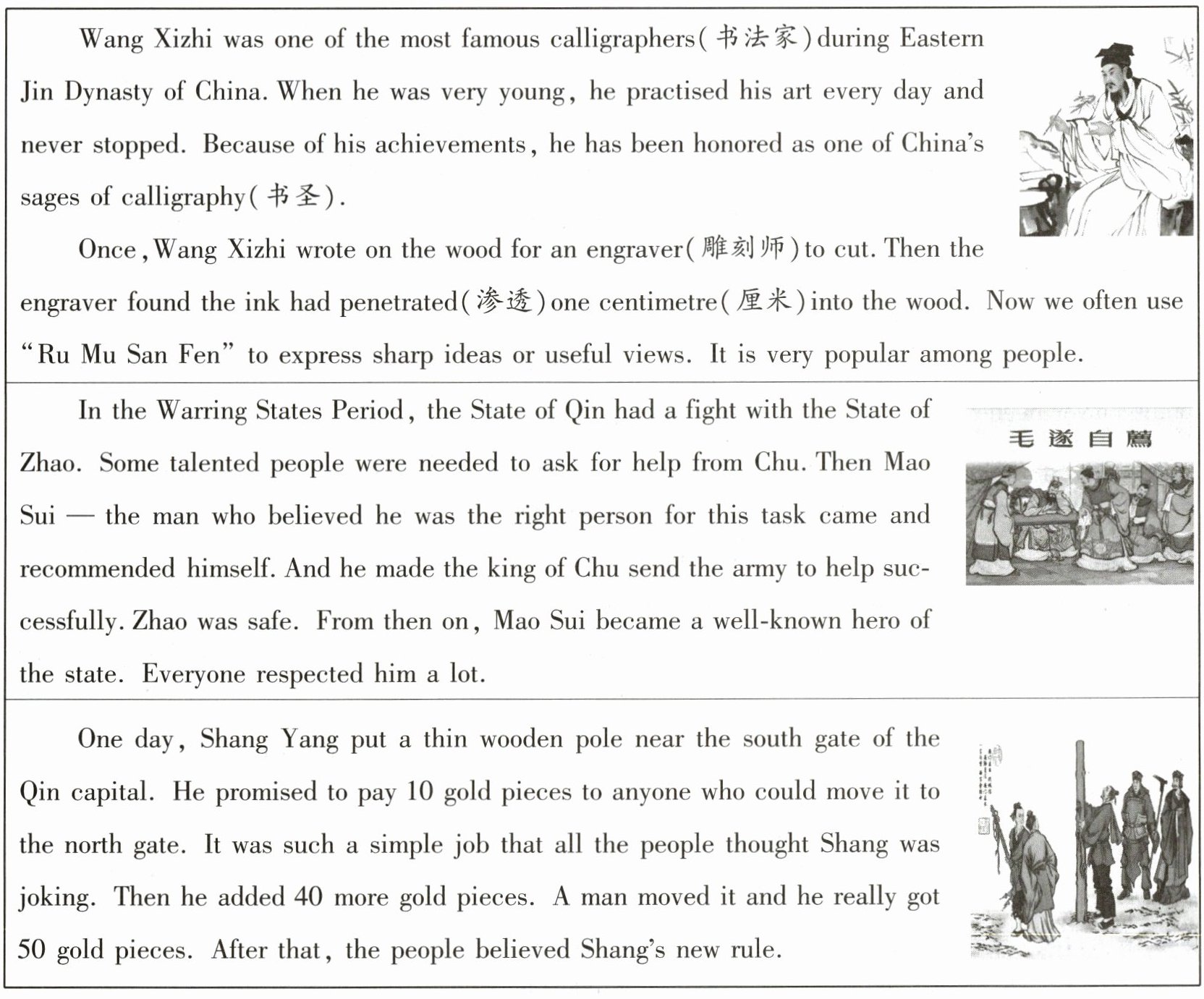 person for this task came and recommended himself. And he made the king of Chu send the army to help successfully. Zhao was safe. From then on, Mao Sui became a well-known hero of the state. Everyone respected him a lot.
One day, Shang Yang put a thin wooden pole near the south gate of the Qin capital. He promised to pay 10 gold pieces to anyone who could move it to the north gate. It was such a simple job that all the people thought Shang was joking. Then he added 40 more gold pieces. A man moved it and he really got 50 gold pieces. After that, the people believed Shang's new rule.
(
A. protect his state
B. get people's trust
C. have new friends
D. make more money
(
A. Mao Sui recommending himself
B. building trust by using a wooden pole
C. Ru Mu San Fen
D. Zhuang Zhou dreaming a butterfly
(
A. an online shopping website
B. a morning news report
C. a Western food magazine
D. a traditional Chinese storybook
Wang Xizhi was one of the most famous calligraphers(书法家)during Eastern Jin Dynasty of China. When he was very young, he practised his art every day and never stopped. Because of his achievements, he has been honored as one of China's sages of calligraphy(书圣).
Once, Wang Xizhi wrote on the wood for an engraver(雕刻师)to cut. Then the engraver found the ink had penetrated(渗透)one centimetre(厘米)into the wood. Now we often use "Ru Mu San Fen" to express sharp ideas or useful views. It is very popular among people.
In the Warring States Period, the State of Qin had a fight with the State of Zhao. Some talented people were needed to ask for help from Chu. Then Mao Sui — the man who believed he was the right
person for this task came and recommended himself. And he made the king of Chu send the army to help successfully. Zhao was safe. From then on, Mao Sui became a well-known hero of the state. Everyone respected him a lot.One day, Shang Yang put a thin wooden pole near the south gate of the Qin capital. He promised to pay 10 gold pieces to anyone who could move it to the north gate. It was such a simple job that all the people thought Shang was joking. Then he added 40 more gold pieces. A man moved it and he really got 50 gold pieces. After that, the people believed Shang's new rule.
(
B
)1. Shang Yang's story tells us a man of his word can get people's trust
.A. protect his state
B. get people's trust
C. have new friends
D. make more money
(
C
)2. We usually use "Ru Mu San Fen
" to express sharp ideas or useful views.A. Mao Sui recommending himself
B. building trust by using a wooden pole
C. Ru Mu San Fen
D. Zhuang Zhou dreaming a butterfly
(
D
)3. The passage may come from a traditional Chinese storybook
.A. an online shopping website
B. a morning news report
C. a Western food magazine
D. a traditional Chinese storybook
答案
1. B
2. C
3. D
