

 登录
听一段对话,回答第11~12小题。
11. Who touched the boy on the head?
A. His grandparents.
B. His friends.
C. Many Chinese.
12. What will the boy do next?
A. He will ask his mother to speak for him.
B. He will try to accept people's behaviour.
C. He will tell his feelings to people who touch him.
11. Who touched the boy on the head?
A. His grandparents.
B. His friends.
C. Many Chinese.
12. What will the boy do next?
A. He will ask his mother to speak for him.
B. He will try to accept people's behaviour.
C. He will tell his feelings to people who touch him.
答案
11. C
12. C
12. C
听第一段独白,完成信息记录表第13~15小题。
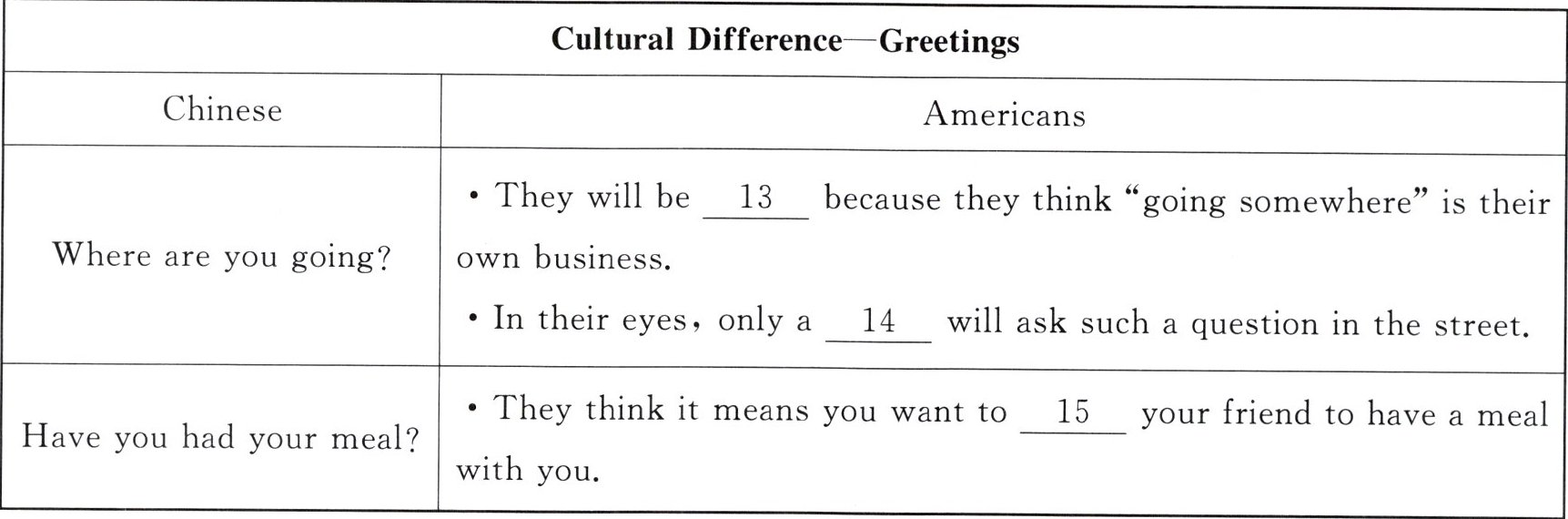
13. A. surprised B. happy C. angry
14. A. friend B. policeman C. stranger
15. A. interview B. introduce C. invite
13. A. surprised B. happy C. angry
14. A. friend B. policeman C. stranger
15. A. interview B. introduce C. invite
答案
13. A
14. B
15. C
14. B
15. C
听第二段独白,回答第16~20小题。
16. What is the article about?
A. Western cultures.
B. Table manners.
C. How to make Western friends.
17. What is the napkin(餐巾) used for?
A. Cleaning your nose.
B. Cleaning your face.
C. Cleaning your hands or mouth.
18. Which is polite below?
A. Stand on the chair.
B. Put your arms on the table.
C. Put your napkin on the table when you finish eating.
19. Where should you put bones?
A. On the edge of the plate.
B. On the edge of the table.
C. On your napkin.
20. How should we take bread?
A. With a hand.
B. With a knife.
C. With a fork.
答案
16. B
17. C
18. C
19. A
20. A
17. C
18. C
19. A
20. A
