

 登录
四、阅读。(共两节,满分35分)
第一节(共15小题;每小题2分,满分30分)
阅读下列短文,从短文后每题所给的A、B、C、D四个选项中,选出最佳选项。
A 跨学科 历史
History makes men wise. Do you want to know more?
Many people think that the Chinese civilization began around the Yellow River, stretching back over 5,000 years without interruption(中断). Compared to other civilizations of the time, Chinese culture stayed largely the same as today's culture. The other nations fell into wars and disappeared, or were controlled by other nations, though.
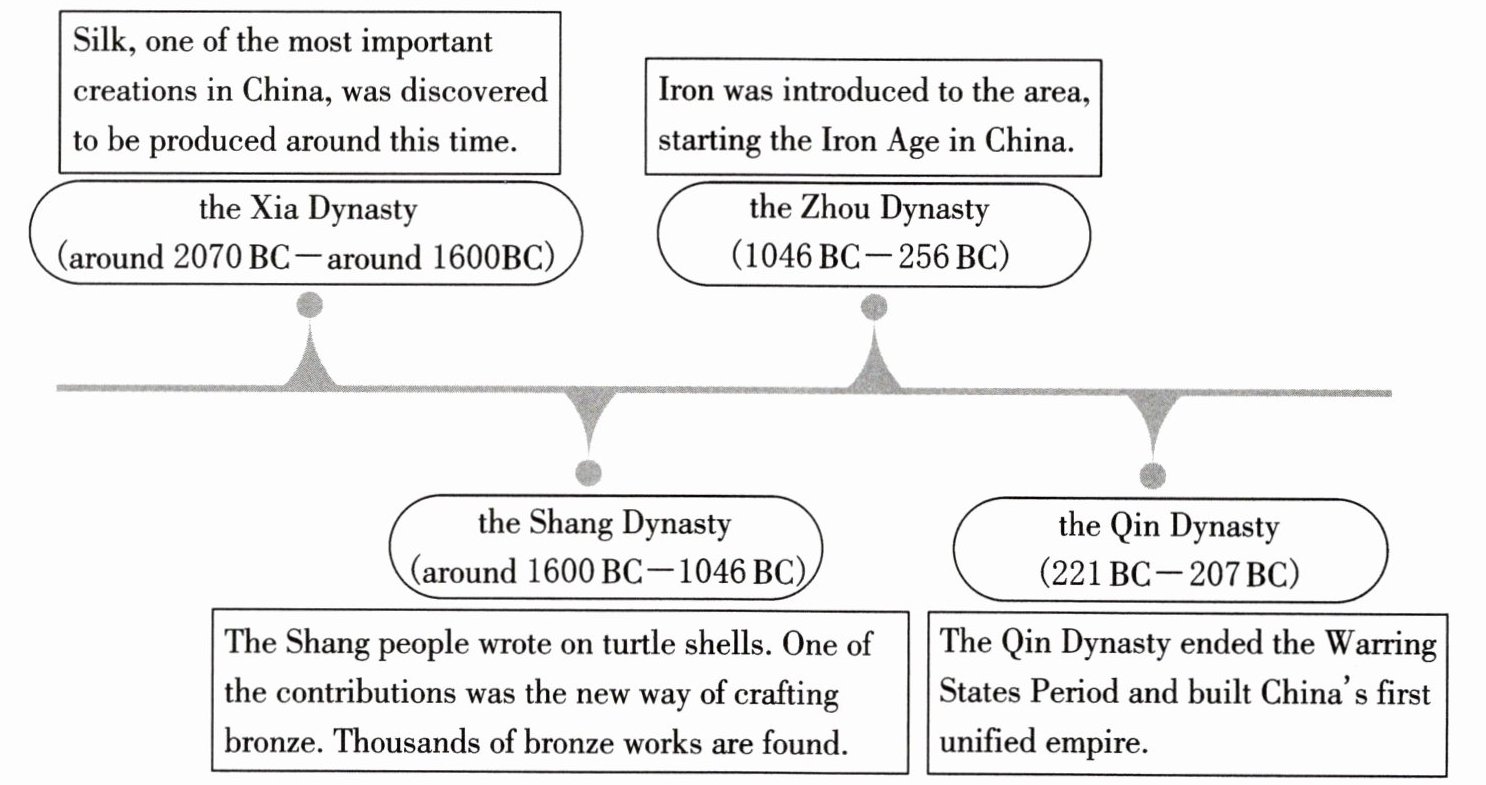
(
A. It is rich.
B. It begins early.
C. It lasts till now.
D. It has many dynasties.
(
A. The Xia Dynasty.
B. The Shang Dynasty.
C. The Zhou Dynasty.
D. The Qin Dynasty.
(
A. Bronze was first used by the Zhou people.
B. The Xia people usually wrote on turtle shells.
C. Silk products were popular before the Xia Dynasty.
D. The Qin Dynasty set up the earliest unified empire in Chinese history.
第一节(共15小题;每小题2分,满分30分)
阅读下列短文,从短文后每题所给的A、B、C、D四个选项中,选出最佳选项。
A 跨学科 历史
History makes men wise. Do you want to know more?
Many people think that the Chinese civilization began around the Yellow River, stretching back over 5,000 years without interruption(中断). Compared to other civilizations of the time, Chinese culture stayed largely the same as today's culture. The other nations fell into wars and disappeared, or were controlled by other nations, though.
(
C
)46. What is Chinese culture special about?A. It is rich.
B. It begins early.
C. It lasts till now.
D. It has many dynasties.
(
C
)47. Which dynasty lasts the longest time?A. The Xia Dynasty.
B. The Shang Dynasty.
C. The Zhou Dynasty.
D. The Qin Dynasty.
(
D
)48. Which of the following is true according to the passage?A. Bronze was first used by the Zhou people.
B. The Xia people usually wrote on turtle shells.
C. Silk products were popular before the Xia Dynasty.
D. The Qin Dynasty set up the earliest unified empire in Chinese history.
答案
46. C 47. C 48. D
解析
【分析】
解答这几道阅读题需结合原文信息与历史朝代时间计算:第46题定位原文关于中国文化特点的描述,匹配对应选项;第47题计算各朝代存在时长,比较得出最长的朝代;第48题逐一核对选项与原文内容,排除错误选项。
【解析】
46题:定位原文第一段“Compared to other civilizations of the time, Chinese culture stayed largely the same as today's culture”,可知中国文化的特别之处是延续至今,对应选项C。
47题:计算各朝代时长:夏朝(2070BC-1600BC)时长约470年;商朝(1600BC-1046BC)时长约554年;周朝(1046BC-256BC)时长约790年;秦朝(221BC-207BC)时长约14年,因此周朝存在时间最长,选C。
48题:逐一分析选项:A选项,原文提到商朝的贡献是青铜制作,并非周朝,错误;B选项,写龟甲的是商朝人,不是夏朝人,错误;C选项,丝绸是夏朝时期生产的,夏朝之前不存在,错误;D选项,原文明确“the Qin Dynasty... built China's first unified empire”,正确,选D。
【答案】
46.C 47.C 48.D
【知识点】
阅读理解细节理解、历史朝代时间计算、文本信息判断
【点评】
本题为跨学科阅读题,结合英语阅读与中国古代历史知识,考查学生的信息定位、计算及判断能力,题目难度适中,只要仔细核对原文和计算时长即可正确解答。
【难度系数】
0.7
Today, microplastics(微塑料) can be found almost everywhere on Earth. Scientists have seen microplastic pollution near the peak of Mount Everest, in the Mariana Trench and even in baby waste. But now, researchers have found these tiny plastic particles(颗粒) in a new place: human blood.
The new research was published in Environment International on March 24. The scientists collected blood samples from 22 healthy adults and found plastic particles in 17 of them. These particles were as small as 0.0007 mm. That is to say, each of them is about 140 times smaller than the width of a human hair.
Half the blood samples had PET plastic, which is usually used in drink bottles. One third had PS in them. This type of plastic is often used for packing food and other products. And PE, which is used to produce plastic bags, was found in a quarter of the blood samples. Researchers even found two or three different types of plastic at the same time in some of the blood samples.
“It is certainly reasonable to be worried,” said study author Dick Vethaak. “The particles are there and are being transported throughout the body.” As a result of his research, Vethaak has been cutting down on his own use of plastics. He has also been covering his food and drinks to prevent plastics from directly entering them.
“The big question is, what is happening inside of our bodies?” said Vethaak. “Do the particles stay in the body? Are they being transported to the organs(器官)? And are these levels high enough to cause diseases?”
(
A. By listing numbers.
B. By comparing facts.
C. By giving examples.
D. By raising questions.
(
A. Blood samples.
B. PET plastic.
C. Plastic particles.
D. Drink bottles.
(
A. To introduce the different uses of PET, PS, and PE plastics in drink bottles.
B. To explain how microplastics enter the human body from the new research.
C. To tell people not to worry about the dangers of particles throughout the body.
D. To report the discovery of microplastics in human blood and discuss concerns.
(
A. Ways to reduce microplastic pollution in the ocean.
B. Detailed statistics about microplastics in Mount Everest.
C. Further research on how microplastics affect human health.
D. The history of plastic production and its usage from all over the world.
C
The new research was published in Environment International on March 24. The scientists collected blood samples from 22 healthy adults and found plastic particles in 17 of them. These particles were as small as 0.0007 mm. That is to say, each of them is about 140 times smaller than the width of a human hair.
Half the blood samples had PET plastic, which is usually used in drink bottles. One third had PS in them. This type of plastic is often used for packing food and other products. And PE, which is used to produce plastic bags, was found in a quarter of the blood samples. Researchers even found two or three different types of plastic at the same time in some of the blood samples.
“It is certainly reasonable to be worried,” said study author Dick Vethaak. “The particles are there and are being transported throughout the body.” As a result of his research, Vethaak has been cutting down on his own use of plastics. He has also been covering his food and drinks to prevent plastics from directly entering them.
“The big question is, what is happening inside of our bodies?” said Vethaak. “Do the particles stay in the body? Are they being transported to the organs(器官)? And are these levels high enough to cause diseases?”
(
A
)49.(创新考法·行文方式)How does the writer develop Paragraph 2?A. By listing numbers.
B. By comparing facts.
C. By giving examples.
D. By raising questions.
(
A
)50. What does the underlined word “them” in Paragraph 3 refer to?A. Blood samples.
B. PET plastic.
C. Plastic particles.
D. Drink bottles.
(
D
)51. What's the main purpose of the passage?A. To introduce the different uses of PET, PS, and PE plastics in drink bottles.
B. To explain how microplastics enter the human body from the new research.
C. To tell people not to worry about the dangers of particles throughout the body.
D. To report the discovery of microplastics in human blood and discuss concerns.
(
C
)52. What is the passage most likely to discuss next?A. Ways to reduce microplastic pollution in the ocean.
B. Detailed statistics about microplastics in Mount Everest.
C. Further research on how microplastics affect human health.
D. The history of plastic production and its usage from all over the world.
C
答案
49. A 50. A 51. D 52. C
解析
【分析】
首先分析每道题的解题思路:49题需判断第二段的行文方式,第二段出现了多个具体数字,是通过列数字展开;50题是代词指代题,需定位前文的名词,确定指代对象;51题主旨题要梳理文章核心内容,即发现人血中有微塑料并讨论担忧;52题推理题需结合最后一段的疑问,推断后续讨论方向。
【解析】
49题:第二段使用了“22 healthy adults”“17 of them”“0.0007 mm”“140 times”等具体数字,以列数字的方式展开,故选A。
50题:第三段围绕“blood samples”展开,“One third had PS in them”中,them指代前文的“blood samples”,故选A。
51题:文章核心是报道在人类血液中发现微塑料的研究,并讨论相关担忧,符合选项D的表述,故选D。
52题:最后一段提出微塑料在人体内的作用、是否致病等疑问,后续最可能讨论微塑料对人体健康影响的进一步研究,故选C。
【答案】49.A 50.A 51.D 52.C
【知识点】英语阅读理解(细节理解、代词指代、主旨大意、推理判断),科普文阅读方法
【点评】本文是关于微塑料在人体血液中存在的科普类阅读,考查多种阅读题型,需学生准确提取细节、理解指代、把握主旨并合理推理,整体难度适中。
【难度系数】0.6
