

 登录
登录
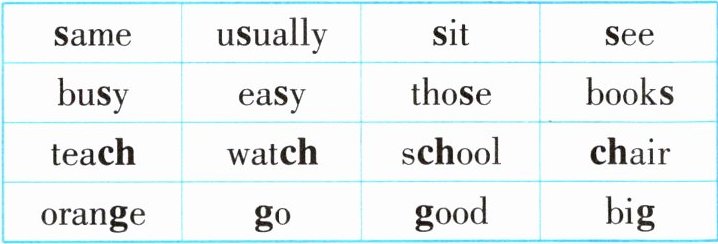
一、朗读下面的单词,在每一行中找出粗体部分读音不一样的单词,并将其圈出来。
答案
usually、books、school、orange
解析
【分析】
要解决该问题,需逐行分析每个单词中粗体部分的发音,对比找出发音不一致的单词。具体步骤:先确定每行单词的粗体字母/字母组合,再分别判断其发音,最后筛选出与其他单词发音不同的那个。
【解析】
1. 第一行:same中s发音为/s/,usually中s发音为/ʒ/,sit中s发音为/s/,see中s发音为/s/,发音不同的是usually;
2. 第二行:busy中s发音为/z/,easy中s发音为/z/,those中s发音为/z/,books中s发音为/s/,发音不同的是books;
3. 第三行:teach中ch发音为/tʃ/,watch中ch发音为/tʃ/,school中ch发音为/k/,chair中ch发音为/tʃ/,发音不同的是school;
4. 第四行:orange中g发音为/dʒ/,go中g发音为/g/,good中g发音为/g/,big中g发音为/g/,发音不同的是orange;
综上,需圈出的单词为usually、books、school、orange。
【答案】
usually、books、school、orange
【知识点】
英语单词读音;字母发音;字母组合发音
【点评】
本题考查常见字母及字母组合的发音辨析,属于英语语音基础题,需学生掌握基础语音规则。
【难度系数】
0.5
要解决该问题,需逐行分析每个单词中粗体部分的发音,对比找出发音不一致的单词。具体步骤:先确定每行单词的粗体字母/字母组合,再分别判断其发音,最后筛选出与其他单词发音不同的那个。
【解析】
1. 第一行:same中s发音为/s/,usually中s发音为/ʒ/,sit中s发音为/s/,see中s发音为/s/,发音不同的是usually;
2. 第二行:busy中s发音为/z/,easy中s发音为/z/,those中s发音为/z/,books中s发音为/s/,发音不同的是books;
3. 第三行:teach中ch发音为/tʃ/,watch中ch发音为/tʃ/,school中ch发音为/k/,chair中ch发音为/tʃ/,发音不同的是school;
4. 第四行:orange中g发音为/dʒ/,go中g发音为/g/,good中g发音为/g/,big中g发音为/g/,发音不同的是orange;
综上,需圈出的单词为usually、books、school、orange。
【答案】
usually、books、school、orange
【知识点】
英语单词读音;字母发音;字母组合发音
【点评】
本题考查常见字母及字母组合的发音辨析,属于英语语音基础题,需学生掌握基础语音规则。
【难度系数】
0.5
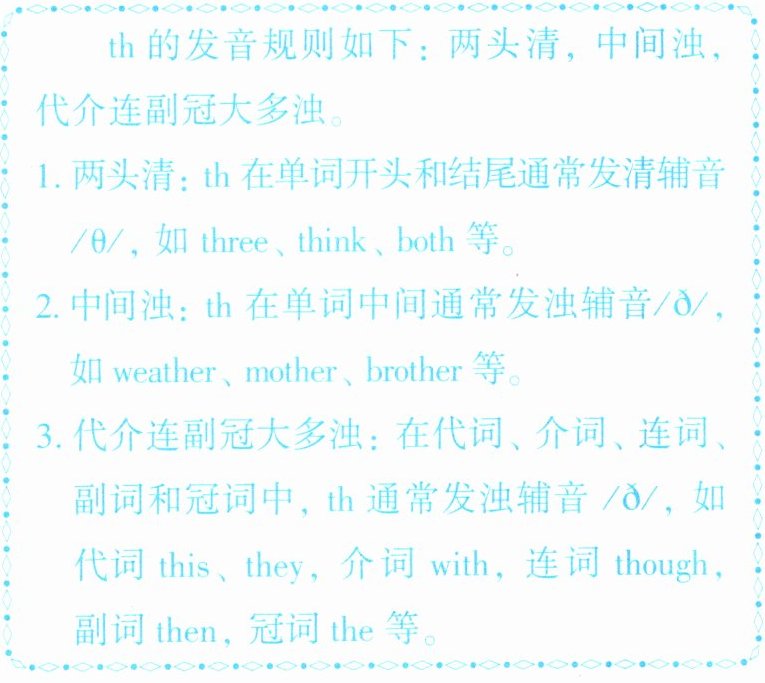
二、根据th的发音规则将下面方框中的单词进行分类。
tooth there thank other that father
cloth thirst them maths
/θ/:
/ð/:
tooth there thank other that father
cloth thirst them maths
/θ/:
tooth thank cloth thirst maths
/ð/:
there other that father them
答案
/θ/:tooth thank cloth thirst maths
/ð/:there other that father them
/ð/:there other that father them
解析
【分析】首先明确th的发音规则:th在单词开头和结尾发清辅音/θ/(两头清),在单词中间发浊辅音/ð/(中间浊),在代词、介词、连词、副词、冠词中大多发浊辅音/ð/(代介连副冠大多浊)。解题时需逐个判断方框内每个单词中th的发音,再分别归类到对应类别中。
【解析】逐个分析单词:
1. tooth:th在单词结尾,符合“两头清”,发/θ/;
2. there:属于副词,符合“代介连副冠大多浊”,发/ð/;
3. thank:th在单词开头,符合“两头清”,发/θ/;
4. other:th在单词中间,符合“中间浊”,发/ð/;
5. that:属于代词,符合“代介连副冠大多浊”,发/ð/;
6. father:th在单词中间,符合“中间浊”,发/ð/;
7. cloth:th在单词结尾,符合“两头清”,发/θ/;
8. thirst:th在单词开头,符合“两头清”,发/θ/;
9. them:属于代词,符合“代介连副冠大多浊”,发/ð/;
10. maths:th在单词结尾,符合“两头清”,发/θ/。
据此分类:/θ/类为tooth、thank、cloth、thirst、maths;/ð/类为there、other、that、father、them。
【答案】/θ/:tooth thank cloth thirst maths;/ð/:there other that father them
【知识点】th的发音规则
【点评】本题考查th的发音规则的应用,需准确掌握不同位置及词性下th的发音规律,属于基础语音知识题。
【难度系数】0.7
【解析】逐个分析单词:
1. tooth:th在单词结尾,符合“两头清”,发/θ/;
2. there:属于副词,符合“代介连副冠大多浊”,发/ð/;
3. thank:th在单词开头,符合“两头清”,发/θ/;
4. other:th在单词中间,符合“中间浊”,发/ð/;
5. that:属于代词,符合“代介连副冠大多浊”,发/ð/;
6. father:th在单词中间,符合“中间浊”,发/ð/;
7. cloth:th在单词结尾,符合“两头清”,发/θ/;
8. thirst:th在单词开头,符合“两头清”,发/θ/;
9. them:属于代词,符合“代介连副冠大多浊”,发/ð/;
10. maths:th在单词结尾,符合“两头清”,发/θ/。
据此分类:/θ/类为tooth、thank、cloth、thirst、maths;/ð/类为there、other、that、father、them。
【答案】/θ/:tooth thank cloth thirst maths;/ð/:there other that father them
【知识点】th的发音规则
【点评】本题考查th的发音规则的应用,需准确掌握不同位置及词性下th的发音规律,属于基础语音知识题。
【难度系数】0.7
三、请仿照所给示例,将对话中需要重读的词用重音符号标出来。
Example:
A: 'Hello! 'What 'time do you 'often 'go to 'school?
B: At 'half past 'seven.
1. A: Hi, Jim! When do you usually have breakfast?
B: At a quarter to seven.
2. A: What do you often do after you get up in the morning?
B: I take a shower.
Example:
A: 'Hello! 'What 'time do you 'often 'go to 'school?
B: At 'half past 'seven.
1. A: Hi, Jim! When do you usually have breakfast?
B: At a quarter to seven.
2. A: What do you often do after you get up in the morning?
B: I take a shower.
答案
1. A: 'Hi, 'Jim! 'When do you 'usually 'have 'breakfast?
B: At a 'quarter to 'seven.
2. A: 'What do you 'often 'do after you 'get 'up in the 'morning?
B: I 'take a 'shower.
B: At a 'quarter to 'seven.
2. A: 'What do you 'often 'do after you 'get 'up in the 'morning?
B: I 'take a 'shower.
解析
【分析】
英语句子中通常需要重读实词(如疑问词、名词、动词、副词等),虚词(如介词、冠词、代词等)一般不重读。解题时需先识别对话句子中的实词,再按规则用重音符号标注,确保符合日常口语的重读逻辑。
【解析】
1. 分析对话1:A句中实词为Hi、Jim、When、usually、have、breakfast,需标注重音;B句中实词为quarter、seven,标注重音。
2. 分析对话2:A句中实词为What、often、do、get、up、morning,需标注重音;B句中实词为take、shower,标注重音。
【答案】
1. A: 'Hi, 'Jim! 'When do you 'usually 'have 'breakfast?
B: At a 'quarter to 'seven.
2. A: 'What do you 'often 'do after you 'get 'up in the 'morning?
B: I 'take a 'shower.
【知识点】
英语句子重读规则,英语语音语调
【点评】
本题考查英语日常对话中实词重读的基础规则,需掌握常见重读词类型,结合对话语境准确应用,属于语音知识的基础应用题型。
【难度系数】
0.5
英语句子中通常需要重读实词(如疑问词、名词、动词、副词等),虚词(如介词、冠词、代词等)一般不重读。解题时需先识别对话句子中的实词,再按规则用重音符号标注,确保符合日常口语的重读逻辑。
【解析】
1. 分析对话1:A句中实词为Hi、Jim、When、usually、have、breakfast,需标注重音;B句中实词为quarter、seven,标注重音。
2. 分析对话2:A句中实词为What、often、do、get、up、morning,需标注重音;B句中实词为take、shower,标注重音。
【答案】
1. A: 'Hi, 'Jim! 'When do you 'usually 'have 'breakfast?
B: At a 'quarter to 'seven.
2. A: 'What do you 'often 'do after you 'get 'up in the 'morning?
B: I 'take a 'shower.
【知识点】
英语句子重读规则,英语语音语调
【点评】
本题考查英语日常对话中实词重读的基础规则,需掌握常见重读词类型,结合对话语境准确应用,属于语音知识的基础应用题型。
【难度系数】
0.5
四、将下列汉语翻译成英语。
1. 一名校园记者
2. 刷牙
3. 在大概三点钟
4. 做某人的家庭作业
5. 上床睡觉
6. 早睡早起!
7. 在一个上学日
8. 待在学校
9. 晚饭后
10. 多长时间
1. 一名校园记者
a school reporter
2. 刷牙
brush teeth
3. 在大概三点钟
at around three o'clock
4. 做某人的家庭作业
do one's homework
5. 上床睡觉
go to bed
6. 早睡早起!
Early to bed, early to rise!
7. 在一个上学日
on a school day
8. 待在学校
stay at school
9. 晚饭后
after dinner
10. 多长时间
how long
答案
1. a school reporter
2. brush teeth
3. at around three o'clock
4. do one's homework
5. go to bed
6. Early to bed, early to rise!
7. on a school day
8. stay at school
9. after dinner
10. how long
2. brush teeth
3. at around three o'clock
4. do one's homework
5. go to bed
6. Early to bed, early to rise!
7. on a school day
8. stay at school
9. after dinner
10. how long
解析
【分析】本题为基础汉译英题,需掌握日常常用短语的对应英语表达,注意固定搭配、介词及冠词的正确使用,逐个将汉语短语匹配对应的标准英语表达即可。
【解析】1. “校园”对应school,“记者”对应reporter,译为a school reporter;2. “刷”对应brush,“牙齿”常用复数teeth,译为brush teeth;3. “大概”对应around,“三点钟”是three o'clock,介词用at,译为at around three o'clock;4. “做”对应do,“某人的”用one's,“家庭作业”是homework,译为do one's homework;5. “上床睡觉”为固定短语,译为go to bed;6. “早睡早起”是固定谚语,译为Early to bed, early to rise!;7. “上学日”是school day,介词用on,译为on a school day;8. “待在”对应stay at,“学校”是school,译为stay at school;9. “晚饭后”对应after dinner;10. “多长时间”对应how long。
【答案】1. a school reporter
2. brush teeth
3. at around three o'clock
4. do one's homework
5. go to bed
6. Early to bed, early to rise!
7. on a school day
8. stay at school
9. after dinner
10. how long
【知识点】汉英短语互译、常用固定搭配、介词用法
【点评】本题考查日常基础短语的汉译英,属于英语学习的核心基础内容,需牢记常用固定表达,难度较低。
【难度系数】0.7
【解析】1. “校园”对应school,“记者”对应reporter,译为a school reporter;2. “刷”对应brush,“牙齿”常用复数teeth,译为brush teeth;3. “大概”对应around,“三点钟”是three o'clock,介词用at,译为at around three o'clock;4. “做”对应do,“某人的”用one's,“家庭作业”是homework,译为do one's homework;5. “上床睡觉”为固定短语,译为go to bed;6. “早睡早起”是固定谚语,译为Early to bed, early to rise!;7. “上学日”是school day,介词用on,译为on a school day;8. “待在”对应stay at,“学校”是school,译为stay at school;9. “晚饭后”对应after dinner;10. “多长时间”对应how long。
【答案】1. a school reporter
2. brush teeth
3. at around three o'clock
4. do one's homework
5. go to bed
6. Early to bed, early to rise!
7. on a school day
8. stay at school
9. after dinner
10. how long
【知识点】汉英短语互译、常用固定搭配、介词用法
【点评】本题考查日常基础短语的汉译英,属于英语学习的核心基础内容,需牢记常用固定表达,难度较低。
【难度系数】0.7
五、用括号内所给词的正确形式填空。
1. Sally usually (brush) her teeth between meals.
2. The afternoon lessons ______ (begin) at 12:30 in Timo’s school.
3. On Saturdays, Sam usually (make) breakfast by himself and then (do) his homework.
4. Tim often (rise) early in the morning.
5. My father is a doctor. He usually (stay) in the hospital for about 10 hours every day.
1. Sally usually (brush) her teeth between meals.
2. The afternoon lessons ______ (begin) at 12:30 in Timo’s school.
3. On Saturdays, Sam usually (make) breakfast by himself and then (do) his homework.
4. Tim often (rise) early in the morning.
5. My father is a doctor. He usually (stay) in the hospital for about 10 hours every day.
答案
1. brushes
2. begin
3. makes; does
4. rises
5. stays
2. begin
3. makes; does
4. rises
5. stays
解析
【分析】首先观察每个句子的时间状语(如usually、often),确定时态为一般现在时;接着判断每个句子的主语是第三人称单数还是复数:若主语是第三人称单数,动词需变为第三人称单数形式;若主语是复数,动词用原形,最后结合括号内所给词的正确形式填空。
【解析】1. 句中时间状语usually是一般现在时的标志,主语Sally为第三人称单数,故将brush变为第三人称单数形式brushes;2. 句子描述日常课程安排,用一般现在时,主语the afternoon lessons是复数,故动词用原形begin;3. 时间状语usually提示用一般现在时,主语Sam是第三人称单数,两个并列谓语动词make和do都需变为第三人称单数形式,即makes和does;4. 时间状语often是一般现在时的标志,主语Tim为第三人称单数,故将rise变为第三人称单数形式rises;5. 时间状语usually提示用一般现在时,主语My father是第三人称单数,故将stay变为第三人称单数形式stays。
【答案】1. brushes
2. begin
3. makes; does
4. rises
5. stays
【知识点】一般现在时,动词第三人称单数变化
【点评】本题考查一般现在时的基础用法,核心是根据主语单复数和时态确定动词形式,是英语语法的基础考点,适合巩固日常时态的应用。
【难度系数】0.6
【解析】1. 句中时间状语usually是一般现在时的标志,主语Sally为第三人称单数,故将brush变为第三人称单数形式brushes;2. 句子描述日常课程安排,用一般现在时,主语the afternoon lessons是复数,故动词用原形begin;3. 时间状语usually提示用一般现在时,主语Sam是第三人称单数,两个并列谓语动词make和do都需变为第三人称单数形式,即makes和does;4. 时间状语often是一般现在时的标志,主语Tim为第三人称单数,故将rise变为第三人称单数形式rises;5. 时间状语usually提示用一般现在时,主语My father是第三人称单数,故将stay变为第三人称单数形式stays。
【答案】1. brushes
2. begin
3. makes; does
4. rises
5. stays
【知识点】一般现在时,动词第三人称单数变化
【点评】本题考查一般现在时的基础用法,核心是根据主语单复数和时态确定动词形式,是英语语法的基础考点,适合巩固日常时态的应用。
【难度系数】0.6
