

 登录
登录
(D)
In England, people usually begin their talks with "Isn't it a nice day?" "Do you think it will rain?" or "What a fine day!" 41. ______ That's because they can have four seasons in a day. In the morning, the weather is just like that in spring. 42. ______ The weather gets a little cold. In the afternoon, it will be sunny. 43. ______ And it will be summer at this time of a day.
In England, people can also have summer in winter, or have winter in summer. 44. And in summer sometimes they should put on warm clothes.
When you go to England, you will see that some English people usually take an umbrella or a raincoat(雨衣) with them on a sunny morning, but you shouldn't laugh at them. 45.
根据语篇内容,从方框内所给的选项中选出能填入空白处的最佳选项,使短文语意连贯。选项中有一项为多余项。
A. If you don't take an umbrella or a raincoat, you will regret(后悔) later.
B. People like to talk about the weather.
C. So in winter they can swim sometimes.
D. The sun will begin to shine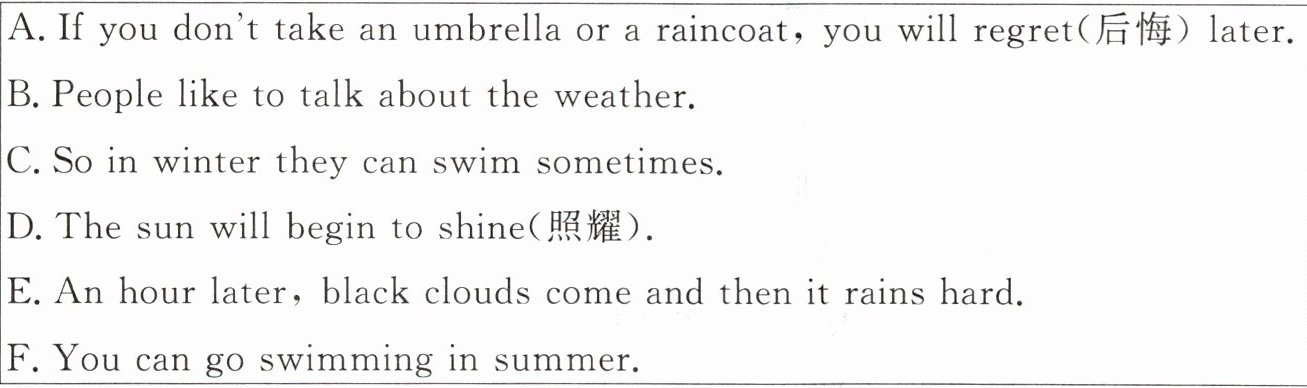 .
.
E. An hour later, black clouds come and then it rains hard.
F. You can go swimming in summer.
In England, people usually begin their talks with "Isn't it a nice day?" "Do you think it will rain?" or "What a fine day!" 41. ______ That's because they can have four seasons in a day. In the morning, the weather is just like that in spring. 42. ______ The weather gets a little cold. In the afternoon, it will be sunny. 43. ______ And it will be summer at this time of a day.
In England, people can also have summer in winter, or have winter in summer. 44. And in summer sometimes they should put on warm clothes.
When you go to England, you will see that some English people usually take an umbrella or a raincoat(雨衣) with them on a sunny morning, but you shouldn't laugh at them. 45.
根据语篇内容,从方框内所给的选项中选出能填入空白处的最佳选项,使短文语意连贯。选项中有一项为多余项。
A. If you don't take an umbrella or a raincoat, you will regret(后悔) later.
B. People like to talk about the weather.
C. So in winter they can swim sometimes.
D. The sun will begin to shine
.E. An hour later, black clouds come and then it rains hard.
F. You can go swimming in summer.
答案
【解析】:我们可以根据上下文的逻辑衔接来逐一确定答案:
1. 第41空:前文提到英国人常以各类天气相关的句子开启对话,后文解释这么做的原因是当地一天可能经历四季,B选项“人们喜欢谈论天气”可以自然衔接前后内容。
2. 第42空:前文描述早上天气像春天,后文说天气会变冷,E选项“一小时后,乌云密布,然后下起大雨”符合天气从春日状态转冷的过程,衔接通顺。
3. 第43空:前文提到下午天气会放晴,后文说这个时候就像夏天了,D选项“太阳将会开始照耀”,符合天晴后阳光充足、如同夏日的逻辑。
4. 第44空:前文说明英国的冬天里也可以有夏天、夏天里也可以有冬天,后文说夏天有时候人们需要穿保暖的衣服,C选项“所以在冬天他们有时候可以游泳”对应“冬天里有夏天”的描述,和后文内容并列,逻辑匹配。
5. 第45空:前文提到不要嘲笑晴天也随身带伞或雨衣的英国人,A选项“如果你不带伞或者雨衣,之后你会后悔的”可以解释不要嘲笑他们的原因,符合语境。
多余选项为F,不需要选用。
【答案】:41.B 42.E 43.D 44.C 45.A
1. 第41空:前文提到英国人常以各类天气相关的句子开启对话,后文解释这么做的原因是当地一天可能经历四季,B选项“人们喜欢谈论天气”可以自然衔接前后内容。
2. 第42空:前文描述早上天气像春天,后文说天气会变冷,E选项“一小时后,乌云密布,然后下起大雨”符合天气从春日状态转冷的过程,衔接通顺。
3. 第43空:前文提到下午天气会放晴,后文说这个时候就像夏天了,D选项“太阳将会开始照耀”,符合天晴后阳光充足、如同夏日的逻辑。
4. 第44空:前文说明英国的冬天里也可以有夏天、夏天里也可以有冬天,后文说夏天有时候人们需要穿保暖的衣服,C选项“所以在冬天他们有时候可以游泳”对应“冬天里有夏天”的描述,和后文内容并列,逻辑匹配。
5. 第45空:前文提到不要嘲笑晴天也随身带伞或雨衣的英国人,A选项“如果你不带伞或者雨衣,之后你会后悔的”可以解释不要嘲笑他们的原因,符合语境。
多余选项为F,不需要选用。
【答案】:41.B 42.E 43.D 44.C 45.A
(E)
Xiao Peng had a long holiday last month. He went to Hangzhou and visited his grandparents. He went there by train. Xiao Peng played with his cousin on the first day of the holiday. The next day, he visited the West Lake. It was very beautiful.
He went boating. He climbed a mountain too. He stayed in Hangzhou for five days. On the last day of the holiday, he sent a postcard to his parents. He came back home in the afternoon. Then he did his homework and prepared to go back to school.
根据语篇内容,回答问题(每题答案不超过4个词)。
46. Who did Xiao Peng visit last month?
47. Where did Xiao Peng go on his holiday?
48. How did Xiao Peng go there?
49. How long did Xiao Peng stay there?
50. Did Xiao Peng send a postcard to his parents?
Xiao Peng had a long holiday last month. He went to Hangzhou and visited his grandparents. He went there by train. Xiao Peng played with his cousin on the first day of the holiday. The next day, he visited the West Lake. It was very beautiful.
He went boating. He climbed a mountain too. He stayed in Hangzhou for five days. On the last day of the holiday, he sent a postcard to his parents. He came back home in the afternoon. Then he did his homework and prepared to go back to school.
根据语篇内容,回答问题(每题答案不超过4个词)。
46. Who did Xiao Peng visit last month?
47. Where did Xiao Peng go on his holiday?
48. How did Xiao Peng go there?
49. How long did Xiao Peng stay there?
50. Did Xiao Peng send a postcard to his parents?
答案
【解析】:我们对照短文内容逐一匹配答案:
1. 第46题:根据短文第二句"He went to Hangzhou and visited his grandparents.",可直接找到小鹏拜访的对象。
2. 第47题:根据短文第二句"He went to Hangzhou and visited his grandparents.",可直接找到小鹏假期前往的地点。
3. 第48题:根据短文第三句"He went there by train.",可直接找到小鹏的出行方式。
4. 第49题:根据短文第二段"He stayed in Hangzhou for five days.",可直接找到小鹏在当地的停留时长。
5. 第50题:根据短文第二段"On the last day of the holiday, he sent a postcard to his parents.",可知该表述是事实,给出肯定回答。所有答案都符合不超过4个词的要求。
【答案】:46. His grandparents.
47. Hangzhou.
48. By train.
49. For five days.
50. Yes, he did.
1. 第46题:根据短文第二句"He went to Hangzhou and visited his grandparents.",可直接找到小鹏拜访的对象。
2. 第47题:根据短文第二句"He went to Hangzhou and visited his grandparents.",可直接找到小鹏假期前往的地点。
3. 第48题:根据短文第三句"He went there by train.",可直接找到小鹏的出行方式。
4. 第49题:根据短文第二段"He stayed in Hangzhou for five days.",可直接找到小鹏在当地的停留时长。
5. 第50题:根据短文第二段"On the last day of the holiday, he sent a postcard to his parents.",可知该表述是事实,给出肯定回答。所有答案都符合不超过4个词的要求。
【答案】:46. His grandparents.
47. Hangzhou.
48. By train.
49. For five days.
50. Yes, he did.
