

 登录
登录
[2026 江苏扬州期末]Mr Smith works in a small city. Last month he had a fifteen-day holiday,
"That's easy," said Bill. "You'd better go to Moscow (莫斯科). Snow and ice are covering the ground now."
Mr Smith agreed
"How
(
(
(
(
(
(
(
(
(
(
C
he didn't know where to spend it. He spoke to his friend Bill, "I D
the hot weather, but I can't find a cool place in our country. How should I spend my holiday?""That's easy," said Bill. "You'd better go to Moscow (莫斯科). Snow and ice are covering the ground now."
Mr Smith agreed
B
his friend, bought an air ticket and soon arrived in Moscow. He had a happy trip there, but one day he C
into trouble. After lunch he went outside the city. He saw a D
following him while he was walking past a house. The dog was B
and wished him to give it some food to eat. Bad luck! He had no piece of bread or cake in his pockets. He tried to drive it away. But it began to bark at him. He wanted to look for a stick but he couldn't find anything A
snow and ice. Suddenly he C
a stone on the ground. He hurried to C
but failed."How
B
Russians are!" Mr Smith said to himself. "They don't tie dogs, but firmly (坚固地) tie the stones. My God!"(
C
)1. A. or B. so C. but D. if(
D
)2. A. like B. think C. am D. hate(
B
)3. A. of B. with C. at D. for(
C
)4. A. made B. took C. got D. found(
D
)5. A. cat B. house C. food D. dog(
B
)6. A. full B. hungry C. good D. bad(
A
)7. A. except B. besides C. inside D. outside(
C
)8. A. see B. look C. saw D. looked(
C
)9. A. picked it up B. picked up it C. pick it up D. pick up it(
B
)10. A. good B. strange C. happy D. mad答案
完形填空·语篇导读 本文主要讲述了史密斯先生为了避暑去了寒冷的莫斯科度假,在那里发生了一件麻烦事。
快速对答案
1—5 C D B C D
6—10 B A C C B
1. C 句意为:上个月他有15天的假期,但他不知道去哪里度假。根据语境可知,前后部分为转折关系,应用but连接,故选C项。
2. D 句意为:我讨厌炎热的天气,但在我们国家找不到凉爽的地方。根据but I can't find a cool place可推知,此处表示讨厌炎热的天气,故选D项。
3. B 句意为:史密斯先生赞同了他朋友的建议……agree with sb为固定短语,意为“赞同某人”,故选B项。
4. C 句意为:他在那里享受了愉快的旅行,但有一天他陷入了麻烦。get into trouble为固定短语,意为“陷入麻烦”,故选C项。
5. D 句意为:他经过一所房子时看到一只狗跟着他。根据后文的dog可知此处指狗,故选D项。
6. B 句意为:这只狗很饿,希望他给它些食物吃。根据wished him to give it some food to eat可知,狗处于饥饿状态。故选B项。
7. A 根据语境可知,除冰雪外他找不到其他物品,应用except,故选A项。
8. C 句意为:突然他看到地上有一块石头。根据“Suddenly he... a stone on the ground.”可知,此处强调“看到”的结果,且时态为一般过去时,故选C项。
9. C 句意为:他急忙去捡石头,但没成功。hurry to do sth为固定短语,pick up为“动词+副词”型短语,代词it作其宾语时应置于短语中间,故选C项。
10. B 句意为:俄罗斯人多奇怪啊!根据下文可知,史密斯先生认为俄罗斯人不拴狗却拴石头,他觉得奇怪,故选B项。
快速对答案
1—5 C D B C D
6—10 B A C C B
1. C 句意为:上个月他有15天的假期,但他不知道去哪里度假。根据语境可知,前后部分为转折关系,应用but连接,故选C项。
2. D 句意为:我讨厌炎热的天气,但在我们国家找不到凉爽的地方。根据but I can't find a cool place可推知,此处表示讨厌炎热的天气,故选D项。
3. B 句意为:史密斯先生赞同了他朋友的建议……agree with sb为固定短语,意为“赞同某人”,故选B项。
4. C 句意为:他在那里享受了愉快的旅行,但有一天他陷入了麻烦。get into trouble为固定短语,意为“陷入麻烦”,故选C项。
5. D 句意为:他经过一所房子时看到一只狗跟着他。根据后文的dog可知此处指狗,故选D项。
6. B 句意为:这只狗很饿,希望他给它些食物吃。根据wished him to give it some food to eat可知,狗处于饥饿状态。故选B项。
7. A 根据语境可知,除冰雪外他找不到其他物品,应用except,故选A项。
8. C 句意为:突然他看到地上有一块石头。根据“Suddenly he... a stone on the ground.”可知,此处强调“看到”的结果,且时态为一般过去时,故选C项。
9. C 句意为:他急忙去捡石头,但没成功。hurry to do sth为固定短语,pick up为“动词+副词”型短语,代词it作其宾语时应置于短语中间,故选C项。
10. B 句意为:俄罗斯人多奇怪啊!根据下文可知,史密斯先生认为俄罗斯人不拴狗却拴石头,他觉得奇怪,故选B项。
解析
【分析】
这是一篇叙事类完形填空,解题思路为:1. 先通读全文,把握故事脉络(史密斯先生为避暑去莫斯科度假,途中遇狗追,因当地只有冰雪想捡石头却失败的趣事);2. 针对每道题,结合前后句逻辑关系、固定短语搭配、词义辨析及时态等逐一分析,确定答案。
【解析】
1. 句意为:上个月他有15天的假期,但他不知道去哪里度假。前后为转折关系,应用but连接,故选C。
2. 句意为:我讨厌炎热的天气,但在我们国家找不到凉爽的地方。由后半句“找不到凉爽的地方”可知,此处表示讨厌炎热天气,故选D。
3. 句意为:史密斯先生赞同了他朋友的建议。agree with sb是固定短语,意为“赞同某人”,故选B。
4. 句意为:他在那里享受了愉快的旅行,但有一天他陷入了麻烦。get into trouble是固定短语,意为“陷入麻烦”,故选C。
5. 句意为:他经过一所房子时看到一只狗跟着他。由后文提到的“the dog”可知,此处指狗,故选D。
6. 句意为:这只狗很饿,希望他给它些食物吃。由“wished him to give it some food to eat”可知,狗处于饥饿状态,故选B。
7. 句意为:他想找一根棍子,但除了冰雪找不到任何东西。except表示“除……之外(不包含在内)”,符合语境,故选A。
8. 句意为:突然他看到地上有一块石头。此处强调“看到”的结果,且时态为一般过去时,应用see的过去式saw,故选C。
9. 句意为:他急忙去捡石头,但没成功。hurry to do sth是固定短语,意为“急忙做某事”;pick up是“动词+副词”型短语,代词it作宾语时需置于短语中间,故选C。
10. 句意为:俄罗斯人多奇怪啊!由下文史密斯先生认为“俄罗斯人不拴狗却拴石头”的想法可知,他觉得奇怪,故选B。
【答案】
1.C 2.D 3.B 4.C 5.D 6.B 7.A 8.C 9.C 10.B
【知识点】
完形填空、固定搭配、语境理解
【点评】
本题为叙事类完形填空,围绕史密斯先生的莫斯科度假经历展开,考查学生对上下文语境的把握、固定短语的运用及词义辨析能力,贴近生活,易于理解,适合初中学生巩固相关知识。
【难度系数】
0.6
这是一篇叙事类完形填空,解题思路为:1. 先通读全文,把握故事脉络(史密斯先生为避暑去莫斯科度假,途中遇狗追,因当地只有冰雪想捡石头却失败的趣事);2. 针对每道题,结合前后句逻辑关系、固定短语搭配、词义辨析及时态等逐一分析,确定答案。
【解析】
1. 句意为:上个月他有15天的假期,但他不知道去哪里度假。前后为转折关系,应用but连接,故选C。
2. 句意为:我讨厌炎热的天气,但在我们国家找不到凉爽的地方。由后半句“找不到凉爽的地方”可知,此处表示讨厌炎热天气,故选D。
3. 句意为:史密斯先生赞同了他朋友的建议。agree with sb是固定短语,意为“赞同某人”,故选B。
4. 句意为:他在那里享受了愉快的旅行,但有一天他陷入了麻烦。get into trouble是固定短语,意为“陷入麻烦”,故选C。
5. 句意为:他经过一所房子时看到一只狗跟着他。由后文提到的“the dog”可知,此处指狗,故选D。
6. 句意为:这只狗很饿,希望他给它些食物吃。由“wished him to give it some food to eat”可知,狗处于饥饿状态,故选B。
7. 句意为:他想找一根棍子,但除了冰雪找不到任何东西。except表示“除……之外(不包含在内)”,符合语境,故选A。
8. 句意为:突然他看到地上有一块石头。此处强调“看到”的结果,且时态为一般过去时,应用see的过去式saw,故选C。
9. 句意为:他急忙去捡石头,但没成功。hurry to do sth是固定短语,意为“急忙做某事”;pick up是“动词+副词”型短语,代词it作宾语时需置于短语中间,故选C。
10. 句意为:俄罗斯人多奇怪啊!由下文史密斯先生认为“俄罗斯人不拴狗却拴石头”的想法可知,他觉得奇怪,故选B。
【答案】
1.C 2.D 3.B 4.C 5.D 6.B 7.A 8.C 9.C 10.B
【知识点】
完形填空、固定搭配、语境理解
【点评】
本题为叙事类完形填空,围绕史密斯先生的莫斯科度假经历展开,考查学生对上下文语境的把握、固定短语的运用及词义辨析能力,贴近生活,易于理解,适合初中学生巩固相关知识。
【难度系数】
0.6
[2026 江苏徐州期末] No two snowflakes(雪花)are the same. They have different shapes and fall in four different ways. By watching how they “dance”, we can learn the weather conditions.
It’s hard to see snowflakes dancing with the naked eye(肉眼). Scientists can use special cameras to watch them. Weathermen can use radars to study these dances to learn about the weather.
| How they dance | What’s the weather like? |
| --- | --- |
|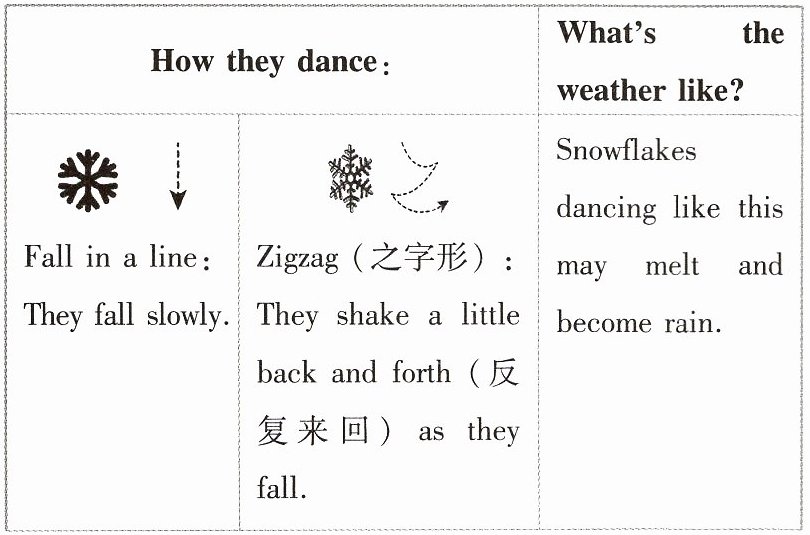
Fall in a line: They fall slowly.
Zigzag(之字形): They shake a little back and forth(反复来回)as they fall. | Snowflakes dancing like this may melt and become rain. |
续表
| How they dance | What’s the weather like? |
| --- | --- |
|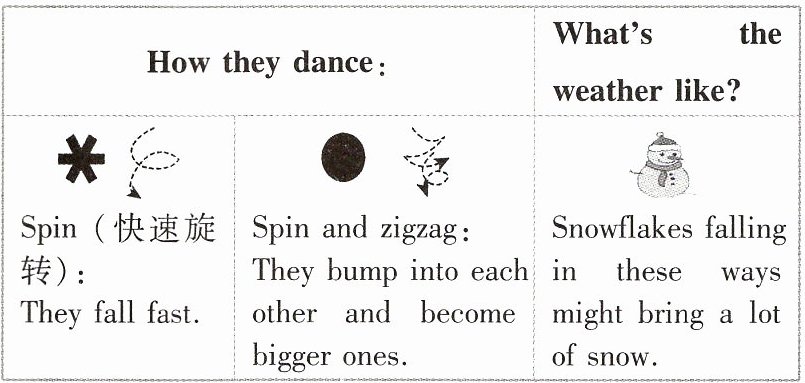
Spin(快速旋转): They fall fast.
Spin and zigzag: They bump into each other and become bigger ones. | Snowflakes falling in these ways might bring a lot of snow. |
(
A. The size of the snowflakes.
B. The weather conditions.
C. The colour of the snowflakes.
D. The temperature of the snowflakes.
(
A. They will fall very slowly.
B. They will become smaller.
C. They might bring a lot of snow.
D. They will melt and become rain.
(
A. By using radars.
B. By using robots.
C. By using the naked eye.
D. By using special cameras.

刷力满满鸭
It’s hard to see snowflakes dancing with the naked eye(肉眼). Scientists can use special cameras to watch them. Weathermen can use radars to study these dances to learn about the weather.
| How they dance | What’s the weather like? |
| --- | --- |
|
Fall in a line: They fall slowly.
Zigzag(之字形): They shake a little back and forth(反复来回)as they fall. | Snowflakes dancing like this may melt and become rain. |
续表
| How they dance | What’s the weather like? |
| --- | --- |
|
Spin(快速旋转): They fall fast.
Spin and zigzag: They bump into each other and become bigger ones. | Snowflakes falling in these ways might bring a lot of snow. |
(
B
)11. What can we learn by watching snowflakes “dance”?A. The size of the snowflakes.
B. The weather conditions.
C. The colour of the snowflakes.
D. The temperature of the snowflakes.
(
C
)12. What might happen if snowflakes spin and zigzag?A. They will fall very slowly.
B. They will become smaller.
C. They might bring a lot of snow.
D. They will melt and become rain.
(
D
)13. How do scientists watch snowflakes “dance”?A. By using radars.
B. By using robots.
C. By using the naked eye.
D. By using special cameras.
刷力满满鸭
答案
阅读选择·语篇导读 本文介绍了雪花的不同下落方式以及由此判断的天气状况。
快速对答案
11—13 B C D
11. B 细节理解题。根据“By watching how they 'dance', we can learn the weather conditions.”可知,观看雪花“舞蹈”能了解天气状况。故选B项。
12. C 细节理解题。根据Spin and zigzag右边的“Snowflakes falling in these ways might bring a lot of snow.”可知,如果雪花在空中旋转并呈之字形下降,可能会带来大量降雪,故选C项。
13. D 细节理解题。根据“Scientists can use special cameras to watch them.”可知,科学家使用特殊摄像机来观察雪花的“舞蹈”。故选D项。
快速对答案
11—13 B C D
11. B 细节理解题。根据“By watching how they 'dance', we can learn the weather conditions.”可知,观看雪花“舞蹈”能了解天气状况。故选B项。
12. C 细节理解题。根据Spin and zigzag右边的“Snowflakes falling in these ways might bring a lot of snow.”可知,如果雪花在空中旋转并呈之字形下降,可能会带来大量降雪,故选C项。
13. D 细节理解题。根据“Scientists can use special cameras to watch them.”可知,科学家使用特殊摄像机来观察雪花的“舞蹈”。故选D项。
解析
【分析】本题为英语阅读理解的细节理解题,解题思路是先明确题目问题指向,再通过关键词定位原文对应内容,最后匹配选项得出答案。第11题关键词为“watch snowflakes 'dance'”,第12题关键词为“spin and zigzag”,第13题关键词为“scientists watch snowflakes 'dance'”,分别定位原文对应语句即可解题。
【解析】11. 根据原文第一段“By watching how they 'dance', we can learn the weather conditions.”可知,观看雪花“舞蹈”能了解天气状况,对应选项B。12. 根据表格中“Spin and zigzag”对应的内容“Snowflakes falling in these ways might bring a lot of snow.”可知,雪花旋转并呈之字形下降可能带来大量降雪,对应选项C。13. 根据原文第二段“Scientists can use special cameras to watch them.”可知,科学家使用特殊摄像机观察雪花“舞蹈”,对应选项D。
【答案】11.B 12.C 13.D
【知识点】英语阅读理解、细节理解题
【点评】本题围绕雪花下落方式与天气的关联展开,主要考查学生快速定位原文细节信息的能力,题型常规,难度适中,仔细阅读原文对应内容即可正确解答。
【难度系数】0.7
【解析】11. 根据原文第一段“By watching how they 'dance', we can learn the weather conditions.”可知,观看雪花“舞蹈”能了解天气状况,对应选项B。12. 根据表格中“Spin and zigzag”对应的内容“Snowflakes falling in these ways might bring a lot of snow.”可知,雪花旋转并呈之字形下降可能带来大量降雪,对应选项C。13. 根据原文第二段“Scientists can use special cameras to watch them.”可知,科学家使用特殊摄像机观察雪花“舞蹈”,对应选项D。
【答案】11.B 12.C 13.D
【知识点】英语阅读理解、细节理解题
【点评】本题围绕雪花下落方式与天气的关联展开,主要考查学生快速定位原文细节信息的能力,题型常规,难度适中,仔细阅读原文对应内容即可正确解答。
【难度系数】0.7
