

 登录
登录
Ⅴ. 根据句意,从方框中选择恰当的单词补全下列句子或对话。
much many cool time T-shirt
1. —What is it? —It’s six o’clock.
2. —Is this your ? —Yes, it is.
3. —How is the Qingbuliang? —It’s ten yuan.
4. —How goats are there? —Twelve.
5. It’s today. I can put on my new jacket.
much many cool time T-shirt
1. —What is it? —It’s six o’clock.
2. —Is this your ? —Yes, it is.
3. —How is the Qingbuliang? —It’s ten yuan.
4. —How goats are there? —Twelve.
5. It’s today. I can put on my new jacket.
答案
1. time
2. T-shirt
3. much
4. many
5. cool
2. T-shirt
3. much
4. many
5. cool
解析
1. 根据答语“六点了”,可知问句是询问时间,固定句型What time is it? 表示“现在几点了”,所以选time。
2. 问句的be动词是Is,后面需要接单数名词,方框里的T-shirt(T恤)符合语境,句意为“这是你的T恤吗”,所以选T-shirt。
3. 根据答语“十元”,可知问句是询问价格,询问价格的固定表达是How much,所以选much。
4. 根据答语“十二”,可知问句是询问可数名词goats的数量,How many后接可数名词复数,用来对数量进行提问,所以选many。
5. 根据后半句“我可以穿上我的新夹克”,能推断出今天天气很凉爽,cool表示“凉爽的”,符合句意,所以选cool。
2. 问句的be动词是Is,后面需要接单数名词,方框里的T-shirt(T恤)符合语境,句意为“这是你的T恤吗”,所以选T-shirt。
3. 根据答语“十元”,可知问句是询问价格,询问价格的固定表达是How much,所以选much。
4. 根据答语“十二”,可知问句是询问可数名词goats的数量,How many后接可数名词复数,用来对数量进行提问,所以选many。
5. 根据后半句“我可以穿上我的新夹克”,能推断出今天天气很凉爽,cool表示“凉爽的”,符合句意,所以选cool。
Ⅵ. 为下列句子选择相对应的图片。
E.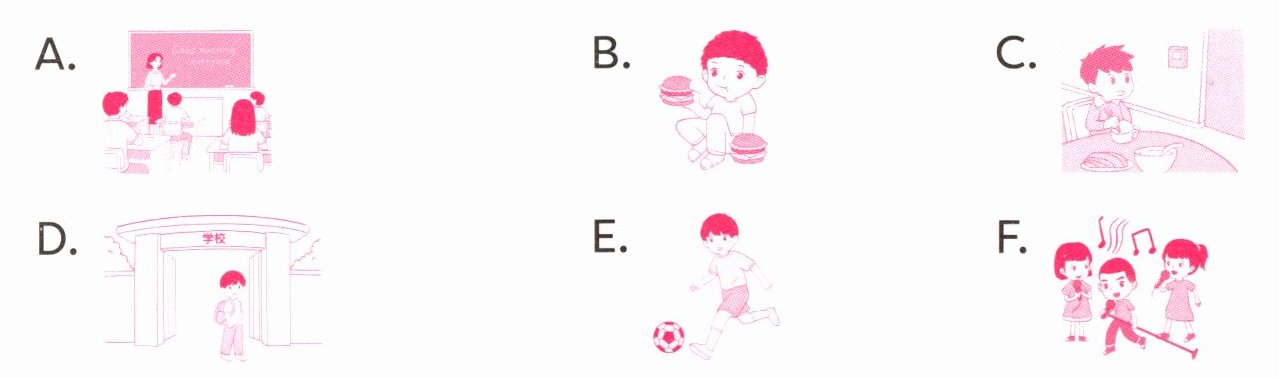
()1. It’s time for dinner. Eat some rice.
()2. It’s time for English class. Read and write.
()3. Class is over. It’s time to go home.
()4. It’s time for lunch. Have some hamburgers.
()5. It’s 3 o’clock. Let’s play football.
()6. Lily, let’s sing and dance.
E.
()1. It’s time for dinner. Eat some rice.
()2. It’s time for English class. Read and write.
()3. Class is over. It’s time to go home.
()4. It’s time for lunch. Have some hamburgers.
()5. It’s 3 o’clock. Let’s play football.
()6. Lily, let’s sing and dance.
答案
1. C
2. A
3. D
4. B
5. E
6. F
2. A
3. D
4. B
5. E
6. F
解析
我们先理解每个句子的含义,再匹配对应图片:
1. 句子"It's time for dinner. Eat some rice."意为“到晚餐时间了,吃些米饭”,对应图C:图中男孩坐在餐桌前用餐,符合吃晚餐的场景。
2. 句子"It's time for English class. Read and write."意为“到上英语课的时间了,读和写”,对应图A:图中是教室上课的场景,老师在黑板前授课,符合上英语课的情景。
3. 句子"Class is over. It's time to go home."意为“下课了,到回家的时间了”,对应图D:图中男孩背着书包正走出学校校门,符合放学回家的场景。
4. 句子"It's time for lunch. Have some hamburgers."意为“到午餐时间了,吃些汉堡”,对应图B:图中男孩手里拿着汉堡,符合吃汉堡的情景。
5. 句子"It's 3 o'clock. Let's play football."意为“三点了,我们去踢足球吧”,对应图E:图中男孩正在踢足球,符合踢足球的场景。
6. 句子"Lily, let's sing and dance."意为“莉莉,我们唱歌跳舞吧”,对应图F:图中孩子们拿着话筒,旁边有音符标识,符合唱歌跳舞的情景。
1. 句子"It's time for dinner. Eat some rice."意为“到晚餐时间了,吃些米饭”,对应图C:图中男孩坐在餐桌前用餐,符合吃晚餐的场景。
2. 句子"It's time for English class. Read and write."意为“到上英语课的时间了,读和写”,对应图A:图中是教室上课的场景,老师在黑板前授课,符合上英语课的情景。
3. 句子"Class is over. It's time to go home."意为“下课了,到回家的时间了”,对应图D:图中男孩背着书包正走出学校校门,符合放学回家的场景。
4. 句子"It's time for lunch. Have some hamburgers."意为“到午餐时间了,吃些汉堡”,对应图B:图中男孩手里拿着汉堡,符合吃汉堡的情景。
5. 句子"It's 3 o'clock. Let's play football."意为“三点了,我们去踢足球吧”,对应图E:图中男孩正在踢足球,符合踢足球的场景。
6. 句子"Lily, let's sing and dance."意为“莉莉,我们唱歌跳舞吧”,对应图F:图中孩子们拿着话筒,旁边有音符标识,符合唱歌跳舞的情景。
