

 登录
Ⅰ. 根据汉语提示完成句子
1. The stars were
2. She felt an
3. Water is a crucial
4. I saw a
5. "What's your
1. The stars were
visible
(可见的) in the clear night sky.2. She felt an
inner
(内部的) peace that she had never experienced before.3. Water is a crucial
element
(元素) in the composition of the human body.4. I saw a
comet
(彗星) streaking across the night sky last night.5. "What's your
nickname
(绰号) among your friends?" he asked curiously.答案
1. visible
2. inner
3. element
4. comet
5. nickname
2. inner
3. element
4. comet
5. nickname
Ⅱ. 用方框中所给单词的适当形式填空
fail; orbit; mass; rotate; requirement
1.
2. The experiment
3. The satellite successfully
4. Earth
5. The job
fail; orbit; mass; rotate; requirement
1.
Masses
of people visit Hebei to enjoy the scenery and waters during the weekends.2. The experiment
failed
due to a minor error in the procedure.3. The satellite successfully
orbits/orbited
around the planet, collecting valuable data for scientific research.4. Earth
rotates
on its axis ( 轴 ), causing the cycle of day and night.5. The job
requirements
include a bachelor's degree in Computer Science and three years of work experience.答案
1. Masses
2. failed
3. orbits/orbited
4. rotates
5. requirements
2. failed
3. orbits/orbited
4. rotates
5. requirements
Ⅲ. 根据汉语意思完成句子
1. 在比赛中,首先上场的是来自中国的短跑选手。
In the race,
2. 这场音乐会吸引了大批音乐爱好者。
The concert attracted
3. 这个团队由五名成员组成。
The team
4. 这款新智能手机的设计与去年型号的设计很相似。
The design of this new smartphone
5. 我们会努力工作,所以总会达到要求。
We'll work hard so we never
1. 在比赛中,首先上场的是来自中国的短跑选手。
In the race,
first
up
was the sprinter from China.2. 这场音乐会吸引了大批音乐爱好者。
The concert attracted
a
large/big
number
of
music lovers.3. 这个团队由五名成员组成。
The team
is
made
up
of
five members.4. 这款新智能手机的设计与去年型号的设计很相似。
The design of this new smartphone
is
similar
to
that of last year's model.5. 我们会努力工作,所以总会达到要求。
We'll work hard so we never
fail
to
meet
requirements
.答案
1. first up
2. a large/big number of
3. is made up of
4. is similar to
5. fail to meet requirements
2. a large/big number of
3. is made up of
4. is similar to
5. fail to meet requirements
Ⅳ. 阅读理解
According to Ken Croswell, the Sun and the moon are different. We often think that the Sun rules the day and the moon rules the night. That's kind of right, but not totally.
The Sun shines all the time. It shines during the day when we see it, and even at night when we don't.
As Earth turns, sometimes we face the Sun. That's when we get day. When Earth's spin (自转) turns us away from the Sun and we are in Earth's shadow, we get night. When people on the opposite side of Earth face the Sun, those people have day while we have night.
The moon is a different story. Unlike the Sun, it doesn't make its own light. Moonlight is actually the Sun's light reflecting off the moon back to us.
The Sun lights up only the side of the moon that faces the Sun. At full moon, the moon is on the opposite side of Earth from the Sun. Then the side of the moon facing Earth is all lit up. During full moon, the moon rises around sunset, shines all night, and sets around sunrise. Since the moonlight is so bright, you can sometimes see it during the day, too. A few days before full moon, if you look east in the afternoon, you may see the moon in the sky. After full moon, you may find it if you look west in the morning.
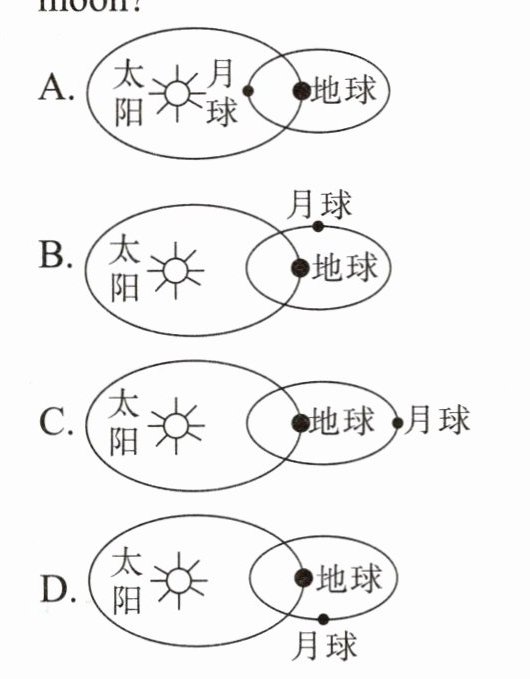
The moon is most difficult to see at new moon, when its orbit puts it between Earth and the Sun. Then, the side of the moon facing Earth is dark and we can't see the moon at all.
1. What can we know about the Sun?
A. The Sun rules the moon.
B. The Sun shines during both day and night.
C. The Sun lights up all the sides of the moon.
D. The Sun shines everywhere on Earth at the same time.
2. Which of the following in the dictionary best explains the underlined word "shadow" in Paragraph 3?
A. The shape of Earth.
B. The force from the Sun.
C. The dark area on Earth.
D. The opposite side of the Sun.
3. What does Paragraph 5 mainly talk about?
A. How the moon makes its light.
B. Why there is day and night on Earth.
C. Why the moon can be seen during the day.
D. What the difference is between full moon and new moon.
4. Which of the following pictures shows us new moon?
5. What is the theme of the text?
A. Culture.
B. Science.
C. Education.
D. Technology.
错题回收站
According to Ken Croswell, the Sun and the moon are different. We often think that the Sun rules the day and the moon rules the night. That's kind of right, but not totally.
The Sun shines all the time. It shines during the day when we see it, and even at night when we don't.
As Earth turns, sometimes we face the Sun. That's when we get day. When Earth's spin (自转) turns us away from the Sun and we are in Earth's shadow, we get night. When people on the opposite side of Earth face the Sun, those people have day while we have night.
The moon is a different story. Unlike the Sun, it doesn't make its own light. Moonlight is actually the Sun's light reflecting off the moon back to us.
The Sun lights up only the side of the moon that faces the Sun. At full moon, the moon is on the opposite side of Earth from the Sun. Then the side of the moon facing Earth is all lit up. During full moon, the moon rises around sunset, shines all night, and sets around sunrise. Since the moonlight is so bright, you can sometimes see it during the day, too. A few days before full moon, if you look east in the afternoon, you may see the moon in the sky. After full moon, you may find it if you look west in the morning.
The moon is most difficult to see at new moon, when its orbit puts it between Earth and the Sun. Then, the side of the moon facing Earth is dark and we can't see the moon at all.
1. What can we know about the Sun?
A. The Sun rules the moon.
B. The Sun shines during both day and night.
C. The Sun lights up all the sides of the moon.
D. The Sun shines everywhere on Earth at the same time.
2. Which of the following in the dictionary best explains the underlined word "shadow" in Paragraph 3?
A. The shape of Earth.
B. The force from the Sun.
C. The dark area on Earth.
D. The opposite side of the Sun.
3. What does Paragraph 5 mainly talk about?
A. How the moon makes its light.
B. Why there is day and night on Earth.
C. Why the moon can be seen during the day.
D. What the difference is between full moon and new moon.
4. Which of the following pictures shows us new moon?
5. What is the theme of the text?
A. Culture.
B. Science.
C. Education.
D. Technology.
错题回收站
答案
1. B
2. C
3. C
4. A
5. B
2. C
3. C
4. A
5. B
