

 登录
登录
五、根据提示,填写表格并仿写句子。
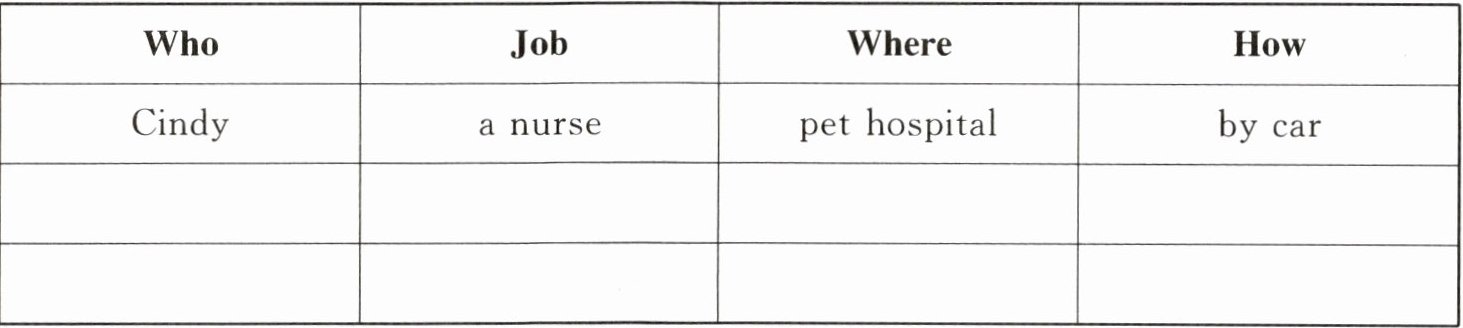
例:Cindy is a nurse. She works in a pet hospital. She goes to work by car.
1.
2.
例:Cindy is a nurse. She works in a pet hospital. She goes to work by car.
1.
2.
答案
1.
| Who | Job | Where | How |
| --- | --- | --- | --- |
| Tom | a pilot | plane | by car (answer varies) |
Tom is a pilot. He works on a plane. He goes to work by car.
2.
| Who | Job | Where | How |
| --- | --- | --- | --- |
| Mary | a teacher | school | on foot (answer varies) |
Mary is a teacher. She works in a school. She goes to work on foot.
| Who | Job | Where | How |
| --- | --- | --- | --- |
| Tom | a pilot | plane | by car (answer varies) |
Tom is a pilot. He works on a plane. He goes to work by car.
2.
| Who | Job | Where | How |
| --- | --- | --- | --- |
| Mary | a teacher | school | on foot (answer varies) |
Mary is a teacher. She works in a school. She goes to work on foot.
六、你知道职业"男女有别"吗?
在英语中,表示男女的称谓、职业或职务等单词有所不同。
让我们一起试着写一写吧!
1. 我们常把 man,woman,boy,girl 等名词加在职业等名词前,以区分男女。
例:man teacher 男教师 试一试:女作家
例:boy student 男生 试一试:女生
2. 通常,动词末尾加"-er/-or"多为男性,加"-ress"多为女性。
例:waiter 男服务员 试一试:女服务员
actor 男演员 试一试:女演员
在英语中,表示男女的称谓、职业或职务等单词有所不同。
让我们一起试着写一写吧!
1. 我们常把 man,woman,boy,girl 等名词加在职业等名词前,以区分男女。
例:man teacher 男教师 试一试:女作家
例:boy student 男生 试一试:女生
2. 通常,动词末尾加"-er/-or"多为男性,加"-ress"多为女性。
例:waiter 男服务员 试一试:女服务员
actor 男演员 试一试:女演员
答案
woman writer; girl student; waitress; actress
解析
1. 根据“man/woman+职业”区分男女,“女作家”用“woman writer”;“女生”对应“boy student”,用“girl student”。
2. 动词加“-er/-or”为男性,加“-ress”为女性,“女服务员”是“waitress”;“女演员”是“actress”。
2. 动词加“-er/-or”为男性,加“-ress”为女性,“女服务员”是“waitress”;“女演员”是“actress”。
