

 登录
五、阅读还原
When winter comes, cranes migrate(迁徙) from northeast Siberia in Russia to Poyang Lake in Jiangxi Province, China. 1.
However, climate change has influenced the birds' living conditions.
In some years, the Poyang Lake experiences floods, while in others, it experiences dry weather. 2.
To help deal with the problem, the local government has planted 70 hectares(公顷) of lotus roots(莲藕) in Nanchang. 3.
Over the years, China has worked hard to protect migratory birds. Recently, 1,140 places in the country have been taken as important breeding(繁殖) grounds, wintering grounds and migratory stops. 4.
5.
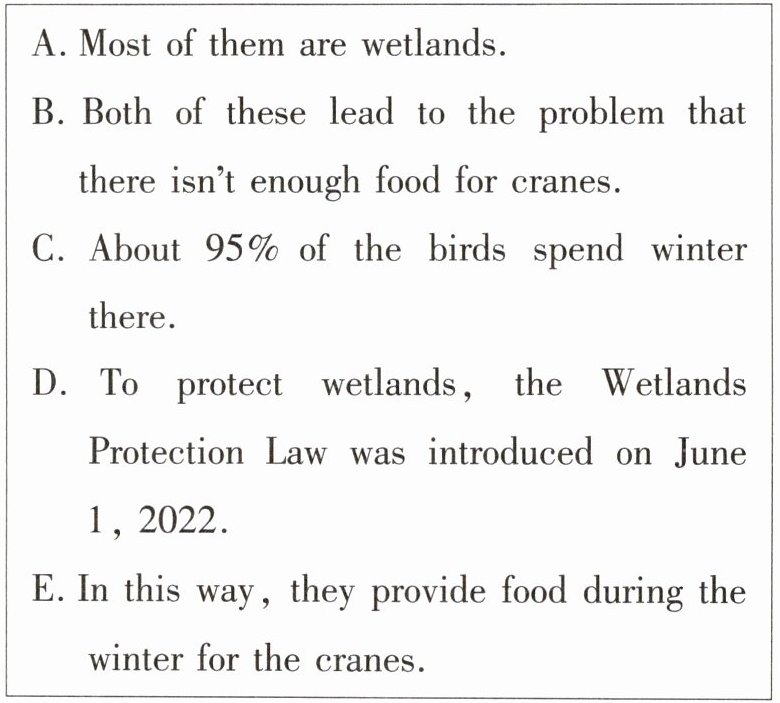
A. Most of them are wetlands.
B. Both of these lead to the problem that there isn't enough food for cranes.
C. About 95% of the birds spend winter there.
D. To protect wetlands, the Wetlands Protection Law was introduced on June 1, 2022.
E. In this way, they provide food during the winter for the cranes.
When winter comes, cranes migrate(迁徙) from northeast Siberia in Russia to Poyang Lake in Jiangxi Province, China. 1.
C
However, climate change has influenced the birds' living conditions.
In some years, the Poyang Lake experiences floods, while in others, it experiences dry weather. 2.
B
To help deal with the problem, the local government has planted 70 hectares(公顷) of lotus roots(莲藕) in Nanchang. 3.
E
The birds' population has risen from about 3,000 to more than 5,000 over the past 20 years.Over the years, China has worked hard to protect migratory birds. Recently, 1,140 places in the country have been taken as important breeding(繁殖) grounds, wintering grounds and migratory stops. 4.
A
They play a key role in cleaning water, preventing floods, and keeping the balance of the environment.5.
D
The law sets rules to help manage wetlands. And it stops harmful activities, including giving out waste water. Thanks to these efforts, China has reported more birds wintering in the wetlands.A. Most of them are wetlands.
B. Both of these lead to the problem that there isn't enough food for cranes.
C. About 95% of the birds spend winter there.
D. To protect wetlands, the Wetlands Protection Law was introduced on June 1, 2022.
E. In this way, they provide food during the winter for the cranes.
答案
1.C 2.B 3.E 4.A 5.D
解析
【分析】这是一道英语阅读还原题,解题时需先通读全文把握文章主旨(围绕中国鄱阳湖及湿地保护、候鸟保护展开),再逐个分析每个空缺处的前后语境,结合选项的语义和逻辑关系(如指代、因果、承接等)匹配正确选项:第1空需承接鹤迁徙到鄱阳湖的内容,选说明候鸟越冬地的选项;第2空需对应前文的旱涝问题,选引出食物不足的选项;第3空需承接种莲藕的行为,选说明提供食物的选项;第4空需对应前文的保护地点,选说明地点属性的选项;第5空需引出后文的法律内容,选说明湿地保护法的选项。
【解析】
1. 第1空:前文提到鹤迁徙到鄱阳湖,选项C“About 95% of the birds spend winter there.”(大约95%的鸟在那里过冬),承接上文的地点,逻辑连贯,故选C。
2. 第2空:前文指出鄱阳湖有时涝有时旱,选项B“Both of these lead to the problem that there isn't enough food for cranes.”(这两个情况导致鹤没有足够食物),“both of these”指代前文的旱涝状况,因果逻辑成立,故选B。
3. 第3空:前文说明政府种植了莲藕,选项E“In this way, they provide food during the winter for the cranes.”(这样,它们为鹤提供冬季食物),“In this way”指代种莲藕的做法,承接自然,故选E。
4. 第4空:前文提到1140个地方被列为重要的候鸟相关地点,选项A“Most of them are wetlands.”(它们大部分是湿地),“them”指代前文的1140个地点,说明其属性,逻辑通顺,故选A。
5. 第5空:后文介绍法律的内容,选项D“To protect wetlands, the Wetlands Protection Law was introduced on June 1, 2022.”(为保护湿地,湿地保护法于2022年6月1日出台),引出后文的法律相关内容,故选D。
【答案】1.C 2.B 3.E 4.A 5.D
【知识点】英语阅读还原;语篇逻辑衔接
【点评】本题考查英语语篇理解与上下文逻辑推理能力,要求学生把握句间的指代、因果、承接等关系,是中等难度的语篇类题目。
【难度系数】0.6
