

 登录
登录
一、单词能量站:看图,将图片与对应单词连线。
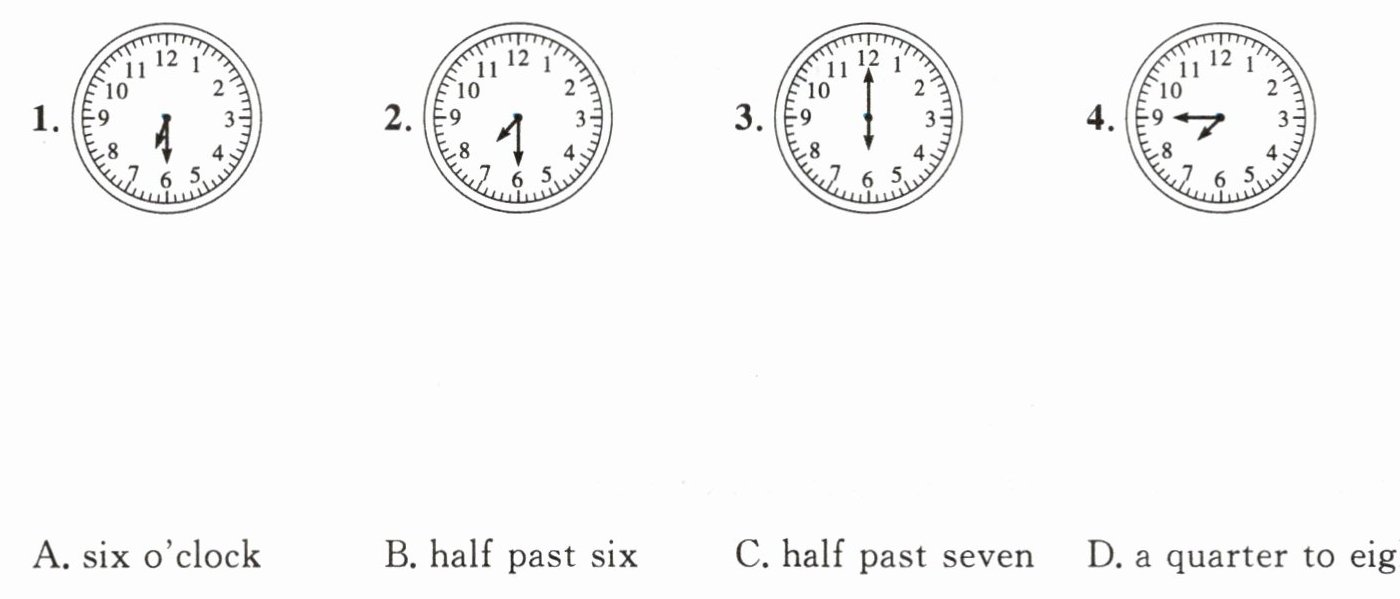
答案
1-B,2-C,3-A,4-D
解析
我们逐个认读钟表的时间,再匹配对应的英文时间表达:
1. 第1个钟表:时针在6和7之间,分针指向6,代表时间是6点30分,对应half past six。
2. 第2个钟表:时针在7和8之间,分针指向6,代表时间是7点30分,对应half past seven。
3. 第3个钟表:时针指向6,分针指向12,代表时间是6点整,对应six o'clock。
4. 第4个钟表:时针在7和8之间,分针指向9,代表距离8点还差15分钟,对应a quarter to eight。
1. 第1个钟表:时针在6和7之间,分针指向6,代表时间是6点30分,对应half past six。
2. 第2个钟表:时针在7和8之间,分针指向6,代表时间是7点30分,对应half past seven。
3. 第3个钟表:时针指向6,分针指向12,代表时间是6点整,对应six o'clock。
4. 第4个钟表:时针在7和8之间,分针指向9,代表距离8点还差15分钟,对应a quarter to eight。
二、课文寻宝:根据课本内容,用方框中单词的正确形式补全句子。
go be have start
1. School at eight o'clock.
2. We dinner at 7 o'clock last night.
3. Sam to school at half past seven every morning.
4. Will you home at seven o'clock?
go be have start
1. School at eight o'clock.
2. We dinner at 7 o'clock last night.
3. Sam to school at half past seven every morning.
4. Will you home at seven o'clock?
答案
1. starts 2. had 3. goes 4. be
解析
1. 本句描述学校的常规作息,使用一般现在时,主语School是第三人称单数,要表达“开始”的含义,动词start要变为第三人称单数形式starts。
2. 句中时间状语last night(昨晚)是一般过去时的标志,have dinner是固定搭配“吃晚饭”,have的过去式为had。
3. 句中时间状语every morning(每天早上)是一般现在时的标志,主语Sam是第三人称单数,go to school是固定搭配“去上学”,go的第三人称单数形式为goes。
4. 本句是Will引导的一般将来时疑问句,will后面需要接动词原形,be home是固定搭配“到家/在家”,因此填be。
2. 句中时间状语last night(昨晚)是一般过去时的标志,have dinner是固定搭配“吃晚饭”,have的过去式为had。
3. 句中时间状语every morning(每天早上)是一般现在时的标志,主语Sam是第三人称单数,go to school是固定搭配“去上学”,go的第三人称单数形式为goes。
4. 本句是Will引导的一般将来时疑问句,will后面需要接动词原形,be home是固定搭配“到家/在家”,因此填be。
三、句型万花筒:仿照例句改写句子。
例:She makes a card for her mum. → She will make a card for her mum tomorrow.
1. My grandpa reads newspaper every evening. → My grandpa newspaper tomorrow evening.
2. She watches TV with her family at eight o'clock. → My sister TV with her family at eight o'clock tonight.
3. My brother finishes homework at five. → He homework at five tomorrow.
4. She usually plays basketball on Sunday. → My sister basketball next Sunday.
5. They do exercises every morning. → My parents exercises tomorrow morning.
例:She makes a card for her mum. → She will make a card for her mum tomorrow.
1. My grandpa reads newspaper every evening. → My grandpa newspaper tomorrow evening.
2. She watches TV with her family at eight o'clock. → My sister TV with her family at eight o'clock tonight.
3. My brother finishes homework at five. → He homework at five tomorrow.
4. She usually plays basketball on Sunday. → My sister basketball next Sunday.
5. They do exercises every morning. → My parents exercises tomorrow morning.
答案
1. will read
2. will watch
3. will finish
4. will play
5. will do
2. will watch
3. will finish
4. will play
5. will do
解析
本题考查一般现在时改写为一般将来时的用法,参照例句的改写规则:原句是一般现在时,改写后要变为一般将来时,在主语后添加助动词will,同时将原句的谓语动词还原为动词原形,匹配句中给出的将来时间状语即可。
