

 登录
4. —What a lasting value
—But to me, I prefer folk, for it has strong local colour.
A.rock
B.jazz
C.country music
D.classical music
D
has!—But to me, I prefer folk, for it has strong local colour.
A.rock
B.jazz
C.country music
D.classical music
答案
4.D
解析
【分析】先通读对话,明确语境:第一句感叹某音乐具有持久价值,第二句转折说明自己更喜欢民谣(原因是有强烈地方色彩),需从四个音乐类型选项中选出符合“有持久价值”的音乐,结合常见音乐类型的特点判断。
【解析】翻译对话:“——它有多么持久的价值啊!——但对我来说,我更喜欢民谣,因为它有强烈的地方色彩。” 分析选项:A.摇滚、B.爵士、C.乡村音乐、D.古典音乐,古典音乐通常被公认为具有持久的艺术价值,契合第一句的描述,因此选D。
【答案】D
【知识点】音乐名词辨析、语境理解
【点评】本题考查英语音乐类名词的词义辨析,需结合对话语境和常识作答,难度适中,侧重考查学生对常见音乐类型的认知及语境理解能力。
【难度系数】0.5
【解析】翻译对话:“——它有多么持久的价值啊!——但对我来说,我更喜欢民谣,因为它有强烈的地方色彩。” 分析选项:A.摇滚、B.爵士、C.乡村音乐、D.古典音乐,古典音乐通常被公认为具有持久的艺术价值,契合第一句的描述,因此选D。
【答案】D
【知识点】音乐名词辨析、语境理解
【点评】本题考查英语音乐类名词的词义辨析,需结合对话语境和常识作答,难度适中,侧重考查学生对常见音乐类型的认知及语境理解能力。
【难度系数】0.5
5. —You must finish your homework if you want to watch the concert tonight.
—I know. I will get everything ready and join you on time.
A.quick; soon
B.quickly; soon
C.quickly; quick
D.soon; quickly
—I know. I will get everything ready and join you on time.
A.quick; soon
B.quickly; soon
C.quickly; quick
D.soon; quickly
答案
5.B
解析
【分析】首先明确解题思路:1. 确定两个空格都需要副词修饰动词(finish和get ready),因为副词可作状语修饰动词;2. 辨析选项中词汇的词性:quick是形容词,quickly、soon是副词;3. 结合语境和词性排除错误选项:第一空修饰动词需用副词,排除含形容词quick的A;第二空修饰动词短语需用副词,排除含形容词quick的C;D选项第一空soon语义不符,排除,最终确定答案。
【解析】本题考查副词的用法。步骤1:分析句子成分,两个空格分别修饰动词finish和动词短语get ready,需使用副词作状语。步骤2:辨析词汇词性:quick为形容词,意为“快的”;quickly为副词,意为“快速地”;soon为副词,意为“不久,很快”。步骤3:逐一排除错误选项:A项第一空用形容词quick,不能修饰动词finish,排除;C项第二空用形容词quick,不能修饰动词短语get ready,排除;D项第一空soon语义不符,排除。因此正确答案为B。
【答案】B
【知识点】副词的用法、形容词与副词辨析
【点评】本题为基础词汇应用题目,重点考查形容词与副词的词性差异及副词修饰动词的用法,属于学生应掌握的基础知识点,难度较低。
【难度系数】0.7
6. —My uncle has worked in for five years and he knows much about local culture.
—He must be familiar with songs and their traditional musical styles.
A.America; African
B.African; America
C.Africa; African
D.American; Africa
—He must be familiar with songs and their traditional musical styles.
A.America; African
B.African; America
C.Africa; African
D.American; Africa
答案
6.C
解析
【分析】
首先明确句子中空缺处的词性需求:第一空位于介词in之后,需填表示地点的名词;第二空修饰名词songs,需填形容词。再结合选项词义逐一排除:B、D选项中African、American为形容词,不符合第一空需名词的要求,先排除;A选项中America是名词,但第二空需形容词修饰songs,America为名词无法修饰,排除;C选项中Africa是地点名词符合第一空,African是形容词可修饰songs,符合语境。
【解析】
本题考查名词与形容词的词义辨析。
1. 分析第一空:介词in后需接表示地点的名词,A项America(美国,名词)、C项Africa(非洲,名词)符合要求;B项African(非洲的,形容词)、D项American(美国的,形容词)不符合,排除B、D。
2. 分析第二空:空格后是名词songs,需用形容词修饰,A项America是名词,不能修饰名词;C项African(非洲的,形容词)可修饰songs,符合语境。
综上,答案为C。
【答案】
C
【知识点】
名词辨析;形容词辨析
【点评】
本题考查英语中名词和形容词的基本用法,需掌握大洲相关的名词及对应形容词形式,结合语境判断词性即可解答,属于基础题型。
【难度系数】
0.5
Ⅲ. 翻译句子
1. 音乐会给我们提供了了解不同种类音乐的机会。
2. 他今晚将打扮成一个美国黑人。
3. 摇滚音乐中使用鼓的时候多吗?
4. 和古典音乐不一样,乡村音乐通常是关于乡村生活和牛仔的。
5. 你熟悉一些能即兴编造部分音乐的音乐人吗?
1. 音乐会给我们提供了了解不同种类音乐的机会。
Concerts provide us with the chance to learn about different kinds of music.
2. 他今晚将打扮成一个美国黑人。
He will dress up as an African American tonight.
3. 摇滚音乐中使用鼓的时候多吗?
Are drums used a lot in rock music?
4. 和古典音乐不一样,乡村音乐通常是关于乡村生活和牛仔的。
Unlike classical music, country music is often about country life and cowboys.
5. 你熟悉一些能即兴编造部分音乐的音乐人吗?
Are you familiar with some musicians who can make up parts of the music while playing?
答案
1. Concerts provide us with the chance to learn about different kinds of music.
2. He will dress up as an African American tonight.
3. Are drums used a lot in rock music?
4. Unlike classical music, country music is often about country life and cowboys.
5. Are you familiar with some musicians who can make up parts of the music while playing?
2. He will dress up as an African American tonight.
3. Are drums used a lot in rock music?
4. Unlike classical music, country music is often about country life and cowboys.
5. Are you familiar with some musicians who can make up parts of the music while playing?
解析
【分析】翻译此类句子时,需先定位核心短语与句式结构,再结合英语表达习惯调整语序。如第1句“给某人提供做某事的机会”对应固定结构provide sb with the chance to do sth;第2句“打扮成”是固定短语dress up as;第3句需转换为英语疑问语序;第4句用介词unlike表达“和……不一样”;第5句需用定语从句修饰“音乐人”,用who引导。
【解析】1. 核心结构为“主语+provide sb with sth+不定式作定语”,“了解”译为learn about,故译为:Concerts provide us with the chance to learn about different kinds of music;2. 一般将来时,“打扮成”译为dress up as,“今晚”译为tonight,故译为:He will dress up as an African American tonight;3. 一般疑问句,主语为drums,“在摇滚音乐中”译为in rock music,“被大量使用”用被动语态,故译为:Are drums used a lot in rock music?;4. “和……不一样”用介词unlike引导,“乡村音乐”译为country music,“关于”译为about,故译为:Unlike classical music, country music is often about country life and cowboys;5. “熟悉”译为be familiar with,“音乐人”译为musicians,定语从句用who引导修饰musicians,“即兴编造”译为make up,故译为:Are you familiar with some musicians who can make up parts of the music while playing?
【答案】1. Concerts provide us with the chance to learn about different kinds of music.
2. He will dress up as an African American tonight.
3. Are drums used a lot in rock music?
4. Unlike classical music, country music is often about country life and cowboys.
5. Are you familiar with some musicians who can make up parts of the music while playing?
【知识点】短语搭配、英语句式、定语从句
【点评】本题为基础英语翻译题,主要考察常用短语、固定搭配及基本句式的运用,需学生掌握核心词汇与短语的正确表达,难度适中,适合基础阶段学生巩固练习。
【难度系数】0.7
Ⅳ. (2026·江苏南京月考)阅读理解
Horace was walking through the music store with his mother. She wanted him to join the school band and play an instrument. As they passed the flute and trumpet(小号) section, Horace frowned. He didn't like their high, bright sounds. He also worried that joining the band might make other kids think he was a “band geek” and not cool.
Then he saw the electric guitars. That's more like it, he thought. A guitar looked cool and strong, not soft like a violin. Excited, he picked one up, put the strap over his shoulder, and tried to play a chord. But when he strummed the strings, all that came out was a messy, twanging(刺耳的) noise. He had no idea what he was doing. His excitement disappeared, replaced by embarrassment. “I'm awful at this,” he muttered, putting the guitar down.
His mother, trying not to show her disappointment, gently led him to the last section of the store. There, an old man was sitting on a stool, playing a large, wooden instrument—a cello(大提琴). The man moved a long bow across the strings, and a deep, rich, beautiful sound filled the air. Horace stopped. The melody was sad but beautiful, and it felt completely different from the sharp sounds of the flutes or the noisy guitar.
The old man saw Horace watching and smiled. He showed Horace how to hold the cello and how to pull the bow gently across one string. With a little help, Horace managed to produce a single clear, vibrating(振动的) note. It wasn't a messy noise, it was a real musical sound. A feeling of surprise and happiness washed over him, “Mum,” he said, looking up with shining eyes. “This is it. I want to learn this. (Picture ★)”
His mother agreed happily. For the next hour, while she talked to the store clerk about prices and lessons, Horace didn't listen. He just watched the old man play and tried to make a few more notes himself. He had found his instrument not by looking for what seemed cool, but by listening for what truly spoke to him.
1. What does Horace mean when he thinks, “That's more like it,” about the electric guitar?
A. It is what the school band needs.
B. It is the instrument his mother likes most.
C. It looks cool and feels right for him.
D. It is easier to play than other instruments.
2. Which of the following pictures can be put into “ ★ ”?
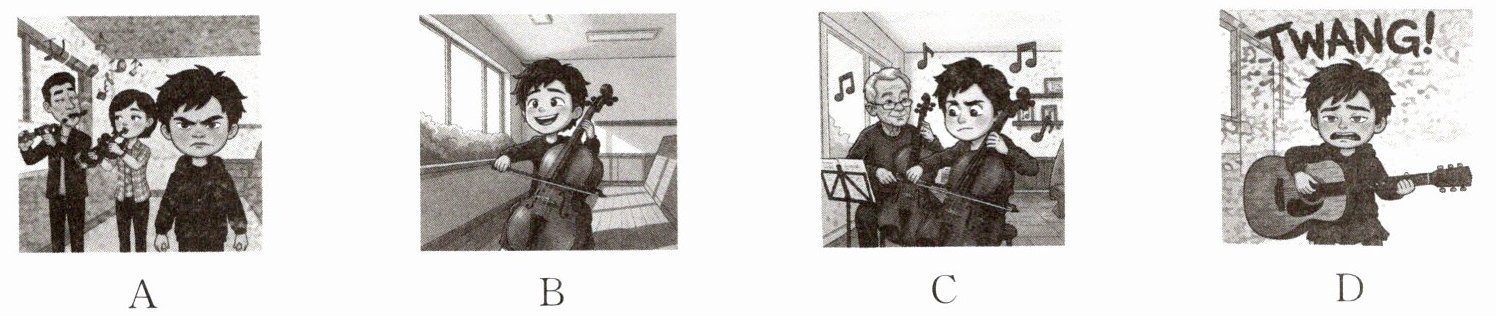
3. Which shows the correct order of what Horace does in the story?
①Decide to learn the cello.
②Try the electric guitar and fail.
③Get lost in practising the cello.
④Visit the music store with mother.
⑤Hear the cello played by an old man.
⑥Dislike the trumpet and flute sounds.
A. ④⑥②⑤③①
B. ④②⑥⑤③①
C. ④⑥②⑤①③
D. ④②⑤⑥③①
4. What does the story mainly tell us?
A. Insist on your first choice.
B. Cool-looking things are best.
C. Parents always know what is best.
D. Choose what truly touches your heart.
Horace was walking through the music store with his mother. She wanted him to join the school band and play an instrument. As they passed the flute and trumpet(小号) section, Horace frowned. He didn't like their high, bright sounds. He also worried that joining the band might make other kids think he was a “band geek” and not cool.
Then he saw the electric guitars. That's more like it, he thought. A guitar looked cool and strong, not soft like a violin. Excited, he picked one up, put the strap over his shoulder, and tried to play a chord. But when he strummed the strings, all that came out was a messy, twanging(刺耳的) noise. He had no idea what he was doing. His excitement disappeared, replaced by embarrassment. “I'm awful at this,” he muttered, putting the guitar down.
His mother, trying not to show her disappointment, gently led him to the last section of the store. There, an old man was sitting on a stool, playing a large, wooden instrument—a cello(大提琴). The man moved a long bow across the strings, and a deep, rich, beautiful sound filled the air. Horace stopped. The melody was sad but beautiful, and it felt completely different from the sharp sounds of the flutes or the noisy guitar.
The old man saw Horace watching and smiled. He showed Horace how to hold the cello and how to pull the bow gently across one string. With a little help, Horace managed to produce a single clear, vibrating(振动的) note. It wasn't a messy noise, it was a real musical sound. A feeling of surprise and happiness washed over him, “Mum,” he said, looking up with shining eyes. “This is it. I want to learn this. (Picture ★)”
His mother agreed happily. For the next hour, while she talked to the store clerk about prices and lessons, Horace didn't listen. He just watched the old man play and tried to make a few more notes himself. He had found his instrument not by looking for what seemed cool, but by listening for what truly spoke to him.
1. What does Horace mean when he thinks, “That's more like it,” about the electric guitar?
A. It is what the school band needs.
B. It is the instrument his mother likes most.
C. It looks cool and feels right for him.
D. It is easier to play than other instruments.
2. Which of the following pictures can be put into “ ★ ”?
3. Which shows the correct order of what Horace does in the story?
①Decide to learn the cello.
②Try the electric guitar and fail.
③Get lost in practising the cello.
④Visit the music store with mother.
⑤Hear the cello played by an old man.
⑥Dislike the trumpet and flute sounds.
A. ④⑥②⑤③①
B. ④②⑥⑤③①
C. ④⑥②⑤①③
D. ④②⑤⑥③①
4. What does the story mainly tell us?
A. Insist on your first choice.
B. Cool-looking things are best.
C. Parents always know what is best.
D. Choose what truly touches your heart.
答案
1.C 2.B 3.C 4.D
解析
【分析】
本题为英语阅读理解题,需结合文章内容解答细节理解、事件排序、主旨大意类题目。解题思路:1. 针对细节题,定位原文对应句子,匹配选项;2. 针对事件排序题,梳理文章中Horace的行为先后顺序;3. 针对主旨题,抓住文章最后总结性语句提炼核心;4. 插图题需结合文章中Horace对大提琴的态度变化匹配对应图片。
【解析】
1. 细节理解题:定位原文第二段“A guitar looked cool and strong, not soft like a violin. Excited, he picked one up...”可知,Horace觉得电吉他看起来酷,适合自己,对应选项C。A选项未提及乐队需要;B选项未提到妈妈喜欢;D选项未说电吉他更容易,均排除。
2. 插图题:文章最后Horace决定学习大提琴,且拉出清晰的音,情绪开心,对应图B(男孩拉大提琴,面带笑容);图A是吹管乐器、图C是和老人拉大提琴但男孩表情严肃、图D是弹吉他(刺耳噪音),均不符合,故选B。
3. 事件排序题:梳理原文顺序:④和妈妈去音乐店→⑥不喜欢长笛小号的声音→②试电吉他失败→⑤听到老人拉大提琴→①决定学大提琴→③沉浸练习大提琴,对应选项C。
4. 主旨大意题:文章最后一句“He had found his instrument not by looking for what seemed cool, but by listening for what truly spoke to him.”点明主旨,即选择真正触动内心的事物,对应选项D。A、B、C均与原文主旨不符。
【答案】
1.C 2.B 3.C 4.D
【知识点】
英语阅读理解、细节理解题、主旨大意题、事件排序题
【点评】
本文通过Horace选择乐器的故事,传递了“选择真正触动内心的事物”的道理,题目涵盖多种常见阅读理解题型,需学生精准定位原文信息、理清事件顺序、把握核心主旨,整体难度适中。
【难度系数】
0.6
