

 登录
Exploring space
Pluto: The Little World Far Away
Read & answer: What do you know about Pluto?
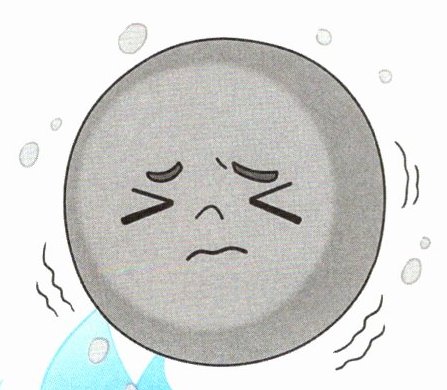
Pluto is a small and cold world far away in space. Because it is so far, we cannot see it with our eyes. We need to use telescopes to find it.
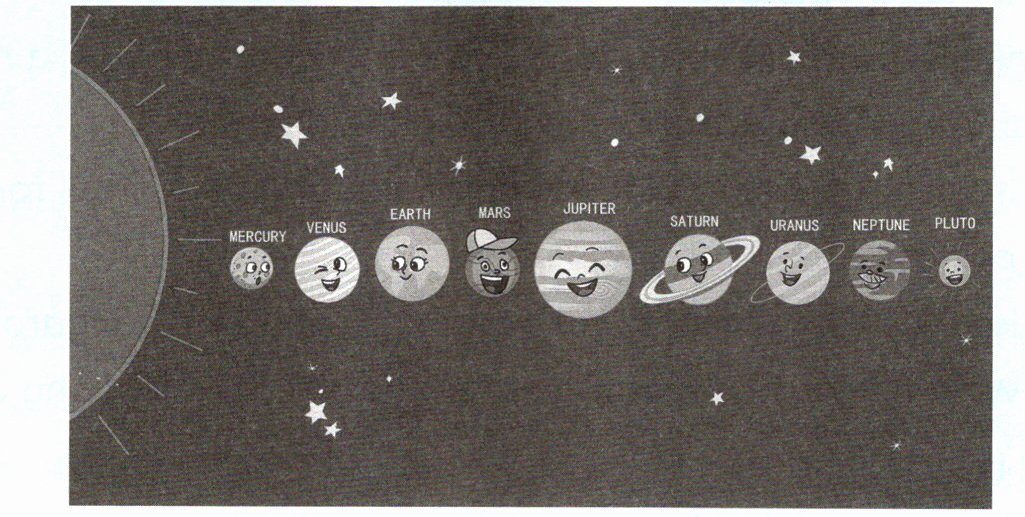
MERCURY VENUS EARTH MARS JUPITER SATURN URANUS NEPTUNE PLUTO 图1
In 1930, Pluto was declared the ninth planet in our solar system. It is much smaller than Earth. Pluto has no oceans or soil like those on Earth. Instead, it is covered with ice. Even in the daytime, the sky on Pluto looks dark.
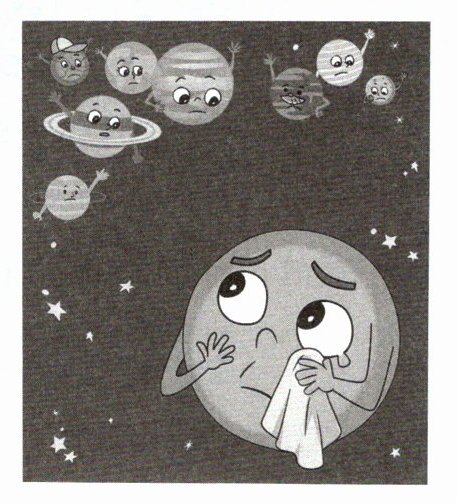
Later, scientists learned more about Pluto. They found that it is too small and that there are many other objects like it nearby. So in 2006, scientists made new rules for planets. Pluto did not follow these rules, so it was no longer called a planet. It became a dwarf planet.
Pluto is very far from Earth. No spaceship has landed on it. No astronauts have visited it. We still do not know if there is liquid water on it. Learning about Pluto is exciting and fun. It tells us that space is full of surprises, and that science helps us learn many new things.
Ⅰ. Read and choose. 读一读,选出正确的答案。
(
A. our eyes B. telescopes C. cameras
(
A. a star B. the ninth planet C. a satellite
(
A. Oceans. B. Soil. C. Ice.
Ⅱ. Read and tick or cross. 读一读,判断对(√)错(×)。
(
(
(
(
Ⅲ. Read and fill in the blanks. 读一读,选出正确的单词填空。
Earth planet telescopes astronauts oceans soil
Pluto is a dwarf 1.
Pluto: The Little World Far Away
Read & answer: What do you know about Pluto?
Pluto is a small and cold world far away in space. Because it is so far, we cannot see it with our eyes. We need to use telescopes to find it.
MERCURY VENUS EARTH MARS JUPITER SATURN URANUS NEPTUNE PLUTO 图1
In 1930, Pluto was declared the ninth planet in our solar system. It is much smaller than Earth. Pluto has no oceans or soil like those on Earth. Instead, it is covered with ice. Even in the daytime, the sky on Pluto looks dark.
Later, scientists learned more about Pluto. They found that it is too small and that there are many other objects like it nearby. So in 2006, scientists made new rules for planets. Pluto did not follow these rules, so it was no longer called a planet. It became a dwarf planet.
Pluto is very far from Earth. No spaceship has landed on it. No astronauts have visited it. We still do not know if there is liquid water on it. Learning about Pluto is exciting and fun. It tells us that space is full of surprises, and that science helps us learn many new things.
Ⅰ. Read and choose. 读一读,选出正确的答案。
(
B
) 1. We can see Pluto with .A. our eyes B. telescopes C. cameras
(
B
) 2. In 1930, scientists thought Pluto was .A. a star B. the ninth planet C. a satellite
(
C
) 3. What is Pluto covered with?A. Oceans. B. Soil. C. Ice.
Ⅱ. Read and tick or cross. 读一读,判断对(√)错(×)。
(
×
)1. Pluto is close to Earth.(
√
)2. No spaceship has landed on Pluto.(
√
)3. Science can teach us new things.(
×
)4. The sky on Pluto is bright because it is very close to the Sun.Ⅲ. Read and fill in the blanks. 读一读,选出正确的单词填空。
Earth planet telescopes astronauts oceans soil
Pluto is a dwarf 1.
planet
in space. It has no 2. oceans
or 3. soil
on it. Pluto is very far away from 4. Earth
. We can’t see it with our eyes, but we can use 5. telescopes
. No 6. astronauts
have visited it yet.答案
1. B 2. B 3. C
1. × 2. √ 3. √ 4. ×
1. planet 2. oceans 3. soil 4. Earth 5. telescopes 6. astronauts
解析
【分析】
本题是关于冥王星的英语阅读理解题,解题思路为:先通读全文把握文章大意,再针对每个题目,回到原文中定位与题目相关的句子,对比原文信息与选项或要求,选出正确答案或完成填空。具体来说,选择题和判断题需精准查找原文对应描述,填空题则结合给出的备选单词和原文内容匹配答案。
【解析】
Ⅰ. Read and choose.
1. 根据原文第一段“we cannot see it with our eyes. We need to use telescopes to find it.”可知,我们需要用望远镜看冥王星,故选B。
2. 根据原文第二段“In 1930, Pluto was declared the ninth planet in our solar system.”可知,1930年科学家认为冥王星是第九大行星,故选B。
3. 根据原文第二段“Instead, it is covered with ice.”可知,冥王星被冰覆盖,故选C。
Ⅱ. Read and tick or cross.
1. 原文第一段提到冥王星是“far away in space”,并非靠近地球,故打×。
2. 原文第四段明确“No spaceship has landed on it.”,故打√。
3. 原文最后一段提到“science helps us learn many new things.”,故打√。
4. 原文第二段指出冥王星“Even in the daytime, the sky on Pluto looks dark.”,且冥王星离太阳很远,并非靠近太阳,故打×。
Ⅲ. Read and fill in the blanks.
1. 根据原文第三段“it became a dwarf planet”,此处填planet。
2. 根据原文第二段“Pluto has no oceans or soil like those on Earth”,此处填oceans。
3. 结合上题,此处填soil。
4. 根据原文第四段“Pluto is very far from Earth”,此处填Earth。
5. 根据原文第一段“We need to use telescopes to find it”,此处填telescopes。
6. 根据原文第四段“No astronauts have visited it yet”,此处填astronauts。
【答案】
1. B 2. B 3. C
1. × 2. √ 3. √ 4. ×
1. planet 2. oceans 3. soil 4. Earth 5. telescopes 6. astronauts
【知识点】
英语阅读理解(细节查找)、科普常识、词汇运用
【点评】
本题以冥王星的科普内容为载体,设置选择、判断、填空三类基础题型,重点考查学生从文本中提取细节信息的能力,内容贴近学生认知,有助于巩固英语阅读的解题技巧。
【难度系数】
0.8
