

 登录
登录
Ⅴ. Read and complete the tasks. 阅读并完成任务,学习如何做文明游客。
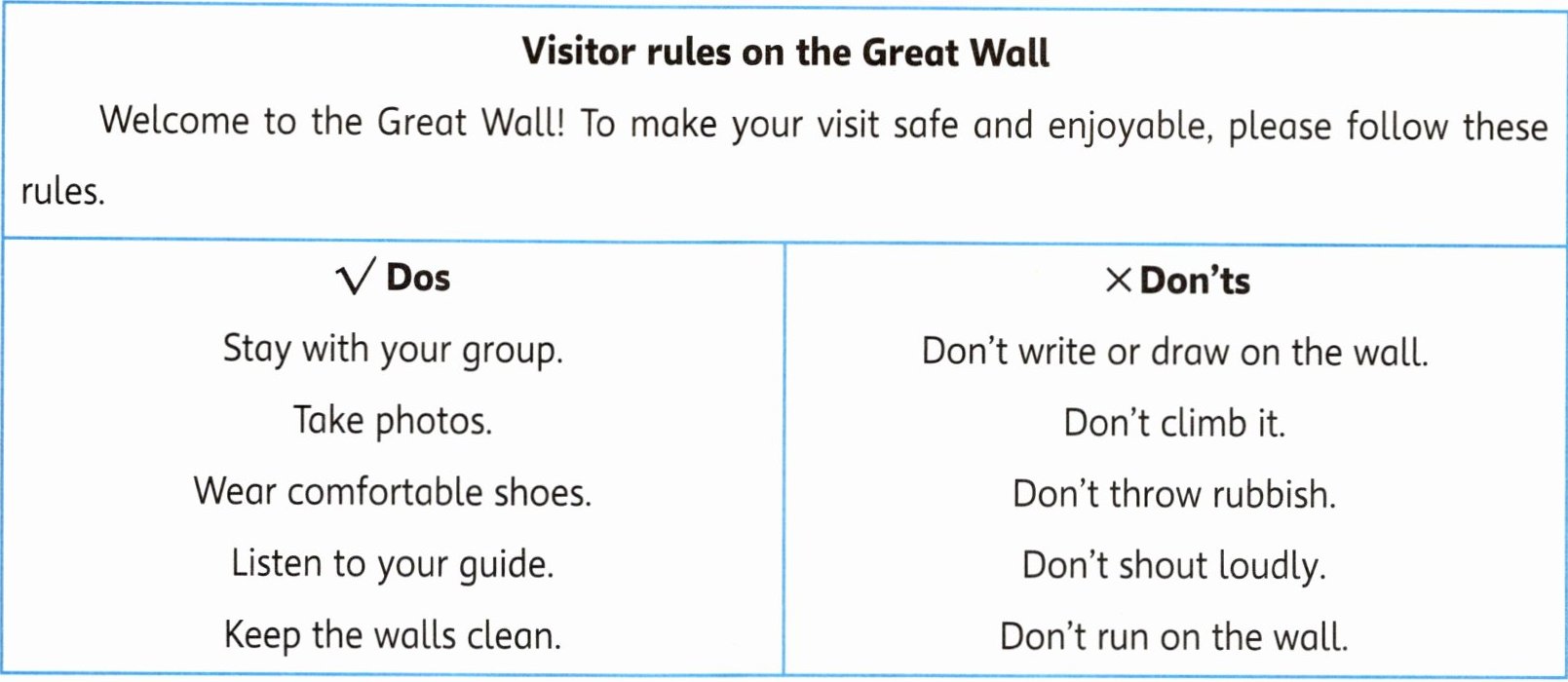
1. 判断正(T)误(F)。
() a. You can write your name on the Great Wall.
() b. You should stay with your group.
() c. It’s OK to throw rubbish on the wall.
() d. You can take photos on the Great Wall.
() e. You should wear comfortable shoes.
2. 想一想,写一写。
A tourist wants to write his name on the wall. What would you say to him?
1. 判断正(T)误(F)。
() a. You can write your name on the Great Wall.
() b. You should stay with your group.
() c. It’s OK to throw rubbish on the wall.
() d. You can take photos on the Great Wall.
() e. You should wear comfortable shoes.
2. 想一想,写一写。
A tourist wants to write his name on the wall. What would you say to him?
答案
1. a. F b. T c. F d. T e. T
2. 示例:Excuse me, please don't write on the wall. It's not allowed. We should keep the Great Wall clean.(表述合理、语法正确即可)
2. 示例:Excuse me, please don't write on the wall. It's not allowed. We should keep the Great Wall clean.(表述合理、语法正确即可)
解析
1. 对照长城游客规则的Dos(允许事项)和Don'ts(禁止事项)逐一核对判断:
a. 规则明确禁止在墙上写字或画画,该表述不符合规则。
b. 规则的允许事项第一条就是和自己的团队待在一起,该表述符合规则。
c. 规则明确禁止乱扔垃圾,该表述不符合规则。
d. 规则允许游客在长城拍照,该表述符合规则。
e. 规则要求游客穿舒适的鞋子,该表述符合规则。
2. 结合规则内容,用简单得体的英文劝阻游客,提醒对方遵守规则、保护长城整洁即可,答案不唯一。
a. 规则明确禁止在墙上写字或画画,该表述不符合规则。
b. 规则的允许事项第一条就是和自己的团队待在一起,该表述符合规则。
c. 规则明确禁止乱扔垃圾,该表述不符合规则。
d. 规则允许游客在长城拍照,该表述符合规则。
e. 规则要求游客穿舒适的鞋子,该表述符合规则。
2. 结合规则内容,用简单得体的英文劝阻游客,提醒对方遵守规则、保护长城整洁即可,答案不唯一。
